Showing posts with label (Deceased). Show all posts

Sunday, June 12, 2016

#365 Bobby Murcer


Who is this player?
Bobby Murcer, reserve outfielder, New York Yankees

A popular fan favorite in the Bronx, the 1980 season was one of mixed emotions for Bobby Murcer. Part of a crowded Yankee outfield picture, a lack of consistent playing time initially frustrated Murcer. Coupled with the illness and passing of his father, Bobby was struggling, batting less than .200 as June began. He heated up with five home runs during the month including a dramatic home run against Oakland and a two-homer day against Cleveland. Bobby played an integral role in the number retirement ceremony of his friend, the late Thurman Munson in September and days later he celebrated the Yankees AL East championship. It was Murcer's first taste of the postseason, but he went 0-4 in a three game sweep of the Kansas City Royals.  The year ended with Murcer touring Japan with a major league All-Star team and opening a short-lived baseball academy in Florida.

Bobby Murcer's life and career in pretty well documented on the web, both on his Wikipedia page as well as a comprehensive biography on the SABR website. Depending on when you were born, you likely think of one of three distinct phases of Bobby Murcer's life and career:

The first is the Oklahoma kid, the heir apparent to Mickey Mantle in the Yankee legacy. Murcer idolized Mantle and achieved a thrill playing alongside him during the mid 1960s. After a stint in the army, he certainly delivered on much of this promise, hitting for power and average as the Yankees slowly started becoming a contender. A five-time All-Star, he was a legitimate MVP candidate, among the league leaders in several categories, leading the the league in on-base percentage in 1971 and runs in 1972. When Bobby clubbed four consecutive home runs in a double header against the Cleveland Indians in 1970, he was on his way to becoming a superstar in the media capital. Bobby appeared on Beat the Clock, Hee Haw and What's My Line (below). His trade to the San Francisco Giants for Bobby Bonds in 1975 was a shocker, but this was the Murcer National League fans were expecting. While he never did match his production with the Giants and later the Cubs, he was still a respected and dangerous bat.


The second phase came upon his return to the Yankees where he performed as a reserve outfielder and designated hitter. However, the most indelible image of Murcer, during this time, if not during his entire career where the events of Monday, August 6, 1979. Yankee captain and Murcer's friend Thurman Munson was being buried after a tragic plan crash. Murcer delivered the eulogy that afternoon and later that night hit a home runs a delivered the game winning hit on a nationally televised game against the Baltimore Orioles. This moment established Murcer as a Yankee legend, a elder statesman and leader in the clubhouse and on the field.


The final phase was as Yankee broadcaster, where he endeared himself to a new generation of Yankee fans. He was also instrumental in several causes, such as the Baseball Assistance Team and becoming an anti-tobacco advocate.

Murcer fought a courageous battle against cancer the final two years of his life, passing away on July 12, 2008. Earlier that year, his biography "Yankee For Life" was released. A moving and inspirational memoir, Murcer wrote with incredible determination, positivity and courage in the face of a deadly disease. It stands as a testament to what kind of human being Bobby Murcer was.

Why I love this card
I am not then, nor am I know a Yankee fan. I don't know why, but getting a Murcer card was different. He was from a different era, played in the old Yankee Stadium with Mantle, Maris and Ford. I respected his longevity at that point but what really stood out was his shin guard. You really didn't see that often in 1980 and it jumped out at me. I played soccer and had shin guards like this and had no clue why Murcer would wear one. Just another source of endless childhood debate.

Something else....
In his autobiography, Murcer writes about his ill-fated baseball school. With big names such as Lou Piniella, Rick Cerone and Charlie Lau, the camp nonetheless underestimated expenses and failed to make money. There was one success story, future major league All Star Mike Stanley was a the most famous graduate, enjoying a 15-year major league career.

Tuesday, June 5, 2012

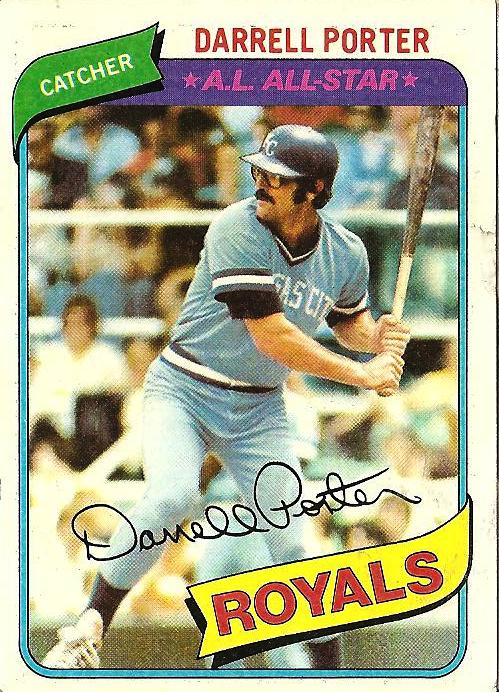
#360 Darrell Porter


Who is this player?
Darrell Porter, catcher, Kansas City Royals
After posting one of the best offensive seasons by a catcher up to that point, Darrell Porter of the Kansas City Royals shocked the baseball world during Spring Training 1980 when he disclosed substance abuse problem. Initally, only alcohol was cited as a problem, but Porter also acknowledged a cocaine addiction. He spent the next six weeks in a rehabilitation facility and his return to the diamond was seen as an example of his will and courage. However, his performance was effected by the lack of Spring Training, hostile opposing fans and a brief hospitalization. Despite this adversity, he was still able to help the Royals advance to their first World Series in franchise history. When the season ended, Porter followed former manager Whitey Herzog to St. Louis when he signed a large free agent contract with the Cardinals.

A Midwestern boy, Darrell Porter was born in Joplin, Missouri and became a prep star at Southeast High School in Oklahoma City, Oklahoma. A standout on the diamond and the gridiron, Porter received scholarship offers from 40 schools as a football candidate. Blessed with a powerful throwing arm, he initially signed a letter of intent with to quarterback at the University of Oklahoma before deciding on a baseball future. The Milwaukee Brewers made him their first selection of the amateur player draft in June 1970 and offered him a reported $70,000, a large sum for its time. The left-handed hitting Porter homered in his first professional at bat later that summer and was immediately tabbed as a major league prospect.

Darrell made his major league debut the following season and lived up to his billing by crashing a home run against AL MVP and Cy Young Vida Blue. At the time, he was the youngest player in the major leagues. However, he required some more seasoning in the minor leagues before returning to the bigs for good in 1973. That rookie season his .257 batting average and 16 home runs, placed him third in the Rookie of the Year voting and he was named to the American League All-Star team in 1974. However, Porter began to be plagued by the pressure to live up to his advance billing, and this ultimately was a major part of his substance abuse issue. He was traded to the Kansas City Royals following the 1976 season in a curious move, partly because of Brewers' owner Bud Selig decision to rid the team of a potential problem.

Blessed with a new start in Kansas City, Porter's offensive production increased. He was named an All-Star three seasons in a row (1978-1980) and helped the Royals reach the postseason three out of the four seasons he was a Royal. The one season Kansas City didn't reach the playoffs was Porter's finest (1979) which saw Darrell become only the sixth catcher in Major League history drive in and score 100 runs in the same season. He also led the American League with 121 walks and reached base a league-leading 284 times. For good measure, he also placed among league leaders in sacrifice flies, hit by pitches and triples.

While with the Cardinals, Porter was never able to regain his offensive production of 1979, but he was still a solid catcher able to draw walks and get on base. Despite this, he was given a hard time by the St. Louis fans, even as the Cardinals drove towards a postseason appearance in 1982. Porter rewarded them with a scintillating performance in the NLCS, batting .556 (5 for 9) in the Cardinals three game sweep of the Atlanta Braves. He followed that with a similar performance in the World Series against Milwaukee. With several timely hits, including the game-winner in Game 7, Porter was again named the Most Valuable Player. He was also an inspirational figure, often re-telling the story of his addictions and his conversion to a born-again Christian. His autobiography, Snap Me Perfect! was released prior to the 1984 season.

Porter had his best statistical season in St. Louis in 1983 but the Cardinals were unable to return to the postseason. Injuries began to take their toll as he fractured a finger in '83 and suffered a broken collarbone and thumb in 1984. St. Louis returned to the World Series again in 1985, with Porter again having a good NLCS, this time against the Dodgers. However, Darrell and the Cardinals struggled offensively in the World Series against Porter's old team the Royals, and St. Louis came up short in seven games. Porter would spend the final two seasons as a part-time player with the Texas Rangers before retiring after the 1987 season and 17 major league campaigns.

In retirement, Porter, like many of his contemporaries became a broadcaster for a time, was heavily involved in charity world and dabbled in antiques. On August 5, 2002, Porter was found dead in Sugar Creek, Missouri outside of his vehicle. It was initially believed that Porter's car was stuck on a tree stump and the high heat and humidity played a role in his death when he attempted to push the car. An autopsy concluded that he died of "toxic effects of cocaine" consistent with recreational use and induced a condition called excited delirium that caused his heart to stop. He was only 50 years old.

Why I love this card
First, any All-Star card commanded my immediate respect. Something about the All-Star banner that was on these cards elevated the players in my young mind as a future Hall of Famer. Secondly, I was drawn to the fact that Porter went to bat without any batting gloves. For an aspiring Little Leaguer, this was affirmation, especially during a time when batting gloves were becoming the rage. They are pretty standard now at all levels, but back then it was kind of cool to see an All-Star buck the on-coming trend.

Something else...
Porter and Hall of Famer Mickey Cochrane are the only catchers in American League history to draw 100 walks, score 100 runs and drive in 100 RBI in the same season. Porter of course in 1979, Cochrane in 1932.

Also included below is Porter's 1980 Topps Super card. Unfortunately, this was not something that I obtained during the summer of 1980, rather it was something that I stumbled across years later when I stumbled across the whole set.


Tuesday, May 1, 2012

#346 Buddy Solomon


Who is player?
Buddy Solomon, starting pitcher, Atlanta Braves
As preparation for the 1980 season got underway, Buddy Solomon was looking to claim a spot in the the Atlanta Braves' starting rotation. Despite Atlanta's acquisition of Doyle Alexander, Solomon pitched well enough in August 1979 for a bad Braves team to earn consideration. However, an incident in Spring Training led to his trade to the Pittsburgh Pirates before the season got underway. He initially pitched out of the bullpen before his performance earned him starting assignments. The hard throwing right hander reverted back to his given name of Eddie and won seven games for the defending world champions. The highlight of the season was his back-to-back complete game victories in August, keeping the club in contention.

Buddy J. Eddie. Kingfish. Eddie Solomon, Jr. answered to all of these during his ten-year major league career with six different teams. A product of Perry, Georgia, Solomon was signed by the Los Angeles Dodgers as a minor league free agent in 1969. In a very deep Dodger system at that time, Solomon played for one of the greatest minor league teams in recent memory, the 1972 Albuquerque Dukes. During his minor league tenure, Eddie would follow a strong season with an inconsistent one, but his blazing fastball was his greatest asset that earned him an initial look from the parent club in 1974.

He joined Los Angeles for the stretch drive in 1974 and even made a postseason appearance in the National League Championship Series. However, Solomon was unable to stick in the majors for long and was traded to the Cubs and then the Cardinals for the 1975 and 1976 seasons. Eddie was pitching in the minor leagues almost as much as the majors.

Solomon was rescued from the bush leagues by the Atlanta Braves in 1977, pitching solidly, if not unspectacularly, as a starter during the second half of the season. The following year, he was moved to the bullpen where he found a groove, at one point not allowing a run in five straight appearances and posting a 0.90 ERA by mid-May. Injuries and lack of depth moved Eddie back to the starting rotation and he was poised to stay there for 1979. Eddie achieved career highs in '79 in strikeouts, games started and innings pitched and was considered the #2 man (behind Phil Niekro) at the end of the season.

Eddie posted another solid outing in 1981, winning eight games in the strike-shortened season and leading the Pirates in ERA. When he struggled to open the 1982 season, however, the Bucs traded him to the Chicago White Sox where he pitched in his final six major league contests. He returned to the minors in 1983 with the New York Yankees chain in attempt to come back but was unable to.

Solomon retired to his native Georgia and for a while sold cars after his playing days. Sadly, he was involved in a one-car accident and killed on January 12, 1986.

Why I love this card
I distinctly recall being puzzled by Buddy/Eddie Solomon's card. The front and the back say "Buddy" but the signature says "Eddie." Having no background information about his multiple monikers, I was convinced for a time that I had an error card. The trade to the Pirates didn't help as some of the 1981 cards (Topps, Fleer, Donruss) weren't consistent with the names either. It probably took me a couple of seasons to figure out the they were the same guy.

Something else....
Solomon is the second player on this blog to have died in a car accident. The other was Aurelio Lopez, who died in 1992.

Thursday, July 7, 2011

Dick Williams 1929-2011


I am sad to report that former major leaguer and Hall of Fame manager Dick Williams has died. He was 82 years old.

It is being reported that Williams died today at his Las Vegas home from what was believed to be an aneurysm.

A 2008 Hall of Fame inductee, Williams is the second manager in major-league history to win pennants with three different teams; the Boston Red Sox (1967), Athletics (1972-73) and San Diego Padres (1984). He had a 21-year major league managing record of 1,571-1,451 (.520). He also managed the California Angels, Montreal Expos and Seattle Mariners.

He also played for 13 seasons (1951-1964), primarily as an outfielder for the Brooklyn Dodgers and Baltimore Orioles. He also played for the Red Sox, Athletics and Indians.

Featured here is Williams on the 1980 Montreal Expos team card.

Our sympathies go out to the Williams family.

Sunday, July 3, 2011

#330 Al Cowens


Who is this player?
Al Cowens, rightfielder, Kansas City Royals
Two new teams, a brawl and an arrest warrant shaped the 1980 season for Al Cowens. Traded to the California Angels before the start of the season, he was shipped to the Detroit Tigers in May because Jason Thompson (a Gene Autry favorite) was available. He was in Detroit for less than a month when he charged and struck Chicago White Sox pitcher Ed Farmer in retaliation for a beaning the previous season. In an unusual move, a warrant was put out for Cowens' arrest, but the controversy ended in September when Farmer and Cowens buried the hatchet. He rebounded from his slow start with the Angels to hit .280 with Detroit and finish the year at .268.

Alfred Edward Cowens Jr. was born in Los Angeles, California and initially earned local renown as a football player at Centennial High School in Compton, CA. He was teammates with fellow future major leaguer Mitchell Page. The Kansas City Royals drafted Cowens on the 84th, yes 84th, round of the 1969 June free agent draft. He worked his way up the minor league ladder, first garnering attention in 1971. Cowens led the California League in fielding percentage that season and later was named Southern League Player of the Year in 1973. That performance earned him a promotion to Kansas City and he would spend the next 13 seasons in the major leagues.

An exceptional athlete, Al's tools were very subtle and often unnoticed by the media. His teammates, however, appreciated Al's skills in the field and at the plate. He was an integral part of a Royals team that won three consecutive AL West flags in the late 1970s, consistently providing stellar defense, speed on the basepaths and a timely bat when needed.

Cowens' best season came in 1977 when he was MVP-runner up to Hall of Famer Rod Carew. Playing in all 162 games, Al hit .312 that season with 189 hits, 23 home runs and 112 RBI. He was also recognized for his defensive excellence with his first (and only) Gold Glove Award. Cowens was a durable .282 hitter in his six Kansas City seasons rarely taking time off unless he was truly hurt. One such occasion came in 1979 when a pitch from Farmer (then with the Rangers) broke his jaw. Cowens felt he was hit intentionally and certainly Farmer did little to change that perception. Those bad feeelings would culminate in their 1980 brawl.

Al was sold by Detroit to Seattle prior to the 1982 season and he experienced ups and downs in Seattle. Most often, he was a productive outfielder contributing decent power and average as well as good defense. The only exception would be his slump during the 1983 season that saw him hit only .205. The Mariners were not a good ballclub during this era, but Al was a bright light in an otherwise dismal situation. As young players in Seattle began moving up, the veteran Cowens soon saw a decrease in playing time and his release in 1986. In retirement he scouted for his first team, the Royals and coached high school kids in California. Sadly, Al Cowens passed away from a heart attack in 2002 at the young age of 50. Today, his son runs the Al Cowens Heart Healthy Foundation.

Why I love this card
Being from Detroit, I remember the fight. What I remember more though was that no one seemed to understand what and why it was happening since it happened when both Farmer and Cowens were with different teams. I had the pleasure of meeting Cowens and getting his autograph the following season at Tiger Stadium and distinctly recall how polite and patient he was with all of the kids gathered. That will be the Al Cowens that I remember.

Something else....
Below is a version of Al's 1980 OPC card that designates him a member of the California Angels. With a traded set a year away, there would not be any mention of Cowens as a Tiger until 1981.


I neglected to include Tom Underwood's 1980 OPC card in his post the other day, which I will show now and add to his post.

Sunday, June 26, 2011

#324 Tom Underwood


Who is this player?
Tom Underwood, starting pitcher, Toronto Blue Jays
When this card was being pulled from packs during the 1980 season, Tom Underwood was already long gone from Toronto. The lefthanded pitcher was traded as part of a package to the New York Yankees shortly after the 1979 season ended. He began the season in the bullpen to fill a role on the staff and did so well he remained there, much to his chagrin. When he returned to the Yankees rotation, he was their best pitcher, winning five straight starts. Nevertheless, he remained unhappy how he was used, despite winning 13 games for the AL East Champions.

The Kokomo, Indiana native was a three-sport athlete in high school, going 25-1 in American Legion ball and helped his team to a state championship in 1972. That attracted the attention of the Philadelphia Phillies who drafted him later that summer. Tom never had a losing season in the minor leagues and he made his major league debut in the summer of 1974. He was inserted into the starting rotation the following year and he had the best year of his career, winning 14 games and being named to the Topps All-Rookie Team. His performance that season led to predictions of stardom.

Underwood was never able to equal the performance of his first full season, despite being part of the Phillies 1976 NL East Champions. In fact, he was on the mound when the Reds clinched the NL pennant. Midway through 1977, Underwood was traded to the St. Louis Cardinals for Bake McBride, and he was subsequently dealt to the Toronto Blue Jays after that season. He pitched decently for horrible Blue Jays teams but Toronto saw him as a chip to trade for some veteran players.

After a rocky start to the 1981 season, he was traded to the Oakland A's. Pitching as a swingman during the second half he again appared in the postseason, this time with the AL West champions. The following year, Underwood put together an effective 1982 season. Again splitting his time between the bullpen and the rotation, Underwood forged a career best ERA of 3.29, won ten games, and saved seven others for Billy Martin, who liked his versatility and willingness to pitch in any role. Underwood played one more year in Oakland and another in Baltimore before his ten-year career came to an end in 1984.

Shortly after his retirement following the 1984 season, Mr. Underwood met his wife and began a second career as financial advisor for Wells Fargo Advisors. He was elected Howard (IN) County's athlete of the century in 1999 and was inducted into the Indiana Baseball Hall of Fame in 1997. Mr. Underwood fought a courageous battle with pancreatic cancer which ultimately led to his death in 2010. His daughter has a site dedicated to raising funds for cancer research where you can donate here


Why I love this card
Immediately, this card makes me think of May 31, 1979. Underwood faces his younger brother Pat, who was making his major league debut. Pat outdeuls Tom in a 1-0 decision. Pat was pitching for the Tigers, Tom for the Blue Jays. The local media made a huge deal out of this in Detroit and I always felt a little sorry for Tom. After all, in my nine-year old mind, Tom was the one that pitched the complete game.

Something else....
For most of the 1980 season, the New York Yankees had four lefthanders in their starting rotation: Underwood, Ron Guidry, Tommy John and Rudy May. I cannot recall any team that has done that since.

Saturday, May 15, 2010

#278 Jim Spencer


Who is this player?
Jim Spencer, reserve infielder, New York Yankees
Generally regarded as one of the top defensive first basemen of his era, Jim Spencer of the New York Yankees was a part-time player in 1980. Splitting time between first base and designated hitter, the lefthanded batting Spencer provided some offensive pop (13 HR) and a reliable late-inning glove. He belted a grand slam early in the season against the Texas Rangers and had a five-RBI performance against the Oakland A's in June. Spencer appeared in the ALCS that fall after he helped the Yankees win the AL East but the Yanks were swept by the Kansas City Royals three straight.

The grandson of a former major leaguer, Jim Spencer was 3-sport athlete in high school and hit a home run at Yankee Stadium as a American Legion All-Star in 1963. Two years later, he was a first round selection (11th overall) by the California Angels. He was the MVP of the Texas League in 1967 and earned a trial look by the Angels after leading El Paso to the championship in 1968. He wrested away the starting position at first base the following season and would remain there for the next four and a half seasons.

In 1973, he was traded to the Texas Rangers and was selected to the American League All-Star team. It was also in Texas where he established his reputation as a fine fielder. Although he already won a Gold Glove in 1970, Jim committed only 2 errors at first base over the next two seasons, in excess of 180 games. Now with the White Sox, he had another fine performance in 1976, only committing two errors in 143 games played. Another Gold Glove followed in 1977. Spencer was traded again in 1978, this time to the New York Yankees, where he saw his first World Series experience as he helped the Yankees overtake the Boston Red Sox and charge to a Series championship.

When he reported to spring training in 1981, Spencer complained to press about excessive platooning the previous summer by former manager Dick Howser and pressure from George Steinbrenner who was unhappy with Spencer's lack of production at the plate. Less than two months later, the Yankees tried to trade Spencer to Pittsburgh, but Commissioner Bowie Kuhn vetoed the deal because the Yankees would have given the Pirates $850,000. exceeding Kuhn's limits for cash transactions. In May, the Yankees sent Spencer to the Oakland Athletics, where he would spend the remaining years of his 15 year career.

After his playing career ended, Spencer was an assistant baseball coach at Navy, and he worked briefly as a scout for the Yankees. He often appeared at charity events and Yankee fantasy camps. Spencer suffered a heart attack at his winter home in Sarasota, Florida in February 2002 and passed away at the age of 54. Only five days before he died, Spencer had played first base in a benefit game for the Joe DiMaggio Children's Hospital in Hollywood, Florida.

Why I love this card
What stood out most with this card is that Spencer was so bad-a**, he is glaring straight into the sun without sunglasses or eyeblack. And isn't the least bit afraid. That may not sound like much, but think back to Little League. What did every kid do the moment any trace of sun was in their eyes? That's right turtle-up at even the sound of a ball coming at you. Seeing Spencer on this card not at unintimidated by sunlight oozed "major leaguer" for me.

Something else....
Like the Rick Bosetti card, Topps again shows some laziness with Spencer's 1980 issue. Check out the back again of Spencer's 1980 card and his 1979 card. They both use the same exact like about a pinch-hit grand slam in 1978!


On this date in 1980:
Shawn Weatherly of South Carolina is crowed Miss USA. Bob Barker hosts the pageant from Biloxi, Mississippi. You can watch the crowing moment here.

Sunday, May 9, 2010

#273 Eduardo Rodriguez


Who is this player?
Eduardo Rodriguez, relief pitcher, Kansas City Royals
Just days before the start of the 1980 season, Eduardo Rodriguez was released by the Kansas City Royals. He did not catch on with another major league team and he did not play in the minor leagues. His seven-year career was over as this card was being pulled from packs that summer.

"Volanta," as he was known in baseball, the righthanded Rodriguez was originally from the Puerto Rico. As a youth, he was a high school star in baseball and volleyball and was one of the top pitchers in the tournaments of Antesalistas of Cataño and Athenian of Manatee. This earned the attention of major league scouts and he was signed by the Milwaukee Brewers as an amateur free agent in 1971.

He was called up to the Brewers in June of 1973 and pitched mostly out of the bullpen. Eduardo was one of only two pitchers on the team to post a winning record and he had the best ERA of all Brewer relievers that season. He also hit a triple in what would be the first and only plate appearance of his career, something that no player had ever done (it has since been done twice more). Despite splitting time between the bullpen and rotation, Rodriguez managed a winning record in six season in Milwaukee, while the Brewers never finished over .500 in that span.

Rodriguez was undefeated coming out of the bullpen in 1975 (7-0) and pitched very well for Milwaukee as a reliever. Yet Eduardo would periodically incur the wrath of managers and teammates for inexplicably changing his pitching style. He had a herky-jerky delivery reminiscent of Luis Tiant and coaches were forever attempting to streamline his delivery. This tendency earned him the derogatory nickname "Edweirdo" and is likely one of the reasons of his departure from Milwaukee. Another was that the Brewers never decided whether he was a full-time starter or reliever, which frustrated Rodriguez. He was traded to the Royals and spent one final season in Kansas City in 1979, going 4-1 with two saves.

Eduardo returned to his native Puerto Rico after his playing days. He had a heart attack and passed away on his birthday in 2009. He was 57 years old.

Why I love this card
The background in this photo jumped out at me then. The ramshackle bleachers and chain link fence in the background look similar to every little league or school field that I played at when I was a kid. I know now that this was likely taken during Spring Training but back then it reinforced the impression that major leaguers weren't all that much different than ordinary adults.

Something else....
Sad week with the passings of Ernie Harwell and Hall of Famer Robin Roberts and now noting the passing of Rodriguez in this post. That brings the total up to 13 so far featured in this set, roughly 5%.

On this date in 1980:
35 people were killed when the Sunshine Skyway bridge in Tampa, Florida collapsed. The accident involved a Greyhound bus, six cars and one pickup truck that plummeted from the bridge when it collapsed. Only one person who went over survived. But Wesley MacIntire, the driver of the pickup, died nine years later. The most famous photograph from the disaster shows a yellow Buick driven by Richard Hornbuckle of St. Petersburg stopped 14 inches short of the bridge's edge. Hornbuckle and his three passengers escaped.

Wednesday, May 5, 2010

Another Piece of My Childhood is Gone.....

As the years pass, different parts of my youth are ceasing to be. My grandparents and my Uncle Frank have all died. My former elementary school closed in 2003 and many of the local neighborhood hangouts are not what they were. All of the places where I bought baseball cards have been gone for ages.

Even the place where I learned to love the game, Tiger Stadium, is gone. Even some of the people connected to my childhood through baseball are gone too. Mark Fidrych. George Kell. Kirby Puckett. Things change, I get that.

Yesterday, Ernie Harwell died.

Harwell was the longtime Tigers broadcaster and subconscoiously for me, one of the reasons behind this blog. The pictures of the ballplayers and teams on these cards are the sights, but Harwell was one of the sounds. For me and millions of kids like me, he is the voice of baseball.

That may sound like hyberbole but if you grew up in Michigan, you can identify. And everything that has been written about what kind of man he was is accurate, not just something kind to say now he has passed. I had the pleasure of meeting him a half dozen times or so and he was nothing short of a classy gentlemen to anyone he met.

Whenever I think of Ernie Harwell, I think of other things other than baseball. I think of my Uncle's garage, my Dad's old Buick and my first radio. I think of the life-long friends I have made that have the same feelings that I do today. How Ernie is one of our common bonds. I think of Tiger Stadium and my personal connection to that old ballpark. And I think of my children, who will never know a finer broadcaster.

If somehow, we would all make the same impression on each other that Ernie Harwell has made on us, the world would truly be a better place.

Sunday, March 28, 2010

#264 Bill Robinson


Who is this player?
Bill Robinson, utility player, Pittsburgh Pirates
By the time that this card was making the rounds during the summer of 1980, the 37-year old Bill Robinson had slipped into a part-time role with the Pittsburgh Pirates. Splitting time between first base and the outfield, Bill appeared in the fewest amount of games played in the last five years. He was still potent with the bat however, batting .287 and clubbing 11 home runs. Robinson also achieved a milestone in 1980, by achieiving his 1000th career hit on April 18th against the St. Louis Cardinals.

Born in raised western Pennsylvania, Bill Robinson was touted as the best baseball prospect in the state. As a pitcher, he had not lost a game in four years. He had also been All-State in basketball and received over 50 scholarship offers. The Milwaukee Braves signed him to a $20,000 bonus and the team converted him into an outfielder so he could play everyday. The scout told him frankly that had Robinson been white he might have received $100,000.

After five years in the Braves organization, Robinson was peddled to the New York Yankees. On Opening Day in 1967, Robinson clubbed a towering home run and the press was quick to dub him a "black Mickey Mantle." Understandably, Robinson was unable to fulfill such expectations and it invariably effected his play. He batted .206 in three years in New York and hit only 16 home runs. He did not appear in the major leagues in either the 1970 or 1971 seasons and it appeared that his career may be over.

Now with the Philadelphia Phillies, Robinson received the opportunity he needed to revive his career. He grew confident as a hitter and had a breakout season in 1973 (.288 25 65). He was on the move again, traded home in April 1975 to the Pittsburgh Pirates where he would spend the next eight seasons. With the Pirates, Robinson was a righthanded power threat and one of the cogs of the powerful "Lumber Company." He hit over .300 twice, hit 20+ home runs three times and 100+ RBI once. In 1979, he platooned with John Milner in left field as the Pirates won a World Series Championship. Robinson appeared in all seven games of that Series and was on base when Willie Stargell hit his go-ahead home run in Game 7.

Bill left the Pirates in mid-1982 and returned to the Phillies for the final seasons of his 16-year career. He was almost instantly hired as a coach by the New York Mets and he was their first base coach when the Mets won the World Series in 1986. He held the same position in 2003 when the Florida Marlins similarly won the championship. Bill passed away in July of 2007 in Las Vegas Nevada at the age of 64. He was a minor league hitting coordinator for Los Angeles Dodgers and was in town to meet with the team.

Why I love this card
Robinson looks like he really needs a pair of sunglasses in this photograph. That's not my primary reason for loving this card, though. Like Lance Parrish, Bill Robinson's place of birth is McKeesport, Pennsylvania. McKeesport is also where my Dad was born but he grew up in Clairton and Robinson in Elizabeth. My Dad liked Robinson because he went things without a lot of fanfare or recognition yet still got the job done. In retrospect, my Dad's approach to things is very similar.

Something else....
With the recent passing of Jim Bibby, the 1979 Pirates have five players who have passed away. While that may not seem like a lot, the 1980 World Champion Phillies have had only one player pass away.

On this date in 1980:
The horror movie "Dont Go In The House" was released. If you haven't heard of it, it's probably because the movie was awful. I think Mystery Science Theater did a parody of it. For those so inclined, the trailer can be found here.

Wednesday, February 17, 2010

Jim Bibby 1944-2010


I am sad to report that former major league pitcher Jim Bibby has died. He was 65 years old.

Community Funeral Home in Lynchburg, South Carolina said Wednesday that Bibby died Tuesday night at Lynchburg General Hospital. The cause was not disclosed. The family asked for privacy but said a statement would be released later.

Bibby played 12 years in the majors and pitched the first no-hitter in Texas Rangers history, beating Oakland 6-0 in 1973. He was a member of the Pittsburgh team that won the 1979 World Series, starting two games against Baltimore - including the deciding seventh game.

He also played for St. Louis and Cleveland during his major league years from 1972 to 1984.

Bibby was featured on this blog back in January.

Our sympathies go out to the Bibby family.

Monday, February 15, 2010

#244 Ken Boyer St. Louis Cardinals Team Card


What is this card?
Team Card, St. Louis Cardinals, Ken Boyer Manager

The St. Louis Cardinals were a team in transition in 1980 as the Lou Brock era had come to an end in 1979. The Cardinals won 86 games in '79 finishing a promising third behind Pittsburgh and Montreal. The Cardinals were seen as a team with a fine core of young and exciting players. Shortstop Garry Templeton was one of the fastest men in the game, a proven All-Star player and .300 hitter. First baseman Keith Hernandez was a Gold Glove winner and the defending batting champion and Most Valuable Player. Ted Simmons was considered the best catcher in the league not named Bench and George Hendrick was steady and excellent in the clutch.

If the Cardinals had a weakness, it was generally thought that it may have been their pitching. The Cards did not have a dominant "fireman" in a bullpen consisting of journeymen and veterans. There were some bright spots in the starting rotation, notably Bob Forsch and Pete Vuckovich, dependable if unspectacular.

The Cardinals began the season under manager Ken Boyer who was entering his third season as St. Louis' skipper. Injuries decimated the pitching staff and the Cards struggled early in the season and they found themselves in last place by early June. Boyer was fired on June 8th and replaced by Whitey Herzog, formerly of the Kansas City Royals. Herzog managed the team for two months before being promoted to GM, turning the reigns over to Red Schoendienst to finish out the 1980 season.

St. Louis played .500 ball the rest of the way, to finish 74-88, in fourth place, 17 games behind Philadelphia. In October, it was announced that Herzog would be GM and field manager, and he began rebuilding the Cardinals immediately. The series of moves that Herzog would make at the 1980 Winter Meetings would set the stage for the team that would win three National League pennants in the decade and become World Champions in 1982.

Why I love this card
This card was one of my "white whales" of the 1980 set. I never did get a Cardinals team card that season and for some reason, neither did my normal trading partners. It wouldn't be until 1987 that I would get a nice version of this card at Nostalgia Nook one of the first card/comic stores that I can remember. The store has been gone 20 years but every time I drive by that store I think of this card and a 1978 Dave Concepcion, but that's another story.

Something else....
This was Ken Boyer's final card before his premature death at 51 years of age from cancer in 1982.

On this date in 1980:
Wayne Gretzky of the Edmonton Oilers sets an NHL record when he records 7 assists in a game against the Washington Capitals. The Oilers would finish the season with a losing record, but qualified for the playoffs, where they were swept by the Philadelphia Flyers.

Wednesday, January 20, 2010

#234 Vern Ruhle


Who is this player?
Vern Ruhle, starting pitcher, Houston Astros
Probably the least heralded member of the Houston Astros' starting rotation, Vern Ruhle's contributions in 1980 were invaluable. Pitching as the #4 starter behind J.R. Richard, Nolan Ryan and Joe Niekro, Ruhle won a career-high 12 games as the Astros claimed the NL West title. After a stroke fell Richard, Ruhle posted a 1.71 ERA in six August starts and entered the postseason with the leading ERA on the team. Ruhle was involved in the most controversial play of the NLCS that you can read about here and listen to here. Unfortunately, the Astros lost the Series in five games.

Born in Coleman, Michigan he attended nearby Olivet College and was drafted in the 1972 amateur draft by the hometown Detroit Tigers. The righthanded Ruhle made an impressive debut at the end of the 1974 season that earned him a spot in the Tigers rotation. He put up a respectable 11 wins for a Detroit team that lost 102 games in 1975. Ruhle struggled overall as a Tiger as Detroit consistently finished in the second division. With an influx of young pitchers moving upward in the Tigers organization, Ruhle was released during Spring Training 1978.

He was unemployed for only one day, signing on with the Houston Astros and began the season at Triple-A. He worked his way back to the major leagues by posting a 2.12 ERA in 13 appearance with the Astros. He was inserted into the rotation in 1979 but missed some time during the summer due to injury. Several of his teammates attributed his absence from the rotation as one of the reasons the Astros lost out on the NL West title that season. Ruhle and the Astros again appeared in the postseason in 1981 and although he pitched well, he and Houston again fell short in the playoffs.

Ruhle spent seven seasons in Houston, winning 39 games and eventually being moved to the bullpen full time in 1983. He was granted free agency following the 1984 season and he spent one year with the Cleveland Indians. He was on the move again and spent his 13th and final season with the AL West Champion California Angels in 1986. Ruhle's last appearance was Game 4 of the ALCS. Vern spent many years as a pitching coach with Astros, Phillies, Mets and Reds. In Cincinnati he was diagnosed with multiple myeloma and Ruhle passed away on January 20, 2007 at the age of 55.

Why I love this card
I was convinced that the Astros got robbed out of a triple play during the NLCS that year. I used to watch the games with all my cards out and I distinctly remember reading the back of Ruhle's card during the confusion and delay over the triple play. I was shocked that he was a Tiger and couldn't understand why the Tigers would have gotten rid of him. My dad's explanation of "he wasn't any good when he was here" didn't help matters.

Something else....
Purely coincidental that this post is going up on the third anniversary of Vern's passing. Rest in peace Mr. Ruhle.

On this date in 1980:
The Pittsburgh Steelers defeated the Los Angeles Rams 31-19 in Super Bowl XIV. One of my favorite sports photos of all time came from this game, capture on the Sports Illustrated cover of John Stallworth.

Wednesday, January 6, 2010

#228 Johnny Oates


Who is this player?
Johnny Oates, reserve catcher, Los Angeles Dodgers
Shortly before the 1980 season began, Johnny Oates was released by the Los Angeles Dodgers. Less than a week later, he signed on with the New York Yankees, with whom he spent the entire campaign. Oates was used sporadically but his primary contribution to the club came in working with the pitching staff and mentoring starter Rick Cerone, who was replacing the late Thurman Munson. By all accounts, Johnny was a good and popular teammate and the Yankees went on to win the AL East in 1980.

Known throughout his career as a defensive specialist and a good caller of games, the lefthanded batting Oates was drafted by the Baltimore Orioles in 1967 off of the campus of Virigina Tech. Johnny was given a brief look in 1970 and enjoyed an outstanding season at Triple-A Rochester in 1971, where he led the International League in fielding percentage. The following year, he earned a position as part of a platoon with Andy Etchebarren and batted .261. At season's end, he was included in a package that found him traded to the Atlanta Braves.

It was in Atlanta that Oates received his only opportunity to be a regular and was the Braves starting catcher for two seasons. It was during that time that Oates cemented his reputation as a good defensive player and a valuable asset to a major league club. Indeed, he was trade twice more before the end of the 1970s, both times to contending clubs, first to the Philadelphia Phillies and then to the Los Angeles Dodgers.

With the Phillies, he worked his way into a spot starting role and helped tutor All-Star Bob Boone. He appeared in the NLCS in 1976 as Philadelphia made the postseason for the first time in 26 years but was traded to the Dodgers after the season. With Los Angeles, he appeared in two World Series, unfortunately the Dodgers lost both contests. In New York, he again joined a contender, as the Yankees tmade the playoffs both years Oates was there. He retired when the 1981 strike hit, ending his 11-year major league career.

Oates moved on to the second phase of his baseball life, as a coach and manager. He was named manager of the Baltimore Orioles in 1991 and moved on to the Texas Rangers in 1995. The Rangers won their first ever AL West title under Oates and qualified for the playoffs on three separate occasions. Oates was rewarded for his managerial efforts in 1996 when he was named AL Manager of the Year. In 2001, he was diagnosed with brain cancer during which he renewed and promoted his relationship with God. He made an emotional return to Camden Yards the following spring when he threw out the first pitch on Opening Day. Johnny passed away in his native Virginia surrounded by his family in 2004.

Why I love this card
OK, I know that this Johnny Oates is not this Johnny Oates. However, if there was a group around you and you got this card, invariably the group would start singing "Rich Girl." Personally, I think it was a cheap excuse to say "bitch."

Something else....
Johnny Oates is one of only two Texas Rangers to have his number retired. It was retired in a ceremony posthumously during the 2005 season. The club honored Oates by wearing a patch on their uniform that year and hanging a sign in the outfield with Oates' name and number.

On this date:
The Pittsburgh Steelers defeated the Houston Oilers 27-13 in the AFC Championship game and advance to their fourth Super Bowl of the decade. The game was memorable for a controversial play that eventually led to instant reply being used by officials. In the NFC, the Los Angeles Rams ended the Cinderella dreams of the Tampa Bay Buccaneers, defeating the Bucs 9-0.

Sunday, December 20, 2009

#219 Steve Mingori


Who is this player?
Steve Mingori, relief pitcher, Kansas City Royals
Released by the Royals at the end of 1979 season, Steve Mingori's 10-year major league career was over by the time kids were pulling this card from packs. Based likely on a poor 1979 in which he posted a 5.79 ERA, the lefthanded sidearmer did not receive any offers from other major league clubs. While his name was mentioned in print regarding a spot with the Cubs or A's, things never materialized.

Born on Leap Year Day in Kansas City, Missouri, Mingori was a standout at Rockhurst High School and in the youth Ban Johnson League. He went on to atttend and star at Pittsburg State University. He wasn't drafted but was signed as a free agent by the Cincinnati Reds in 1965. The "book" on Mingori read that he had the stuff to be solid relief pitcher and he was groomed as such by the Reds. Cincinnati traded him to the Cleveland Indians shortly before the 1970 season was set to begin.

With Cleveland, he made his major league debut and settled in as a important member of the Tribe's bullpen. He led the team in ERA in 1971 and in saves in 1972. Despite that, he was traded to the Kansas City in June of 1973 and Mingori would be returning to his hometown as a member of the Royals.

Mingori was part of the Royals bullpen that won the AL West three years in a row (1976-1978). He appeared in the ALCS each year (all against the Yankees) but the Royals were unable to defeat New York and advance to the World Series. Mingori was normally used as a situational pitcher designed to get a tough out against a lefthanded batter in a crucial situation. He helped define this role years before it became an accepted part of baseball strategy. His best season likely came in 1976 when he finished in his leagues Top Ten in saves (10) and appearances (55) and posting a 2.32 ERA.

After his playing days, Mingori was a pitching coach in the Toronto Blue Jays organization in the early 1990s and was active in the Royals' Alumni. He was a fixture at several fund raising events and helped dedicate a field for disabled children in 2005. Unfortunatelt, Mingori died in 2008 at the age of 64 of natural causes.

Why I love this card
Mingori was born on Leap Year Day. This intrigued me as a kid. If it wasn't a Leap Year, when would he celebrate his birthday? February 28 or March 1? Did his age really count each year or every Leap Year? He would have been nine years old in 1980 using that logic, just like me, so it worked. Steve is also the third out of the last four cards to have their last name end in the letter "I." How's that for obscure?

Something else....
In 1962, the youth league that Mingori was part of, the Ban Johnson League, featured four future major leaguers: Mingori, Chuck Dobson, Paul Lindblad and the recently-famous Steve Renko. And to think that the guys I played Little League with never even played high school ball.

Wednesday, December 9, 2009

#212 Dave Roberts


Who is this player?
Dave Roberts, relief pitcher, Pittsburgh Pirates
Shortly after the 1980 season began, the Pittsburgh Pirates sold lefthanded pitcher Dave Roberts to the Seattle Mariners. He pitched in only two games with Pittsburgh and appeared primarily in relief with the Mariners. Pitching for the worst team in the American League, Roberts appeared in 37 games winning two and saving three. However, he was not in the Mariners' long term plans as he was granted free agency at the season's end.

One of the more prolific Jewish pitchers in Major League history, Roberts ended his career second all-time in appearances (he is current third) among all pitchers of Jewish descent. He began his career in 1863 when he was signed by the Philadelphia Phillies as an amatuer free agent. Over a 13-year major league career, he would play for eight different major league teams; San Diego, Houston, Detroit, Chicago Cubs, San Francisco, Pittsburgh, Seattle and the New York Mets.

Roberts' career had several highlights. He was an original San Diego Padre and in 1971 finished second in the National League in ERA. It would be the only time that Roberts would receive Cy Young consideration (he finished sixth overall). Two years later, with the Houston Astros, Dave had likely his best season when he won a career high 17 games and finished with a 2.85 ERA. He was traded to Detroit where he won 16 games as second fiddle to Mark Fidrych. He had surgery on his knee and it would be the last time that he would be used exclusively as a starter.

In 1979, Roberts appeared in the postseason for the first and only time in his career. He began the campaign with the San Francisco Giants, but found himself traded to the Pirates in the Bill Madlock trade. The Pirates went on to win the World Series and Roberts appeared in the NLCS against the Cincinnati Reds. He pitched with the Mets in 1981, the final season of his major league career.

On January 9, 2009, Roberts died of lung cancer at his home in Short Gap, West Virgiia. He had developed asbestos lung cancer from a young age working as a boilermaker. He was only 64 years old.

Why I love this card
The things kids argue about. I can't remember who I argued with about this card, but I was convinced that Roberts was about to throw a pitch. My antagonist insisted that he was only stretching his arms behind his back. Really now, does it matter? But I did waste part of my young life debating this particular point.

Something else....
Only seven players featured so far have passed away, but three of them played on the 1979 Pittsburgh Pirates, Roberts, John Milner and Dock Ellis.

Thursday, August 13, 2009

#117 Dock Ellis


Who is this player?
Dock Ellis, starting pitcher, New York Mets
By the time this card was in my hands during the spring of 1980, Dock Ellis' colorful 12-year career was at its end. He began the 1979 season with the Texas Rangers, was traded to the New York Mets in June and sold to the Pittsburgh Pirates in mid-September. It was not a successful season for Dock, as he won only 4, lost 12 and posted an astronomical 5.84 ERA in his three stops. He was, however, able to finish his career as a Pittsburgh Pirate, a small contributor to the Fam-A-Lee that won the World Series.

Drafted as an amateur free agent by the Pittsburgh Pirates in 1964, Dock Ellis was part of a great influx of great young Pirate talent that would lead the Pirates throughout the 1970s. The strong right-hander became part of the Pirates starting rotation in 1969 and in 1970, famously pitched a no-hitter while under the influence of LSD. To hear the call of that game, as well as Dock's reflection's on it, click here. To commemorate the 35th anniversary of the no-hitter, the Dallas News printed an excellent biography on Dock. Rather than have me fumble through, click here for a great read.

A quote from Dave Parker in that article sums up the kind of player Dock Ellis was:
Dock Ellis was without question the most intimidating pitcher of his era. "Bob Gibson is up there, too, obviously, but with Dock it wasn't just his stuff. It was his flamboyance, his perceived militancy and his fearlessness. When he came and said he was gonna hit all those Reds, I thought, 'You ain't gonna do nothing, man.' Then he did it. I gained a lot of respect for him right there. Dock was and is one of my best friends--I call him my baseball father--but after he left the Pirates, he said he was gonna hit me in the face. And every time I faced him, I was scared."
Parker, of course, was referring to a game when the Cincinnati Reds taunted the Pirates after beating them in the 1972 National League Championship Series. Ellis decided to motivate his team by hitting every single batter in the Reds' lineup. He hit the first three and walked two (although his intent was clear) before he was pulled.

Ellis pitched in the postseason five times in his career and in two World Series. He was part of the 1971 World Champion Pirates when he won a career high 19 games and started the All-Star Game for the National League. Many times throughout his career he was tagged with the label when he spoke out against racism or would make a point on something he believed in. Case in point: when baseball brass complained about his haircut, he wore hair curlers on the field. It would underscore what kind of man Dock Ellis was. He died on December 19, 2008 at the age of 63 following a liver aliment. Meanwhile, his daughter has posted a tribute video on Youtube that can be seen here.

Why I love this card
Whenever I think of Reggie Jackson's famous 1971 All Star home run I think of Dock Ellis. To me they are inseperable. What I didn't know was that when Ellis faced Reggie in 1976 for the first time after that home run, Ellis beaned Reggie in the face.

Something else....
I can't understand why Ellis would be pictured with the Mets in his 1980 card and not the Pirates, the team that he finished the season with. Granted he appeared in only three late-season games for only seven innings, but its strange to have him on the Mets when he clearly wasn't with them anymore.

Wednesday, August 12, 2009

#116 Larry Cox


Who is this player?
Larry Cox, catcher, Seattle Mariners
A reserve for most of his career, in 1980 Larry Cox finally became a regular player as starting catcher for the Seattle Mariners. Seattle was a young team at that time, only three years removed from expansion. Larry was a decent fielder and handler of the pitching staff but struggled at the plate. He was under .200 for most of the summer and with the Mariners out of contention, more playing time went to the younger Jerry Narron. He finished the season with a .202 average. In December, he was part of an 10-player trade that sent him to the Texas Rangers.

A native of Bluffton, Ohio, Cox was the MVP of his high school team and signed with the Philadelphia Phillies as an amateur free agent. For the next seven seasons, Cox's baseball career resembled a road map of several minor league stops. Spartanburg, South Carolina. Huron, South Dakota. Tidewater, Virginia. Raleigh-Durham, North Carolina. Hawaii. Toledo. By the time he made his major-league debut in 1973, Cox had more than earned his dues. However, he appeared in only one game and was shuttled back to the minor leagues.

He split the 1974 & 1975 seasons between Philadelphia and the minors and was traded to the Twins organization in October, 1975. He spent the entire 1976 campaign back in Triple-A, Tacoma. It was after that season that Cox received the break that arguably saved his career when he became an original member of the expansion Seattle Mariners.

Starting in 1977, Cox was in the majors for five full seasons, playing for the Seattle Mariners (1977), Chicago Cubs (1978), the Mariners again (in 1979 and 1980) and Texas Rangers (1981). While primarily a substitute, Cox established a reputation as the proverbial student of the game and a valuable asset to the pitching staff. It was in his second tour of duty with Seattle that Cox saw the most playing time, appearing in over 100 games each season.

He returned to the Cubs again briefly in May 1982 but spent most of that season beginning his second career as a coach in the minors. His nine-year major league career may have ended but he was soon the Cubs Triple-A manager in Iowa where he managed Rafael Palmiero and future Hall of Famer Greg Maddux. He was promoted to bullpen coach on Don Zimmer's staff in 1989, the year the Cubs won the NL East. However, that would be Cox's last season in baseball as he passed away on February 17, 1990 when he suffered a heart attack while playing racquetball.

Why I love this card
Please indulge me while I allow my immaturity to shine through for a moment. In earlier posts, I mentioned how some of the older kids in the neighborhood would chuckle about the exploits of Sparky Lyle or Bill Lee. I also went along with the older kids who laughed at the name "Cox" when it had nothing to do with baseball - and I had no idea why I was laughing. Invariably, there would be references to Dick Davis, Pete LaCock and eventually Dick Pole. And I couldn't make the connection. It must be me, but there was probably no greater age differential than between nine and twelve.

Something else....
I researching Cox's extensive minor league career I noticed that he was one the first professional team ever managed by Dallas Green and played Triple-A under future Hall of Famer and Senator Jim Bunning. Thought it was interesting.