Showing posts with label California Angels. Show all posts

Friday, June 17, 2016

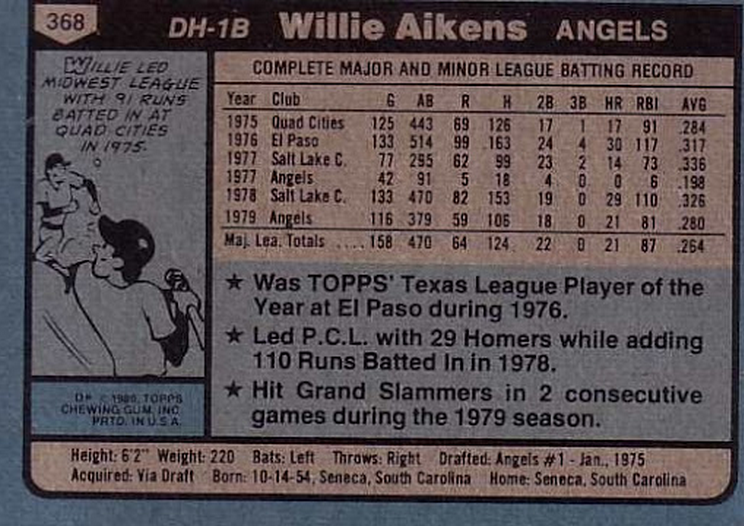
#368 Willie Aikens


Who is this player?
Willie Aikens, first baseman, California Angels

During the summer of 1980, Willie Aikens was now a key member of the Kansas City Royals. As the Royals were on their way to another AL Western Division Championship and their first World Series appearance, Aikens was their left-handed slugging first baseman. In his second full season in the major leagues, the 25-year old crashed 20 home runs and plated 98 teammates while batting .278. It was in the postseason, however, where Aikens would make his greatest contribution. He batted .364 in the Royals' three game sweep of the New York Yankees in the ALCS, but made a bigger splash in the World Series, becoming the first player ever to hit two home runs in a World Series game twice, in Game 1 and Game 4. Behind the scenes, however, Aikens was at the beginning of a substance abuse problem that would evetually alter his life and career. He would admit to using cocaine after games, even World Series contests. But at that moment, the future looked bright for the World Series hero, unaware that what would unfold was still light years away as the 1980 season came to a close.

Today, Willie Mays Aikens is predominantly remembered for those World Series home runs and his long substance abuse issues and incarceration. His story is now about redemption, one that he tells in an autobiography, "Safe At Home."  However, there is much more to the man and the ballplayer.

Rather than write up the traditional player summary that has accompanied these posts, this can be best served by spending some time with this video currently on-line:


Why I love this card
Like most, it has to be the inclusion of his complete name. How can any kid not be infatuated with a player named Willie Mays Aikens. The questions were numerous. Are they related? Is he as good as his namesake? Regardless, it was a cool card to have.


Something else....
Aikens 1981 Topps card discussed the naming issue as well in the cartoon on the reverse:


Friday, July 22, 2011

#337 Carney Lansford


Who is this player?
Carney Lansford, third baseman, California Angels
The June 1980 issue of Baseball Magazine touted Angels' third baseman Carney Lansford as one of the players most likely to be a star in the 1980s. Indeed, when the season began, it was thought that he would be a cornerstone of the franchise. After all only one year earlier, the Angels refused to part with him as part of the Rod Carew trade. However, the Angels changed their stance after a .261 15 80 season and traded him to the Boston Red Sox in exchange for All Star veteran Rick Burleson.

A native Californian born to an athletic family, Carney Lansford's little league team from Briarwood played in the finals of the 1969 Little League World Series. He was a three-sport star in high school, primarily in baseball. This drew attention from several teams and the California Angels drafted him on the third round in 1975. He spent a little over two years in the bushes, where a .332 average at El Paso in 1977 earned him a call to the majors for good. He made the Angels squad the following season as starting third baseman. His .294 average, speed and exceptional fielding drew raves, as well as a third place finish in Rookie of the Year voting.

He was a major piece of the 1979 AL West Champions, clubbing 19 home runs while typically batting second in the lineup. After his trade to Boston, he had a breakout season, leading the league with a .336 average and earning his only career Silver Slugger Award. Remarkably, Lansford was the only righthanded batter to lead the AL in an 18-year span (1971-1988). However, the emergence of Wade Boggs numbered his days in Beantown and he was traded again, this time to the Oakland A's for All-Star slugger Tony Armas.

It was in Oakland that Lansford earned his most renown. Although today he primarily remembered for his role on the dominant A's teams of the late 1980s, Lansford starred for them during many of the previous lean seasons. He was a .288 career hitter for Oakland, three times topping .300. He led baseball with a 24-game hit streak in 1984 and was named to the AL All Star team in 1988. Injuries and personal tragedy periodically interrupted his bottom line figures, but Lansford rightfully earned a reputation as a professional hitter with an excellent glove and a reliable teammate. The culminated in 1989 with a Worlds Championship as Oakland defeated the San Francisco Giants.

After the 1992 season, Lansford retired, completing 15-years of major league service. He transitioned into coaching, first as a bench coach with Oakland (1994-1995) and then with St. Louis (1997-98) and served as manager of the 1999 Edmonton Trappers. He left coaching to focus on the careers of his son's (both of whom are in the minor leagues) before returning in 2008 as hitting coach of the Giants. After a somewhat controversial tenure there, he now serves in the same capacity for the Colorado Rockies.

Why I love this card
I was always a fan of warm-up jerseys, primarily because you never really got to see them. The only time you could is if you showed up early for batting practice (which they never allow these days) or on cards. The Angels one always intrigued me. I don't know if they were the first to have them, but I am stretching to think of another.

Something else....
Lots of interesting tidbits about Carney. First he is a direct descendant of Sir Francis Drake and is also a distant cousin of Tex Ritter. Second, he is one of only seven men to play in both the Little League and Major League World Series. Finally, he had a cameo appearance in the 1994 movie "Angels in the Outfield" as White Sox slugger Kit "Hit or Die" Kesey


Sunday, June 27, 2010

#312 Mike Barlow


Who is this player?
Mike Barlow, relief pitcher, California Angels
Midway during Spring Training in 1980, Mike Barlow found himself traded from the defending AL West Champion California Angels to the Toronto Blue Jays. Despite coming off a 109-loss season, there was optimism in Toronto and Barlow was being called upon to provide veteran guidance on the young Blue Jays pitching staff. The imposing (6'6") righthander served primarily as a setup man and sometimes closer. He won three, saved five and posted a 4.09 ERA in 40 games in 1980. A highlight for Mike came on September 7th, when he saved both games of a doubleheader against the Chicago White Sox.

An outstanding athlete as a youth, Mike Barlow pitched two no-hitters in American Legion baseball in New York, but he was also an outstanding basketball player. He was such a good hoops player, he received a scholarship to play at Syracuse University. Barlow played sparingly for three seasons with the Orangemen, though he would letter in 1968 and 1969. Illness kept him to only 3 games his senior year. He also stood out on the diamond and was drafted twice (by the Orioles and Dodgers) before signing a free agent contract with the Oakland A's in 1970.

Used mostly as a middle reliever for the majority of his career, Barlow pitched with four different teams; the St. Louis Cardinals, Houston Astros, Angels and Blue Jays. For nearly every year of his career, Barlow split time between the majors and minors, the only exception being 1979, the season the Angels won their first ever division title. Though he posted a high ERA (5.13), he appeared in 35 games for the AL West champs, including Game 4 of the American League Championship Series.

Barlow last appeared in a major league game in 1981, bringing to end a major league career that spanned parts of seven seasons. He stayed in the Blue Jays organization in 1982, earning 8 saves in relief for the Syracuse Chiefs. When the minor league season ended, Barlow was not recalled to the major leagues, and Mike left organized baseball.

From 1987 to 1993, he teamed with Syracuse's Doug Logan as the official broadcast team for Syracuse University basketball games. He became the Athletic Director of Bishop Grimes High School (Syracuse) in 2001 as position that he still holds today.

Why I love this card
I loved the backs of cards of players like Barlow. Seeing all the minor league stops all the way made me appreciate how long the road sometimes is to the major leagues. However, later on I became curious as to why they included some player's minor league records and not others. I know that there are space limitations, but I wonder what the decision making process was. Barlow's entire history is here, but for a similar player, say Dave Rosello, only his major league record is listed. Funny what I still waste time thinking about.

Something else....
I am fairly certain that this photograph was taken at Tiger Stadium in Detroit. The visitor's dugout in relation to the seats is consistent and the shadows suggest a 1:35 afternoon start. What I cant figure is what Barlow is leaning on. He is above the top of the dugout, so its not that. It appears to be a chair turned the opposite way that he is sitting on, which would be highly unusal for Tiger Stadium at that time. Again, funny what I still waste time thinking about.

On this date in 1980:
One of the worst heat waves in history begins to claim its first victims. In Dallas, record temperatures reach 113 degrees and the drought continues in Montana, Minnesota, Wyoming and the Dakotas. Comparisions to Dust Bowl days of the 1930s are evoked. By the time the summer comes to an end, more than 200 deaths are blamed on the heat in 13 states.

Tuesday, May 25, 2010

#285 Don Baylor


Who is this player?
Don Baylor, outfielder/DH, California Angels
The reigning American League MVP, Don Baylor had a frustrating season in 1980. Mirroring the fate of his team, Baylor broke a wrist in May and missed six weeks of action. When he returned, the Angels were mired in a deep losing streak and were in last place. Baylor likely pressed to turn things around and was unable to repeat the offensive heroics of 1979. His season came to an end when he was injured a second time, dislocating his toe in early September. Baylor finished the year batting .250 and managed only five home runs and 51 RBI.

Don Baylor's path to the major leagues was unique. He was one of the first students to integrate both his junior and senior high school in Texas during the early 1960s. He voluntarily crossed a wide racial barrier, not an easy task then, and the prejudices of the time were a consistent obstacle. The young Baylor was an outstanding athlete and he learned the resolve to accept and face a challenge. It was a quality that would serve him well as he worked his way towards a major league dream. He was recruited to play football at Texas, but Baylor's passion was baseball and he was selected number two by the Baltimore Orioles in the 1967 free agent draft.

In Baltimore, Baylor found a mentor and friend in Hall of Famer Frank Robinson. Baylor closely observed and emulated Robinson's style of play and leadership. The Orioles were a perennial contender and had a deep farm system, so despite being named Minor League Player of the Year in 1970, Baylor had difficulty finding playing time. He made the big leagues for good in 1972 and stayed in the Oriole lineup for five years, showing an impressive combination of power and speed. Although it looked as if he would be an Oriole for some time, he was part of a multi-player package to the Oakland A's for Reggie Jackson.

After a year in Oakland, Baylor was one of the first free agents and signed an eye-popping contract with the California Angels before the 1977 season. Despite early struggles, Baylor had a career year in 1979, leading the Angels to their first postseason appearance. In being named the AL MVP, Don hit 36 home runs and led the league in runs, games played and RBI. Baylor would spend six seasons in Anaheim, and when he left after the 1982 season, he was the franchise leader in several categories.

He went to the New York Yankees in 1983 and then to the Boston Red Sox in 1986. In the last three years of his 19-year career, Baylor appeared in the World Series each year, each time with a different team (Boston, Minnesota, and then Oakland). He retired after the 1988 season and began a second career as a coach. He finished his playing career as the all-time leader in being hit by a pitch (267) a record now held by Craig Biggio.

Baylor was the first manager of the Colorado Rockies in 1993 and was only the fifth black to manage a major league club. He led the Rockies to the postseason in 1995 and was named NL Manager of the Year. By 1997, the Rockies under Baylor's leadership had the best five-year record (363-384) of any expansion club in MLB history. He managed the Chicago Cubs in the early 2000s and returned to Colorado in 2009 where today serves as the club's hitting coach.

Why I love this card
Actually, this card irritated me for a long time. Baylor started the 1979 All Star Game in Seattle when Rod Carew was injured and Carl Yaztremski shifted over to first base. Baylor was the MVP and had another card in this set to recognize his RBIs. I know that it was Topps' practice to designate as All-Stars the guys who won the voting, but I always felt Baylor got rooked. Now, inspired by recent posts regarding customized cards, here is my attempt to recognize Baylor:


Something else....
Baylor also had a 1980 Super Card. Here it is below. I remember my original one getting ruined with a Slurpee at some point.


On this date in 1980:
Scott Hairston, currently with the San Diego Padres and son of former major leaguer Jerry Hairston is born.

Saturday, March 27, 2010

#263 Dave LaRoche


Who is this player?
Dave LaRoche, relief pitcher, California Angels
After several seasons as the Angels' leading fireman, Dave LaRoche had settled into a different role with the team as the 1980 season got underway. Being used primarily as a setup man, LaRoche excelled during the first half of the season earning and handful of saves and posting an ERA near 3.00. Injuries to the Angels pitching staff led to the lefthanded LaRoche getting more work and he was moved into the starting rotation. A rocky August saw him go 1-3 with a 6.23 ERA, but was effective when returned to the bullpen to close out the season. In his final appearance of the year, he introduced an eephus pitch, one he would later call "La Lob".

An All-League pick in three sports in high school, Dave LaRoche helped lead his Colorado team to the Connie Mack World Series title. Signed originally as an outfielder by the Angels in 1967, he was converted into an pitcher the following year and quickly made his major league debut, in 1970. In his first appearance, he came in to face Boston legend Carl Yastrzemski in the 16th inning and end a Red Sox threat. He earned the win when the Angels pushed across a run in the bottom half of the inning.

As the role of closer (or "fireman" as it was called at the time) evolved, LaRoche was one of the better relievers of the 1970s. However, since he spent that time with second division clubs (Angels, Cubs, Twins and Indians) much of his work went unnoticed. A two-time All-Star with Cleveland, LaRoche averaged 12 saves a year during the decade and five times finished the season with an ERA under 3.00. He was consistently among the league leaders in appearances, games finished and saves, twice finishing second in that category (1976, 1978).

Dave also earned the stereotypical reputation of lefthanded flake for antics throughout his career. He once almost missed a team flight after running out of gas and another time hit the scoreboard at Anaheim Stadium with a ball to show a coach he was loose. He remains the last pitcher to use the eephus pitch on several occasions, inducing a friendly exchange with Milwaukee's Gorman Thomas in the process.

LaRoche was released by the Angels in Spring Training in 1981 and he was quickly scooped up by the New York Yankees. He spent the final three seasons of his 14-year career in New York where he was popular with the fans. Since 1984, Dave has served in a coaching capacity, twice at the major league level with the White Sox and Mets. Today, he is the pitching coach of the Triple-A Las Vegas 51s in the Toronto organization. His sons Adam and Andy are both currently in the major leagues, at one point teammates in 2009 with the Pittsburgh Pirates.

Why I love this card
In previous posts, I talked about a visit to Tiger Stadium in 1980 where I got some autographs of the visiting Angels. LaRoche was one of the guys who signed for me and he looked exactly as he did on this card. He was wearing a similar warmup and had the same look on his face. Even when his sons are on TV today, I think of the moment that he signed for me in 1980 (here, along with Richie Hebner)


Something else....
According to LaRoche's wikipedia page, he once got into a tussle with Hall of Famer Rod Carew:
(LaRoche) "complained about everything. In fact, they filed a grievance about the choice of ice cream we had in the clubhouse. [He] loved to agitate, and it was not right. He was always negative about everything in the locker room. I finally got tired of it one night...we were having a team meeting and he was constantly interrupting people. I said to him, 'Just shut up and listen to what the guys have to say.' He asked what I was going to do about it, so I challenged him to a fight. There was a broom closet in the back of the clubhouse. I opened its door, turned on the light and said, 'Come on, let's go in.' As soon as he walked in, I turned off the light, closed the door and whaled away at him."


On this date in 1980:
"Silver Thursday" A steep fall in silver prices led to panic on commodity and futures exchanges.

Sunday, February 28, 2010

#253 John Montague


Who is this player?
John Montague, relief pitcher, California Angels
In what would be the final year of his seven-year major league career, John Montague of the California Angels was very effective to start the 1980 season. He earned two saves the first month and was the most reliable setup man on the Angels' staff. However, he had a rough second half and had a 11.25 ERA in August. Like many Angels that year, he became injured and missed the last month of the season. The righthanded Montague finished the year 4-2 with three saves and a 5.13 ERA.

A native of Newport News, Virgina, John Montague played college baseball at Old Dominion University and was selected by the Baltimore Orioles in the third round of the 1967 amateur draft. He spent several years pitching in the Orioles system and was traded to the Montreal Expos in April, 1973. He made his major league debut that year but spent his Expo career shuttling between Quebec and the minor leagues. Unable to find a consistent role for him, Montreal released Montague at the end of the 1975 season.

He was quickly signed by the Philadelphia Phillies, with whom he made only three appearances. John again was assigned to the minor leagues in 1976, where he won 14 games and was named American Association Pitcher of the Year. This caught the eyes of the expansion Seattle Mariners, who selected John to be a member of the inaugural team in 1977. He was team's first ever relief pitcher and earned the first save in Mariner history on April 9, 1977.

Montague saw some action as a starting pitcher, but made history as a reliever. He set an American League record in mid-season when he retired 33 consectutive batters. He finished second on the team in wins, appearances and innings pitched. Montague was sidelined with hip pain in 1978; a benign tumor was found and removed after the season. He was traded to the Angels in late August of 1979 and won two games and saved five, playing a key role in the Halos division title.

He appeared in the postseason for the only time in his career and allowed the famous home run to John Lowenstein in the 12th inning of Game 1. The Angels would lose the ALCS to Baltimore in four games. He was released in Spring Training of 1981 and was not picked up by another team. Any information on his current whereabouts would be most appreciated.

Why I love this card
There are not many blatant example of airbrushing in the 1980 set. Airbrushing was a staple of many Topps sets over the years, but so far there haven't been any really obvious ones. Montague's card, however, falls into that category, as it appears Topps used a picture from earlier years. Case in point, here is Montague's 1979 card:


Here's some pertient parts of that card up close:


Compare this with the 1980 Montague card and it appears that the shots were taken on the same day, down to the cloudless blue sky.


Something else....
Montague's record was actually shared with Royals' hurler Steve Busby who accomplished the feat in 1974. The record has since been broken and is held by Mark Buehrle. He retired 45 consecutive batters in 2009. The National League record belongs to Jim Barr of the San Francisco Giants who retired 41 straight batters in 1972.

On this day in 1980:
Musical theme today: Dizzy Gillespe appeared on the Muppet Show, Pink Floyd performed at Nassau Colisuem and Queen had the #1 song in the country with "A Crazy Little Thing Called Love."

Tuesday, February 2, 2010

#239 Don Aase


Who is this player?
Don Aase, starting pitcher, California Angels
Beset by injuries, the California Angels were unable to defend their AL West crown in 1980, slipping instead to sixth place. Righthanded pitcher Don Aase was one of the only healthy pitchers in Anaheim and he started and relieved, depending on the needs of the team. Aase started 21 games and was moved to the bullpen at mid-season. He was 3-0 and posted a 2.07 ERA in 19 appearances as a reliever, six of which were four innings or more.

The righthanded Aase was originally a selection of the Boston Red Sox in 1972. His professional career began dubiously as he went 0-10 with a 5.81 ERA with Williamsport and followed with a 15-loss season in 1973. However, Aase turned things around the following year as he was the best pitcher in the Carolina League, leading the circuit in wins, ERA and innings pitched. That performance earned him a promotion to Triple-A Pawtucket where he spent two seasons before earning a spot in the Boston rotation after the All-Star break in 1977.

Aase began his major league career with three straight wins, including a complete game shutout against the California Angels. He won six games, threw two shutouts and four complete games. However, the Red Sox traded Don to the Angels for Jerry Remy and won 11 games. He was a major part of the AL West division champions in 1979 and won the first postseason game in franchise history when he won Game 3 of the ALCS against the Baltimore Orioles.

He became the Angels closer in 1981 and spent the remainder of his career pitching out of the bullpen. An elbow injury in 1982 cost him almost two full seasons but Aase rebounded nicely, returning in 1984 to record 8 saves with a 1.62 ERA in 23 appearances. He became a free agent and signed with the Baltimore Orioles prior to the 1985 season. Installed as the Orioles closer, Aase was an All Star in 1986 and earned the save in the AL's win in Houston. He finished the year with 34 saves, the second most in the American League.

Injuries returned in 1987 and Aase never regained closer status, bouncing to three teams in the last four seasons of his 13-year career. He ended his career following stints with the New York Mets in 1989 and the Los Angeles Dodgers in 1990. Of all of the players in major league history, Don is listed fourth alphabetically behind David Aardsma, Hank Aaron, and Tommie Aaron. Today, Aase is enjoying retirement and his son is playing baseball for UNLV.

Why I love this card
When I first got this card, I first thought that Aase was photographed picking something up off the ground. The football stands in the background also reminded me of the local high school stadium. Today, I realize that this photo was likely taken in 1978 since the Angels had names on the back of their uniforms in 1979.

Something else....
Until today, I never knew that the correct pronunciation is AW-see. When I was a kid, I pronounced it ASS-ee, simply because it was a cheap reason to say "ass." My dad saw right through that. Since then, I had been pronouncing it Ah-see. Shows what I know.

On this day in 1980:
Today would have been the final day of the Star Trek Meal at McDonald's a cross promotion of Star Trek: The Movie. You can watch the commercial here. Notice that it is not called a Happy Meal - I think that this may be one of the first examples of a movie-themed combination at McDonald's.

Saturday, December 12, 2009

#214 Jim Fregosi California Angels Team Card


What is this card?
Team Card, California Angels, Jim Fregosi Manager

As the 1980 season began, the defending AL West California Angels were faced with a "good news/bad news" scenario. First the good news....

The Angels had 47 injuries in 1979 but were still able to win the division. Granted, the AL West was the weakest division in baseball, but that still doesn't deter from the accomplishment. Don Baylor won the MVP Award and the Angels had two young stars in catcher Brian Downing and third baseman Carney Lansford. Bobby Grich was arguably the best second baseman in the league and they had a future Hall of Famer (Rod Carew) at first base. Dan Ford was a 100-RBI man and despite having off-season knee surgery, the Angels added outfielder Al Cowens and added Fred Patek as a free agent shortstop. On paper they had the best offensive attack in their division.

Now the bad news....

After eight seasons as the cornerstone of the Angels' pitching staff, Nolan Ryan left the club as a free agent. To replace him, California signed Bruce Kison from the Pirates and were counting on a strong return from Frank Tanana. There were also some concerns regarding their bench depth and left handed hitting, but most publications predicted that the Angels would repeat as division champions. Besides, no team could be unlucky with injuries two years in a row, could they?

The Angels could. Almost immediately, they lost Downing to an ankle injury and Baylor to a series of different problems. Lansford slumped, largely due to little protection in the lineup. Kison was a bust as Ryan's replacement and was also injured. Ford did not recover from his knee surgery and their lack of depth was clearly evident.

Initally the Angels tried to fill the holes by adding Dave Lemanczyk, Dave Skaggs and Jason Thompson. Grich and Carew were named to the American League All Star team and Carew was fifth in the league in batting. However, their pitching woes were too great and only the Indians had a worse team ERA. The Angels finished 1980 with 95 losses and finished a distant sixth in the AL West.

Why I love this card
You can't beat a picture of a division champion. When I got this card early in the season I made a mental note to take good care of it, by summer it didn't matter any more.

Something else....
It appears that Topps is working through the AL West in regard to the team cards. Five of the seven teams in the division have now been covered and the other two are also West teams (albeit NL), the Braves and Astros.

Friday, December 4, 2009

#206 1979 Strikeout Leaders


What is this card?
1979 Strikeout Leaders Card
J.R. Richard had completed one of the most dominant seasons of the post-expansion era in 1979. His 313 strikeouts had established a National League record for righthanded pitchers, breaking his own record of the previous year. When this card came out, it was the seventh time that Nolan Ryan led the league in strikeouts. He left the Angels after the season and in 1980 both of these guys became teammates.

How was the race? Richard was, far and away, the most dominant strikeout pitcher in the game at this time, including Nolan Ryan. He outdistanced his closest pursuer in the NL by over 100 strikeouts and was never challenged. Ryan, meanwhile, led the American League for nearly the entire season with nine first-half starts of 10+ strikeouts. He withstood a late-season surge by Ron Guidry of the Yankees who struck out 10, 11 and 11 in three of his final five starts.

Where are the 1980 League Leaders? Len Barker of the Cleveland Indians, who led the American League with 187 punchouts, is not listed here on this card. Meanwhile, Steve Carlton of the Phillies led the National League in 1980 and was runner-up to Richard in 1979.

Did these players ever repeat? Yes and No. Richard didn't pitch again after 1980 due to his career ending stroke. Ryan would go on to add to his Hall of Fame career by leading the league in strikeouts four more times. Amazingly, he would do so at ages 40 through 43 for the Houston Astros and Texas Rangers.

Why I love this card
As mentioned, the fact that Richard and Ryan were teammates made this a very popular card that summer. Luckily, I had two of these that year, and it was one of the few cards that I had that I refused to trade. It was the reason that I rooted for the Astros that season

Something else....
Largely forgotten today, but a rotation of Ryan, Richard and Joe Niekro was pretty awesome. Had it not been for Richard's misfortune, one wonders how well the Astros would have really done in 1980. Sports Illustrated also speculated this in 1993 and a reprint of that article can be found here.

Monday, November 30, 2009

#203 1979 Runs Batted In Leaders


What is this card?
1979 Runs Batted In Leaders Card
Don Baylor of the AL West Champion Angels led the majors with 139 RBI. Dave Winfield of the San Diego Padres was the National League Leader with 118. Baylor is the first player to appear on a Leader card that also made it to the postseason in '79, while Winfield is the first future Hall of Famer.

How was the race? Both men had significant challenges from multiple pursuers. Winfield sewed up the NL race with two 4-RBI games in September to hold off Dave Kingman and Mike Schmidt. Baylor surged ahead in late-August with an 8-RBI game. The runner-up in the AL, Jim Rice (130), along with Gorman Thomas (123) and Fred Lynn (122), would all have led the National League with their RBI totals.

Where are the 1980 League Leaders? Mike Schmidt, the NL leader was third in the league while Cecil Cooper of the Milwaukee Brewers placed eighth on the American League leaderboard.

Did these players ever repeat? No. While Winfield would place in the Top 10 on ten different occasions during his career, the highest he ever finished was third. Baylor, meanwhile, only placed one more time among the league leaders in RBI.

Why I love this card
Two completely new guys pictured. Winfield in particular was foregin to me because the Padres were rarely on TV and weren't known for great players. I also thought that it was strange that the AL Top Ten outweighed the NL's in RBI, but the opposite was true for home runs.

Something else....
I am glad that Topps decided to write out Runs Batted In instead of abbreviating it. If anything, they decided to truncate "Leaders" into LDRS.

Sunday, November 1, 2009

#183 Jim Anderson


Who is this player?
Jim Anderson, utility player, California Angels
The Player To Be Named Later. When the Angles acquired pitcher John Montague from the Seattle Mariners for the stretch drive in 1979, Jim Anderson was cast out in December. Anderson played five different positions with the 1980 Mariners, primarily as a third baseman and shortstop. Providing much-needed depth from the bench, Anderson even appeared behind the plate in a game for Seattle. He achieved career highs in nearly every offensive category and appeared in 116 games.

A high school standout at Kennedy in Granada Hills, California, Anderson played in the state championship game in just his sophomore year. He earned the attention of the local Angels, who drafted him on the second round of the 1975 draft. He worked his way up the minor league ladder, earning a reputation as a good defensive player. He eventually landed in Anaheim in July of 1978 and remained on the Angels' roster for the remainder of the season, usually as a substitute. He saw action as a late inning sub but struggled hit over .200.

In 1979, he was with the Angels for the entire season, culminating in the Angels' first post-season appearance. He had a four-hit game in July to lead an Angel rout against the Kansas City Royals and when the Angels clinched the AL West, Anderson poured champagne over the head of President Richard Nixon. The deposed former President had adopted the Angels as his favorite team and was a fixture at many of their games during the season.

Anderson spent only one more season in Seattle (1981) and was waived shortly before the start of the 1982 season. He spent the entire 1982 campaign with the Texas Rangers' Triple-A club in Denver and earned a spot on the major league roster in 1983. In limited action in two years with the Rangers, Anderson batted only .181. He was traded to the Montreal Expos with Bob Sebra for the rights to Pete Incaviglia in November, 1985 but he never again appeared in a major league game, ending a six year career.

In recent years, Anderson has become an active member of the Angels Alumni Association and makes numerous appearances each month at various activities throughout the Greater Los Angeles region. He also entered the real estate industry after his playing days is helping to lead the cause of deregulation of public utilities and telecommunications.

Why I love this card
This card reminds me of our third grade school pictures. I know that the blue background here is likely the Spring Training sky, but it looks exactly like the tarp that they would set up when they would take our photo. I half expect to see "Jim '80" embossed in gold in the bottom right hand corner. No way Sr. Kathleen would have let us get away with looking away like Mr. Anderson is doing here.

Something else....
Anderson's card is another one of the DP cards sprinkled throughout the set. Like most of these, if I opened three packs, I would get this card (it seemed). In one of my more destructive moments, I set this card up in the path of the lawnmower, "just to see what it would do." The results were predictable.

Sunday, August 2, 2009

#105 Frank Tanana


Who is this player?
Frank Tanana, starting pitcher, California Angels
For the first time in his career up to the point this card was printed, Frank Tanana began to struggle with injuries. The left-hander pitched the division-clinching game that earned the Angels their first ever playoff birth, but he started only 17 games for the AL West champions. He started slowly in 1980, beginning 3-9, and he refused to be sent to the minor leagues. There were whispers that he had lost his fastball. He turned things around in the second half, however, going 8-3 with a 2.84 ERA.

The son of a minor league outfielder, Frank Tanana was a two-sport high school prep star that was drafted in the first round of the 1971 draft by the Angels. Blessed with a blazing fastball, Tanana zipped through the Angels' minor leagues as a big winner and made his major league debut in just two years. He won a job in the starting rotation in 1974 and he won 14 games and struck out 180 batters.

By 1975, he and teammate Nolan Ryan were becoming the most feared pitching duo in baseball. Together, they would fan 500 or more opponent three times, more often than any teammates in history. Tanana in particular had a spectacular breakout season in '75. He led baseball with 269 strikeouts (17 in one game), was 16-9 with a 2.62 ERA and finished fourth in the AL Cy Young voting. He was only 21 years old. The following season (1976), he won 19 games and made his first of three consecutive All-Star teams. The year after that (1977) he led the league in ERA and shutouts (7). Comparisons to some of the greatest left-handers of all-time invariably started.

While he won 18 games in 1978, Tanana began to feel fatigue in his elbow. He would never again be the dominant flamethrower he was previously. However, he never lost his control, and he began his transition into the second stage of his career. After a dispute with the Angel front office in 1980, he was traded to the Boston Red Sox in a package for Fred Lynn. He lasted one season in Boston, who shipped him to the Texas Rangers, where he led the league in losses 1982. When he began poorly in 1985, the Rangers traded him to his hometown Detroit Tigers.

In Detroit, Tanana would be an important part of the Tiger rotation for the next seven seasons. His assortment of "junk" pitches at slow speeds kept hitters off guard and his pinpoint control was key to his success. Tanana's masterful performance on the final day of the 1987 season clinched the AL East for the Tigers with a memorable 1-0 shutout. He would earn his 200th win and 2000th strikeout in a Tiger uniform and posted a winning record in six seasons. Even though he was a popular Tiger, new management in 1992 showed him the door and he played the 1993 season with both New York teams, the final year in his 21-year career. Today, Tanana focuses on spreading the Word of God and started two discipleship groups that focus on prayer, memorizing Scripture, and teaching men how to spend personal time studying the Bible.

Why I love this card
Ah, Frank Tanana. I have no memory of the young flamethrower for the Angels pictured here, my memories are all of the junkballer with the Tigers. I saw him countless times during his tenure with the Tigers, but I probably remember most the game I didn't see him start. The last weekend of the 1987 season, my Dad was lucky enough to have access to tickets to either the last or second to last game of the 1987 season against the Jays. My choice. I chose the Saturday game, thinking at least we could see the Tigers clinch a tie. Great game, Trammell wins it in 12-innings with a ball through Manny Lee's legs. The next day, Tanana hurled the gem. My timing was never good.

Something else....
Frank Tanana is one of two pitchers to surrender a home run to both Hank Aaron and Barry Bonds. He also faced Minnie Minoso in both of his plate appearances in 1976 and 1980 when Minoso was activated by Bill Veeck in an effort to get Minoso a plate appearance in five decades.

Friday, June 26, 2009

#68 Larry Harlow


Who was this player?
Larry Harlow, reserve outfielder, California Angels
Although he began the 1979 season with the Baltimore Orioles, Harlow was traded in June to the California Angles. He was a reserve outfielder most of the season and had the game winning RBI in the Angels' only win in the ALCS that fall. In the offseason, he entered into a weight lifting and conditioning program, something that was not as common as today. Harlow received more playing time in 1980 due to an injury to Dan Ford and batted .276.

Larry Harlow was drafted by the Orioles in 1970, a part of a huge influx of talent that the Orioles produced throughout decade. Unfortunately, that influx also prevented the left-handed hitting Harlow from cracking the major league lineup. He made his major league debut in a late-season call up in 1975. He did not appear in the majors in 1976 but made the team out of Spring Training in 1977.

He stuggled at the plate and was returned to the minors. When Al Bumbry was injured in 1978, Harlow took over for him in center field. He achieved career highs in nearly every offensive category, appearing in 146 games, even appearing as a pitcher in one of them.

1981 was Harlow's last season in the major leagues, batting .207 in only 43 games. While he returned to the minors for a couple of seasons, his six-year major league career had come to an end. He also played both seasons in the Senior Professional Baseball Association in 1989 & 1990.

Why I love this card
Harlow's helmet. While not quite on par with the Great Gazoo, his helmet jumps out at you. If you look closely, you can see the reflection of a couple of his teammates in there.

Something else....
Harlow in the same season played for the two teams that faced each other in the post-season (1979 ALCS). I know that there have to be other players who have done this, but for the life of me I can't think of any.

Thursday, May 28, 2009

#48 Rick Miller


Who was this player?
Rick Miller, centerfielder, California Angels
In addition to centerfield, the left-handed hitting Miller was often times the leadoff batter for the defending AL West Champion California Angels. As the Angels looked to return to the postseason in 1980, Miller was looked at as the defensive captain of the outfield and the table setter at the top of the order. Unfortunately, injuries doomed the Angels as they lost 95 games and finished sixth.

Hailing from Grand Rapids, Michigan, Miller was invited to a pre-game workout with the Detroit Tigers in the summer of 1966. Along with a fellow Michigan high school standout, Ted Simmons, where he had the chance to meet his boyhood hero Al Kaline. He went to Michigan State University and was drafted by the Boston Red Sox in 1969. Miller was called up for the final 15 games with the Red Sox in 1971, and he played reserve roles in the outfield. He wound up going 11-for-33 with a home run, batting .333 in the month of September.

In 1972, Miller played in 89 games, but usually as a late-game defensive replacement in center field. He hit three home runs with a .214 batting average. His efforts were recognized as Miller was also named Red Sox' "Unsung Hero of 1972" by the Boston Baseball Writers Association. Miller became the regular in centerfielder in 1973, but the arrival of Fred Lynn and Jim Rice in Boston moved Miller back to the bench. He appeared in a reserve capacity for the Red Sox in the 1975 World Series.

However, Miller wanted to play everyday, and he signed a free agent contract with the Angels in 1978. In his first year in Anaheim, he was awarded with a Gold Glove award and was in the postseason in his second, batting a career high .293. After the Angels disastrous 1980 season, he was traded back to the Red Sox where he would spend the remainder of his 15-year career. He was the regular starter in center in 1982 and 1983, but moved to the bench again when the Sox acquired slugger Tony Armas. At this stage in his career, Miller became one of the most dangerous pinch hitters in the league, ranking high among the leaders in the pinch hits and average.

Most recently, Miller was manager of the independent Nashua Pride in 2008. The team folded after the season and Miller did not follow the team when it became the American Defenders of New Hampshire.

Why I love this card
It's the first in action shot in a while and it captures Miller in full swing. Miller has every late 1970s/early 1980s accoutrement of the typical baseball player. Eye black? Check. One batting glove? Check. Wrist bands? Check. If Miller was photographed in the field, I'm sure that he would have had flip up shades.

Something else....
As mentioned on the back of this card, Miller married the sister of Red Sox teammate Carlton Fisk. Interesting that they are only 8 cards apart. More interesting is the depiction of Miller's wife/Fisk's sister. Is there a Jessica Rabbit thing going on here? Shame on you for clicking.

Monday, April 27, 2009

#20 Dan Ford


Who was this player?
"Disco" Dan Ford, right fielder, California Angels
Dan Ford was an important piece of the Angel team that won the American League West in 1979. He was the number three hitter in the Angels lineup and had 100 runs scored and 100 RBI. Ford hit for the cycle in 1979, only the second Angel ever to do so. Although he had surgery in November 1979, there were high expectations of Ford coming into 1980.

A product of the Watts section of Los Angeles, Ford used athletics to escape the divisive race problems happening in his neighborhood. He was originally drafted by the Oakland A's Charlie Finley in 1970, an owner known for an eye for talent. Unable to crack a loaded A's lineup that won three World Series, he was traded to the Minnesota Twins, where he made an immediate impact.

Playing in 130 games and hitting .280, Ford would have received Rookie of the Year consideration had it not been the same year Fred Lynn and Jim Rice both debuted for the Boston Red Sox. Ford never played in less than 140 games the next three seasons and established himself as a tough out in the Twins lineup. In 1976, Ford hit the first home run in the newly remodeled Yankee Stadium.

Sensing that Ford was due a increase in pay, miserly owner Calvin Griffith traded him to California instead of having Ford leave via free agenct. In Anaheim, Ford would replace the tragically deceased Lyman Bostock, ironically a former teammate.

Ford missed nearly all of spring training due to his knee surgery and got off to a terrible slump in 1980. He was hurt in mid-season and missed nearly two months and drove in only 26 runs. After the strike-shortened 1981 season, he was traded to the Baltimore Orioles for Doug DeCinces. Ford was an important part of the Orioles run to the 1983 World Series, hitting a home run in a Game 3 win off of Hall of Famer Steve Carlton. Ford retired two years later in 1985, ending an 11-year big league career.

Why I love this card
Where to start?
1. This photo was taken at Tiger Stadium in Detroit.
2. The navy blue warmups
3. The old style batting helmet, very similar to the souvenir plastic editions they sold at the ballpark.
4. The fact that the guy Ford was traded for, Ron Jackson is only a card away from him. Coincidence? I think not.

Something else....
How did the name "Disco" originate? From an interview on MLB.com:

The Twins' rookie of the year in '75, Ford quickly became popular on the field and in the Minneapolis social scene. A loyal fan following spawned, as did his nickname, "Disco" Dan Ford.

"I had some friends that owned a disco. We started the disco club out of there," he said. "We officially made it with some T-shirts and a trophy, and we brought it to the stadium. That's what made it really get going, 200-300 people had bought T-shirts and sat out in right field on occasions."