Showing posts with label Chicago White Sox. Show all posts

Thursday, July 14, 2016

#379 Kevin Bell


Who is this player?
Kevin Bell, third baseman, Chicago White Sox

The Hot Corner was up in the air on the South Side as 1980 began. Despite earning an extended look at the end of the 1979 season, Kevin Bell found himself in a Spring Training competition for the job with Alan Bannister. Ultimately, Bannister was named as Opening Day starter, but Bell ended up starting and appearing in the most games at third for the Pale Hose. His struggles at the plate kept the position opened all season as manager Tony LaRussa started six different players at third in 1980. Bell even went so far to consult an hypnotist to help him out of his season-long slump. Bell batted only .178 with one home run during the season and was eventually released in December. 

A California native whose father was a minor league player, Kevin Bell was an outstanding high school and college player that was a #1 draft pick by the White Sox in 1974. He was sent to Appleton, Wisconsin, which in time would become his home state, meeting his future wife Bonnie, a Wisconsin resident. 

Eventually, he made it to the Major Leagues in 1976, apparently after a trade with the Baltimore Orioles to bring Brooks Robinson to Chicago fell through. Given the third base job, Bell would appear in 68 games, the highlight being and inside the park grand slam in his seventh major league game. It appeared that Bell would be in the White Sox' long term plans, but the acquisition of Eric Soderholm (along with several others that would become the South Side Hit Men) led to Bell starting the year in the minors. When he returned, a devastating knee injury slowed his progress, taking almost two years to return to his full strength.

After the 1980 season, the Padres signed him as a free agent, but he did not appear in a Major League game in 1981. Traded to the Oakland A's. before the 1982 season, he appeared in three games in a late September call up before the right handed hitting Bell ended his six year big league career. 

Bell relocated to the Wisconsin area where he has remained since the mid-1980s as a business consultant for US Venture, in the AutoForce division. In 2001, he was inducted into the Appleton Hall of Fame.

What I love about this card
When I was in Little League there was only one way to hit a home run: Inside the Park. The fences were way too far away in the parks we played in, so our only chances were to hit one over the outfielders heads (usually the opposite way). It helped if you could run fast and if someone missed the cutoff man (which they usually did). Seeing Bell's greatest feat recognized on the back of is 1980 card gave credibility to all of us Little Leaguers everywhere.

Something else...
The TV announcer for the White Sox during the 1980 season was none other than Harry Caray. More known for his time with the Cubs, Caray began his tradition of singing "Take Me Out to the Ballgame" on the South Side. The "Nancy" that he refers to in this clip is Nancy Faust, the longtime organist at Comiskey Park. It is also from the game in which Kevin Bell hit his only home run of the season, against the Indians on August 18, 1980:

Wednesday, May 2, 2012

#347 Harry Chappas


Who is this player?
Harry Chappas, reserve infielder, Chicago White Sox
Although he did not enter the season with as much fanfare as the previous season, Harry Chappas broke north with the Chicago White Sox at the end of Spring Training as an infield reserve. Despite all of the fuss made of his diminutive stature, Chappas was switch-hitting contact hitter whose batting eye and swift feet earned him a spot on the roster. The highlight of his season was a 4-hit performance against the defending AL Champion Baltimore Orioles. However, he managed only three hits in nineteen games after that and was shuttled back and forth to Triple-A. The last time came in June, and it was suggested that Chappas may return since he had an option left that would have prevented him from being placed on waivers. Unfortunately, Chappas did not return to the major leagues and his brief three-year career would come to an end.

Born in Maryland but raised in Florida, Harry Chappas was a prep baseball star as the back of this card indicates. He enrolled in Miami Dade North Junior College, where is performance attracted attention from the White Sox and was drafted in 1976. His early days as a player were described as "aggressive" and "combative"; indeed when a White Sox scout doubted Chappas' ability, he crushed a 425-foot drive.

Chappas had a solid season Single-A Appleton, batting .302 and being named an All-Star. He helped lead the team to 97 wins and in the process earned a ticket to the major leagues. Owner Bill Veeck used the opportunity to play-up Chappas' height. A stunt was created to have broadcaster Harry Caray "measure" Chappas and come in at 5' 3", making hims the shortest player in the majors (Chappas was actually closer to 5' 7'). In his September call-up, he batted .267 for Chicago and handled 92 chances without an error. Appropriately, his first big league hit was a perfect bunt which traveled 30 feet before rolling dead.

The following spring, Chappas made the cover of Sports Illustrated and won the starting shortstop position from Don Kessinger, who was the White Sox' player manager at the time. He struggled mightily the first month and was returned to the minors. When Kessinger was fired and Tony LaRussa took over as manager, Chappas was called back up. He batted .363 upon his return and hitting his only career home run.

Chappas played three more years in the minor league systems of the White Sox and Atlanta Braves before joining an Italian baseball league in 1984. While there, he was involved in a motorcycle accident and crushed his leg. Shortly thereafter, his professional baseball career came to an end.

In the subsequent years, Chappas returned to Florida and entered a vocational program. It was also reported that he had passed courses in precision-parts making and reading blueprints.


Why I love this card
I was oblivious to Chappas' appearance on the cover of Sports Illustrated. I was more transfixed by the cartoon of the base thief on the back of the card, who for some reason, looked suspiciously like the Hamburgler:


.


Something else....
Chappas also had some off-the-field idiosyncrasies. For instance, he raised and bred Australian and African finches, leaving most of them at his Florida home during the season, but keeping some with him. On the road, he also drove roommates to distraction by building model airplanes in his motel room half the night.

Friday, June 24, 2011

#322 Claudell Washington


Who is this player?
Claudell Washington, rightfiedler, Chicago White Sox
Spring Training for Claudell Washington began with a contract dispute, and the miserly White Sox were not about to sign him to the multimillion dollar deal he was seeking. Already unpopular with White Sox fans who famously hung "Washington Slept Here" signs because of his casual style of play, it was widely believed that it would be a matter of time before he was traded. Indeed, the Sox shipped Claudell to the New York Mets for a minor league pitcher in June. He made history shortly after the trade, becoming (at the time) only the third player to hit three home runs in a game in both leagues on June 20 (he hit three in a game for the Sox in 1979). After the season, he signed the contract he was seeking with the Atlanta Braves, a five year deal worth $3.5 million dollars.

Washington's path to the major leagues was an unusual one. A very talented athlete, he spent most of his youth concentrating on basketball and track. He was working as a janitor while playing on the sandlots of Berkely, California when he was discovered and signed by the legendary A's owner Charlie Finley in 1972. Two years later, he was destroying minor league pitching when the A's brought him up shortly before the 1974 All Star break. After a few weeks getting acclimated, he hit .310 in the final month of the season and helped the A's to their third straight World Series, where he batted .571 (4 for 7) in a five-game victory over the Dodgers.

Handed the leftfield job in 1975, Claudell blossomed into a star and he became a favorite of Finley. He was selected to the All Star Game for the first time and finished fifth in batting and second in stolen bases. He struggled in 1976 as the A's dynasty disintegrated. In March of 1977 Finley peddled him to Texas for cash and two players. He never gelled with the Rangers, so when Texas had a chance to get Bobby Bonds they swapped him to the White Sox in May of 1978. His tenure in Chicago was described as uninspired and underwhelming after so much promise only three years previous.

The Braves gambled that with a long-term deal, Washington would blossom into a superstar. While he did help lead the Braves to the 1982 NL West title and was also named to the 1984 NL All Star team, Washington was a solid, if unspectacular outfielder. In six years with Atlanta, the most he would spend with any team, he hit a cumulative .278 and hit just 67 home runs. One of the possible reasons Washington put up such underwhelming numbers may have been due to a substance abuse issues that he had during these stages of his career.

He was traded to the Yankees in mid-1986 and had a fine year in 1988, hitting over .300 for a second time and playing solid outfield for a contending team. Claudell also earned the unique distinction of hitting the 10,000th home run in Yankee franchise history that season. His 1988 effort earned him his last big free agent contract, this time with the California Angels but his career quickly wound down after that. The final year of his 17-year career was 1990 when he hit .167 in 45 games with the Angels and Yankees.

Why I love this card
I loved this card, because of this card:


This was my first ever Kellogg's card and it came in the Spring of 1980. When I ended up getting his Topps card, I thought I was on to something special...after all, if you had a Kellogg's card, you had to be a superstar, right?

Something else....
In addition to being known as the player that Nolan Ryan has struck out the most (39 times), recently, Washington has been indentified as the player that hit the foul ball that Ferris Bueller caught in the 1986 movie. Ah, Retrosheet, you did it again.

Monday, May 31, 2010

#291 Randy Scarbery


Who is this player?
Randy Scarbery, relief pitcher, Chicago White Sox
After leading the Chicago White Sox in appearances in 1979, things did not go as well for Randy Scarberry in 1980. When allowed three earned runs in his first appearance, and when April ended, his ERA was well over 5.00. He pitched in ten more games during May and began to get into a groove, allowing seven runs in 18.2 innings. To his surprise, he was sent to the minor leagues and then traded to the California Angels for infielder Todd Cruz. Randy never again made a appearance in a major league game, drawing the curtain on his brief two-year career.

A native of Fresno, California, Randy Scarbery was the first player selected twice in the first round of the amateur draft when Houston Astros selected him in 1970. He turned down an $86,000 bonus, choosing college instead, and was a standout at USC, a collegiate baseball powerhouse. The Trojans won the College World Series every year that Scarbery was on on the team, and he led the nation with 15 victories in 1973. He was drafted in the first round in 1973 by the current World Champion Oakland Athletics.

He immediately debuted at the Triple-A level, and although he sometimes struggled, he was often among the Pacific Coast League leaders in innings and starts. After three seasons in the Oakland organization, he was traded to the St. Louis Cardinals in April 1977 for fellow prospect Steve Dunning. He was granted free agency at the end of the season and signed on with the Chicago White Sox.

In Chicago he would finally break through and make the major league roster. He made his major league debut in April of 1979 and spent most of his rookie season coming out of the bullpen. He was used in virtually all roles, periodically used as a closer, long relief, and was even given five starting assignments. He finished his first season with a 2-8 record and a 4.62 ERA.

Scarbery didn't pitch anywhere after the 1980 season and I could not find any information on his whereabouts or activities post-baseball. Any information would be most appreciated.

Why I love this card
I loved the cartoons like the one depicted on the back of Scarbery's card. I always wanted to earn a trophy like that. The ones that I had always had a little baseball player on it and the bat always broke off.

Something else....
I found a little clip of Scarbery (along with several White Sox teammates) in Spring Training that you can find here.

On this date in 1980:
Ken Landreaux of the Minnesota Twins goes 0-for-4 in an 11 - 1 loss to the Baltimore Orioles, ending his hitting streak at 31 consecutive games, the longest streak in the American League since Dom DiMaggio hit safely in 34 games in a row in 1949.

Saturday, May 8, 2010

#272 Ralph Garr


Who is this player?
Ralph Garr, utility, Chicago White Sox
Famously known as "Roadrunner," the 13-year career of Ralph Garr was over by the summer of 1980. Appearing in only a handful of games for the California Angels, Garr was released on June 6th. The 34-year old Garr was a career .306 hitter that was batting .190 at the time of his release and didn't catch on with another team. This upset Garr, who said:
I can’t understand it. I never complained. They (the Angels) weren’t fair with me. They’re giving guys $1 million a year today that couldn’t hold my jock.
Garr first attracted national attention when he batted .582 at Grambling College in 1967. This earned the Ruston, Louisiana native a mention in the "Faces in the Crowd" section of Sports Illustrated. The Atlanta Braves selected him that summer in the amateur draft and he batted .324 over four minor league seasons, including an International League record .386 in 1970. His bat earned him looks by the Braves three straight years (1968-1970) but his glovework was of concern to Atlanta and his time at the major league level was brief.

Ralph earned a break in 1971 when he replaced the injured Rico Carty as the Braves leftfielder. He responded with 219 hits, 101 runs scored and 30 stolen bases. His .343 average was good for second in the National League. The Braves, eager to capitalize on the recognition of their new star, reached an agreement with Warner Brothers Inc., for exclusive rights to formally nickname Garr Road Runner II. Yes, as in The Second. To his peers, however, Garr most often responded to Gator, in honor of his Louisiana heritage.

Garr would bat .317 over the next five seasons as a Brave regular, including a league-leading .353 in 1974. In what would be his career year, Garr was selected to the All-Star team en route to a circuit topping 214 hits and 17 triples. He became the Braves highest paid player through arbitration in February 1975, a bitter process for both sides. Garr was the subject of trade rumors all year and slumped, batting under .300 for the first time as a regular. Predictably, Atlanta traded him to the Chicago White Sox.

In Chicago, Garr was a solid everyday player, batting .300 twice. However, he never quite returned to All-Star status and didn't lead the league again in any offensive categories. He was one of the "South Side Hitmen" in 1977, typically batting out of the leadoff position. He was sold to the California Angels in 1979 as insurance for the stretch drive. The Angels went on to the playoffs, but Garr hit only .125 and did not make the postseason roster.

Since his retirement, Garr has been with the Braves organization since 1985 working as an area scout. He has also been honored by being inducted into Halls of Fame for the Atlanta Braves, the International League, the Louisiana Sports, and Grambling State. In 2009, he was inducted into the College Baseball Foundation’s Hall of Fame.

Why I love this card
Garr's flip shades were something that I wanted for probably five years. Nothing said "baseball player" more than the flips, they were ultra cool.

Something else....
I don't understand Topps' decision-making process. Garr was sold to the Angels in September of 1979 yet he is pictured here with the White Sox. Topps even acknowledges the transaction on the back of Garr's card. This is not without precedent as Topps did something similar with Dock Ellis' card. On the other hand, they airbrushed John Montague's card to reflect the new team. Don't get me wrong, I really like the photo used on this card and I'm not really a fan of airbrushing, but it would be nice to know the back story on why some cards were and some were not. Below is the 1980 OPC card that has the correct team indicated.


On this date in 1980:
The Toronto Blue Jays moved into first place in the AL East by way of their 9-2 win over the California Angels. It was the first time in team history the Jays (15-9) were in first place this late into the season. They would finish the 1980 season in last place at 67-95.

Thursday, February 11, 2010

#242 Lamar Johnson


Who is this player?
Lamar Johnson, first baseman, Chicago White Sox
Splitting his time between first base and DH, Lamar Johnson was one of the top run producers on the Chicago White Sox. The righthand hitting Johnson led the team with a career-high 81 RBI. Lamar started off the 1980 campaign hot, hitting .381 in April with 17 RBI en route to being named Player of the Month. He was moved to the designated hitter's role almost exclusively in the second half, earning 39 RBI in that role. He was the White Sox cleanup hitter and twice had four hits in a game during 1980.

Johnson was selected by the White Sox in the third round of the 1968 amateur draft and slowly moved up the minor league ladder. He led the Midwest League with 26 HR and 89 RBI at Appleton in 1972 and eventually was give a brief look by the White Sox in 1974. He won his promotion to the parent club with a sensational 1975 season at Triple-A Denver where he hit .336 with 101 RBI. Despite consecutive .300 seasons in 1976 and 1977, Lamar was often used in a reserve role, filling in at either first base, DH or pinch-hitting.

Given a full-time opportunity in 1978, Lamar appeared in a career high 148 games, and driving home 72 runs. He fared even better in 1979 when he fashioned a 19-game hitting streak, finishing the season with a .309 batting average, 12 HR and 74 RBI. Unfortunately, the White Sox were not a very good team during this period, and the Pale Hose expected more production from their first baseman. Perhaps this was an unrealistic expectation as Johnson was one of the more reliable White Sox of this era, but nevertheless, Chicago did not attempt to resign him as a free agent and he left for the Texas Rangers prior to the 1982 season.

Lamar played only one year with the Rangers, the last in his nine-year major league career. In 1989, Johnson played for the St. Petersburg Pelicans of the Senior Professional Baseball Association. In the league's championship game against the Johnson hit a home run and drove in three runs to help lead the Pelicans to the title. Johnson was named the "Star of Stars", the name given to the MVP of the championship game. He returned to the SPBA in 1990 and stayed with the league until it folded.

Johnson spent several seasons coaching and managing at the minor league level. He earned major league coaching experience with the Milwaukee Brewers (1995-98), Kansas City Royals (1999-2002) and most recently, the Seattle Mariners (2003). When Hall of Famer Larry Doby died in 2003, Johnson was quoted in his obituary.

Why I love this card
Because I had no idea what "loops" were when I read this card. At this stage in my life, the only loops were Fruit Loops. My dad eventually told me what they were and I found this feat quite impressive. But not before I got over seeing the word "loops" on the back of a baseball card.

Something else....
Here's a pretty good day: On June 19, 1977, against the A's, Johnson sang the National Anthem before the game, and followed up with two homers, the only White Sox hits on the day, as the Sox won 2-1. An accomplished singer, Johnson sang the national anthem quite a few times in his career before a ball game.

On this date in 1980:
Speedskaters Eric and Beth Heiden appear on the cover of Time magazine. The Winter Olympic Games were soon to take place in Lake Placid, NY and the Heidens were the story going into the Games. Of course, this Olympics would become memorable for a certain hockey team....

Thursday, November 5, 2009

#186 Junior Moore


Who is this player?
Junior Moore, utility player, Chicago White Sox
On the final day of Spring Training in 1980, Junior Moore failed to make the Chicago White Sox roster and was optioned to Triple-A Iowa to begin the season. After a month, he was back in Chicago and given an opportunity to win the third base position. He performed well in his brief trial, batting .256 but was another victim of a numbers game in the White Sox infield and was again sent to the minors. He received another recall in September but played in only four games. 1980 would be the final season of his five year career.

Born Alvin Earl Moore, the righthanded hitting Junior was originally drafted by the Atlanta Braves in 1971. He began in the Braves chain as an outfielder but was eventually converted to an infielder as a faster path to the majors. A line drive hitter with good speed, Moore hit .300 in four of six minor league seasons and was a multiple-time minor league All-Star. He made his major league debut in 1976 when he was given a brief September look.

The following season, he earned the Braves starting third base job and he batted .260 with 5 home runs and 34 RBI. After his rookie year, a unique clause in his contract allowed him to leave the Braves and he signed on with the Chicago White Sox in November of 1977.

With the White Sox, he spent the next three years primarily as a utility player, appearing at six different positions. Moore was also a very popular player and manager in the Mexican minor leagues after completing his big league career. He later coached later coached college baseball at both Patten University in Oakland and Bethany College in Scotts Valley, California.

Why I love this card
I always liked the way that Moore signed "Jr." instead of the full "Junior." Looking at this card today, the look on Junior's face suggests that he knows his playing days are coming to an end. You don't often see a worried look on a major leaguer's baseball card, but I see it here.

Something else...
Moore was a client of Abdul-Jalil and Superstar Management, who negotiated his contract with Ted Turner with the Braves. His website is here, and you can read more about Junior's contract about halfway down the page.

Wednesday, October 14, 2009

#164 Greg Pryor


Who is this player?
Greg Pryor, shortstop, Chicago White Sox
The Opening Day starter at short for the Chicago White Sox, Greg Pryor won the position in 1979 with a solid year at the plate and appeared to be the incumbant for years to come. Tpically batting ninth, Greg began the 1980 campaign slowly, but the White Sox were a weak hitting club and Pryor was utilized at three different infield positions. He spent significant time at third, replacing Kevin Bell who batted only .178. He finished the year with a .240 average in 76 games at shortstop and another 41 at third base.

The son of former Baltimore Colt George Pryor, Greg earned a scholarship to Florida Southern College, mainly due to his older brother Jeff. The diminutive Greg was not a serious college prospect wheras Jeff showed promise as a pitcher. Pryor's father conviced the coach to give scholarships to both sons by threatening to send Jeff to another college. Greg earned his keep and ended up making the NCAA Division II All-American team two seasons in a row. This earned him attention from major league scouts and he was drafted in the sixth round of the 1971 draft by the Washington Senators.

When the Senators moved to Texas to become the Rangers in 1972, Pryor worked his way up the minor league ladder and was given a brief look by the Rangers in June, 1976. He was traded to the New York Yankees in 1977, but never appeared in a major league game for them and was not resigned following the season. Greg caught on the White Sox in 1978 and spent the entire season on the major league roster, batting .261 as a utility infielder.

After the 1979 season, Pryor saw his playing time decrease steadily and he was traded to the Kansas City Royals in March, 1982. He spent five seasons (1982-1986) in Kansas City, mainly as George Brett's understudy. Greg had significant playing time in 1984 when Brett was injured and he achieved career highs in home runs. Another highlight was Pryor's participation in the post-season in 1984 and 1985 when the Royals won the World Series. He was released in Spring Training 1987 and his 10-year major league career had come to an end.

In retirement from baseball, Pryor has been committed to personal health and physical fitness. In 1995, he founded Life Priority, a nutritional supplements company, in Lenexa, Kansas. Ten years later, the enterprising Pryor created Sportsaholic, Inc. Created in the sorority house of Pryor's daughter, the idea devloped into fan wear and appearal for college teams in the midwest.

Why I love this card
Pryor's card is first of several little-known "error" cards sprinkled throughout the 1980 set. While I personally have never seen in person, a version of Pryor's card exists without his name on it. There is even some speculation of the existance of this card as most collectors have never seen it. One sold on ebay a number of years ago for over $200 so it does exist. Below is an approximation of what Pryor's card would look like. Note that this is a touched up photo of the real Pryor card and NOT the original error card.


Something else....
Pryor was the last draft pick of the Washington Senators to play in the major leagues. In case you were wondering.

Tuesday, September 8, 2009

#138 Ross Baumgarten


Who is this player?
Ross Baumgarten, starting pitcher, Chicago White Sox
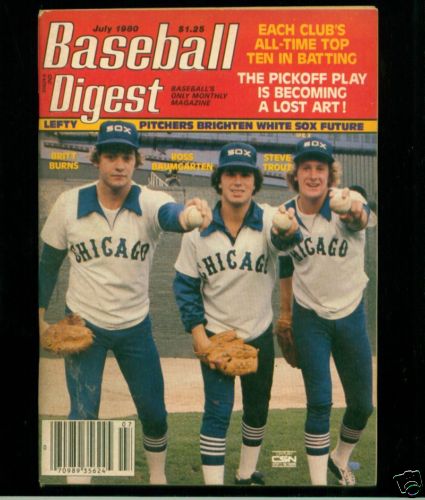
As the 1980 season began, the 24 year old Ross Baumgarten was slated to be the #4 starting pitcher in the Chicago White Sox rotation. He was coming off 13 wins in his first full season in 1979 and he was one of many young arms in the White Sox system. He was featured on the cover of Baseball Digest and pitched a one-hitter against the defending division champion Angels in July. However, 1980 was not kind to Baumgarten as he won only two games due mainly to poor run support and missed a month due to a muscle stain in his back.

Baumgarten's road to the major leagues was a unique one. An heir to a family fortune in furniture stores, a store branch manager was a former minor leaguer with ties to White Sox GM Roland Hemond. Baumgarten was doing well at a junior college in Florida but was not seriously considered a prospect. More or less as a favor, Baumgarten was selected with the White Sox 20th and final draft pick in 1977. In less than a year, Ross was pitching in the major leagues.

He won his major league debut after notching 16 victories in the minor leagues in 1978. His performance earned him a spot in the White Sox starting rotation in 1979. He won his first four decisions en route to the best season of his career. He led all White Sox starters in ERA and also led the team in shutouts. Ross was poised to return in 1981 and was handed the ball in the Sox home opener, an eight inning win over the powerful Milwaukee Brewers.

Baumgarten was again slated to be the #4 starter but lost five of his first six decisions after Opening Day. He lost another month due to injury again and didn't win a game after June 1981. Even worse, he lost the confidence of his manager Tony LaRussa in the process. This led to his trade to the Pittsburgh Pirates shortly before the start of the 1982 season. He began poorly and then lost a month to fractured fingers on his pitching hand fielding a line drive off the bat of Bill Buckner. He didn't win a game, finishing 0-5 in 12 games.

He was released in Spring Training in 1983, but spent the season with the Triple-A affiliates of the A's and Tigers. When he wasn't able to make either major league roster, his five year major league career came to an end. In retirement, Baumgarten found a second career in financial management. In 2008, he was appointed first vice-president and financial adviser at Baird & Warner Holding.

Why I love this card
I was aware of who Ross Baumgarten was well before I acquired this particular card. You just don't forget a name like Ross Baumgarten. From time to time, my Dad and I would pick up a game in the car from out of town. Usually KDKA (Pittsburgh) or KMOX (St. Louis) it was a treat to get a National League game. I don't recall the specifics or even the game, but we were able to pick up a White Sox game and the pitcher was Baumgarten. In the pre-cable days it was special to be able to see or hear a game outside of the local market. I still make the connection to Baumgarten and my Dad's 1978 Buick Riviera.

Something else.....
Back to back, John Castino and Baumgarten. Initially seen as potential stars as the 1980 season opened, both had short careers and then made a name for themselves in the world of finance. Probably made way more money in these jobs than as a ballplayer. Amazing that you can be best remembered for five years of your life and little mention of what happened before and after.

Monday, August 10, 2009

#112 Tony LaRussa Chicago White Sox Team Card


What is this card?
Team Card, Chicago White Sox, Tony LaRussa Manager

In the midst of the 1979 season, manager Don Kessinger abruptly resigned and was replaced by the young manager of the Iowa Oaks, Tony LaRussa. Under LaRussa, the Sox finished the final 54 games with a .500 record. In 1980, LaRussa's first full season, the White Sox again finished in fifth place in the AL West with a 70-90 record, 26 games behind the division champion Royals.

Not much was expected of the 1980 Chicago White Sox and the didn't fail to disappoint. The made no significant trades or free agent signings during the winter of 1979-80, primarily because owner Bill Veeck did not believe in signing free agents to multimillion dollar contracts. It was becoming increasingly clear that Veeck was looking to sell the club.

The bright side of the South Side was the plethora of young pitching the White Sox possessed, especially lefthanders. The Sox used six pitchers at different times during the season in their rotation, four of the lefthanders and all 28 years or younger. They were led by 21-year old Britt Burns who won 15 games and was third in the league in ERA. The bullpen was led by All-Star Ed Farmer who also finished third with 30 saves and Sox as a team finished third in team saves.

Things were not as promising for the White Sox at the plate. Claudell Washington was traded in June and there were holes at third and catcher. Rookie Harold Baines showed promised in his first season, but Chicago finished last in the league in runs per game. Chet Lemon led the team in average (.292), Jim Morrison in hits, doubles and home runs and Lamar Johnson in RBI.

A highlight of the 1980 season came during the final series when the team activated coach Minnie Minoso. He was activated so that he would become the second player in history (Nick Altrock) to appear in five decades.

Why I love this card
Where was this team photo taken? At the ocean? It certainly doesn't look like a ballpark. LaRussa's mutton chops are pretty sweet too. Have to feel a little bit bad for the batboy on the lower left. Couldn't anyone have given him a hat to wear? Anything to offset those collars.

Something else....
A highlight, if you want to call it that, came in June. With the White Sox hosting the Tigers, Sox pitcher Ed Farmer faced the newly-acquired Al Cowens in the 11th inning of a 3-3 game. Cowens led off the inning by grounding to short. He attacked Farmer, in retaliation for Farmer breaking his jaw with a pitch the previous year when Cowens was with the Royals. Problem was, none of Cowens new Tiger teammates knew what the hell was going on. Farmer eventually filed assault charges and Cowens had to miss a series in Chicago later in the year for fear of being arrested. The charges were dropped and there was a public handshake between the two. When it happened, I remember my Dad saying "Great. We traded for a lunatic."

Monday, August 3, 2009

#107 Francisco Barrios


Who is this player?
Francisco Barrios, starting pitcher, Chicago White Sox
As part of the White Sox rotation, Barrios was leading the team in victories when a shoulder injury ended his season in July of 1979. It was later determined that he suffered a rotator cuff injury and had surgery to repair the damage when the season was over. He was brought along slowly in 1980, not making his first start until May 13th, but the injury persisted. He made only three appearances the entire year, going 1-1 with a 4.96 ERA.

The Mexican League Rookie of the Year in 1973, Barrios signed originally as a free agent with the San Francisco Giants that summer. In less than a year, he was traded to the Chicago White Sox and made his major league debut. He spent the entire 1975 season in the minor leagues and earned a spot on the pitching staff in 1976 as a swingman. He won five games, completed six and had three saves. The highlight of his season undoubtedly came on July 28th when he combined with Blue Moon Odom on a no-hitter.

The 1977 season was a memorable one in White Sox history as the "South Side Hitmen" thrilled fans with a divisional title run before fading in late summer. Barrios was the young ace of the staff, winning 14 games while leading the team in innings pitched, games started, and complete games. At 24 years old, Barrios' future seemed bright. As the White Sox were depleted by free agency, Barrios was a dependable starter but not as successful in 1978. Although he finished 9-15, he still led Sox starters in ERA, complete games and shutouts.

Barrios was never able to recover from his torn rotator cuff. It was a different era and the surgery was primitive by today's standards. He attempted yet another comeback in 1981, beginning the season in the White Sox rotation before the shoulder began to act up again. From there, Barrios' season and life began to spiral out of control. First, he was arrested after a brawl with teammate Steve Trout. He was arrested a second time after a fight in a bar and in August, had a warrant issued for his arrest when he failed to appear in court on a cocaine charge.

Before the season ended, the controversy proved too much for the White Sox who released him. He entered a rehab facility for drug and alcohol rehabilitation and the Brewers were interested in him in 1982. He was invited to Spring Training but he never responded to the Brewers invitation. Less than a month later, he suffered a fatal heart attack from an accidental drug overdose. He was only 28 years old.

Why I love this card
Barrios is pictured without his hat. This is only the third card to have a player without his hat. Topps had come a long way from the sets of the late 1960s and early 1970s when nearly half of the cards had players without hats.

Something else....
Out of the first 98 cards, there was only one player who is deceased. In the last nine cards, there are three deceased players, two in Mexico.

Wednesday, July 15, 2009

#83 Steve Trout


Who is this player?
Steve Trout, starting pitcher, Chicago White Sox
"Rainbow" had earned his way into the White Sox starting rotation in 1979 going 10-5 since as a starter since July 1. He was part of an influx of young starting pitchers that the Sox were hoping would carry them into the 1980s. He struggled a bit in 1980 and finished with a losing record (9-16) but he lowered his ERA from the previous season. A highlight came in June when he and Rudy May of the Yankees both flirted with no-hitters in the same game. When the season ended, there were still high hopes on the South Side for the young lefthander.

The son of former Detroit Tiger Paul "Dizzy" Trout, Steve carried on the family tradition. Dizzy would pass away from cancer in 1972, four years before the White Sox selected Steve in the first round of the amateur draft. He would be in the major leagues for a brief look a little more than two years later at the end of the 1978 season.

He rebounded in the strike-shortened 1981 season and had an ERA under 3.00 until his final two starts of the year. However, he was inconsistent the following season, at one point even demoted to the bullpen. The Sox had grown impatient with his inconsistency, and he and Warren Brusstar were traded to the Cubs for a package of players that included veteran Dick Tidrow. It was as a Cub that Trout enjoyed the greatest success of his career.

In the Cubs' magical season of 1984, Trout led the team in innings pitched and games started. He was the Cubs #2 starting pitcher behind Cy Young winner Rick Sutcliffe as Chicago appeared in the postseason for the first time in 39 years. He was the starter and winner in Game 2 of the NCLS against the Padres, dominating them in a 4-2 win. He appeared in the decisive Game 5, but by the time he did it was too late as the Cubs lost the series. He started quickly in 1985, but was felled by an injury. Inconsistency marked the 1986 season and in 1987 he was traded to the New York Yankees.

Trout's stock could not have been higher prior to the trade as he had just pitched two consecutive complete game shutouts. However, he did not fare well in New York who had acquired him for the stretch drive and he failed to win a game. It was around this time that Trout seemingly lost the ability to consistently throw strikes. It was an issue that would eventually lead to the end of his career. Trout was traded again, to the Seattle Mariners where he spent the final two seasons of his 12 year career.

Why I love this card
Fourth of July weekend, 1980. Family get-together/BBQ at my grandparents house. My cousin Ann-Marie who is about four years older than me (and was always so much cooler than all of us little kids) is looking at my cards. She gets to this Trout card and says "Oh, he is so cute!" At that very moment, my cousin stopped being cool and I still laugh every time I see a Trout card. Additionally, there is a mistake on this card as Trout's father Dizzy began his career his 1939 not 1932 as stated here.

Something else....
Trout attempting a comeback with the Pittsburgh Pirates in 1997. It didn't pan out. Today, he runs his own website, where he sells such items as a "Lesson Ball" and a behinds the scenes DVD of the 1984 Cubs.

Wednesday, July 1, 2009

#72 Fred Howard


Who was this player?
Fred Howard, relief pitcher, Chicago White Sox.
Howard's only season in the major leagues was 1979. Called up in late May, he started a few games before being sent to the bullpen. He remained with the White Sox through September and although he appeared on the Sox 40-man roster in 1980, he did not make the team out of Spring Training.

Originally a product of the University of Maine, Fred Howard was drafted by the White Sox in 1976. During this time, the Sox were accumulating a collection of young pitchers, many of whom would help lead the White Sox to a division title in 1983. However, in the late 1970s, Howard was one of many trying to earn a spot on the White Sox pitching staff. Some of his minor league competition were fellow major leaguers Ross Baumgarten, Steve Trout, Dave Frost, Britt Burns, Rich Dotson and LaMarr Hoyt.

This influx of talent did not prevent Howard from pitching well in the minors and all of these pitchers made their major league debuts about the same time. Howard's came on May 26, 1979 against the California Angels. He earned his win a couple of weeks later against the Milwaukee Brewers.

Perhaps Howard's most infamous moment game on July 12th as the starting pitcher of the first game of a doubleheader against the Detroit Tigers. These games became noteworthy as they were part of Disco Demolition Night. He also pitched in what would be Thurman Munson's final game before a tragic plane crash a few days later. He finished his only major league season 1-5 in 28 appearances with a respectable 3.57 ERA.

Howard pitched in the minors for a few more years in the early 1980s before giving up baseball for good. After his playing days, Howard went to medical school, graduating from University of Missouri, Columbia School of Medicine in 1996. He is currently a surgeon at the Gessler Clinic in Winter Haven, Florida.

Why I love this card
Howard is a little like the Moonlight Graham of the 1980 set. The fact that he reached the top of not one, but two professions is really cool. Maybe not as cool as the lapel collars the White Sox were sporting at this time, but cool nonetheless.

Something else....
The Disco Demolition link earlier in this post likely contains one of the only recordings of Howard in action. It comes at about the 2:35 mark with a young Greg Gumbel commentating. This card is also our second straight DP card.

Friday, May 15, 2009

#36 Rusty Torres


Who was this player?
Rusty Torres, reserve outfielder, Chicago White Sox
Rosando “Rusty” Torres was a defensive specialist in the outfield . He was released by the White Sox as spring training was coming to an end in 1980, and he signed on with the eventual AL Champion Kansas City Royals. He did not finish the season in Kansas City as he was released shortly before September callups.

Because of his defensive mastery, Torres was able to find a space in the outfield for three different teams, the Yankees, Indians and Angels. As a regular player, however, his batting average never rose above .211. However, Torres is most remembered for being in uniform at three of the most infamous games of the 1970s.

The first was the final game of the Washington Senators:
On September 30, 1971, the Washington Senators were leading 7-5 with two outs in the top of the ninth and Torres was in the on-deck circle. In a 2007 interview, Torres gave his view of the situation: "Bobby Murcer hits a ground ball. He gets thrown at first. They thought it was three outs. It was only two outs. And they rushed us! They rushed the field. They took dirt. People were taking dirt, taking the bases. They were tearing up the seats. It was unbelievable. That was a real scary experience. Thankfully, none of us got hurt."

The second was 10-cent Beer Night:
Torres did not start the 1974 game, but was inserted as a pinch hitter. With the game tied the game at 5-5, and Torres (now with the Indians) on second base, the inebriated crowd took over. After Texas outfielder Jeff Burroughs violently reacted to a fan stealing his glove, hundreds of fans poured into the outfield, many of them throwing whatever they could lay their hands on, even several chairs. As a result, the head umpire forfeited the contest to the Rangers—the same franchise, of course, as the old Senators.

The third was Disco Demolition Night:
This time, at least, Rusty wasn't on the field when the madness started. The first game had ended and Torres who had started in right field, singled and scored the Sox' only run in the 4-1 loss, was in the dressing room when disc jockey Steve Dahl "blew up" a box of disco records. Thousands of fans overran the field, which was eventually cleared by police in riot gear. Tigers’ manager Sparky Anderson refused to field his team citing safety concerns, which resulted in the forfeiture by the White Sox to the Tigers.

Why I love this card
Torres signs his complete name on this card. I am glad that he did, because nowhere else Topps acknowledges his given name, Also the appearance Torres as a White Sox here means that every MLB team has now been represented by at least one player.

Something else....
This is Torres final card as an active major leaguer.