Showing posts with label Philadelphia Phillies. Show all posts

Sunday, July 17, 2016

#380 Garry Maddox


Who is this player?
Garry Maddox, centerfielder, Philadelphia Phillies

The 1980 season was one of redemption for the Phillies' Garry Maddox. After failing for three consecutive years in the postseason, Maddox was at times a symbol of that frustration. When the year began, there were some question marks that surrounded the Phillies. While not as solid offensively as years past, Maddox was very reliable in center field and at the plate, especially down the stretch in September. Garry earned his sixth Gold Glove award in 1980 as Philadelphia advanced to the World Series for the first time in 30 years, winning their first World Championship. Maddox was instrumental in leading them there, primarily in the NLCS where he was lifted on the shoulders of his teammates. 


Garry Maddox did not take the traditional route to baseball stardom, instead he first served his country in US Army in Vietnam after what he termed his "disallusionment" with organized baseball. He returned home after his father suffered three heart attacks and his family (eight siblings) needed assistance. He was allowed out on the condition that he have a job. It was then that Maddox turned back to baseball.

The Giants, though, held Maddox's rights after his time in the service, and he was given a look. In 1971, he became the only player in California League history to go 6 for 6 in a game twice. That got the attention of the parent club and he was in the Bay Area within a year's time. Named to the 1972 Topps All Rookie team, Maddox was doing very well for a 22-year old that was saddled with the pressure and responsibility of being Willie Mays' replacement in center field for the Giants.

The following year, he was the third best hitter in the league, with a .319 batting average. Within 18 months, however, the Giants had dismantled much of their young core of talent, shipping away several future All Stars such as Dave Kingman and Gary Mathews. Maddox was traded to the Phillies in May of 1975, where his career and reputation began to blossom.  

He would be known in Philly as the "Secretary of Defense," and that he was responsible for the third of the earth that wasn't covered by water. Garry would quickly become a fan favorite, earning raves for his defensive prowess and explosive bat. He would win eight Gold Gloves in a Phillie uniform and helped lead them to the postseason six times in an eight year period (1976-1983). He was a regular on "This Week in Baseball" for his defensive gems, well before the instant highlight era of today.

He would have highs and lows throughout, as evidenced in 1980, but he is also known for this; in the 1978 NLCS:

And this, his home-run in Game 1 of the 1983 World Series that was the Phils only win of the Series:


And this, his home-run in Game 1 of the 1983 World Series that was the Phils only win of the Series. 

Garry walked away from the game in April 1986, spending 15 seasons in the major leagues, but he had spent several years preparing for the next stage in his life. He has been involved in numerous charitable and civic causes in the City of Brotherly Love, served on the board of the Federal Reserve bank of Philadelphia and is the CEO of A. Promerantz & Company, a multi-million dollar furniture company.

Why I love this card
I knew nothing of the famous Oscar Gamble card or afro in the summer of 1980. Maddox's card was the next best thing for me. I found his facial hair, afro and huge smile positively compelling. Even now, this card still makes me smile. What I never knew was that exposure to chemicals in Vietnam left his skin highly sensitive, and he has always worn a full beard to protect his face. In fact, the Phillies had to waive their clean-shaven rule to accommodate Maddox. 

Something else...
I know that this was posted before, but it is too good not be posted again. Here's Maddox as part of a singing quintet with Larry Bowa, Mike Schmidt, Greg Luzinski and Dave Cash.

Saturday, April 28, 2012

#344 Randy Lerch


Who is this player?
Randy Lerch, starting pitcher, Philadelphia Phillies
Coming into the 1980 season, the Phillies were looking to Randy Lerch to fill in the back end of their starting rotation. The 25-year old lefthander was roughed up in his first start of the season against the St. Louis Cardinals and he was never able to find a groove as the Phillies made a run towards their first world championship. He won only four of 22 starts in 1980 and by August he was removed from the starting rotation. Now in the bullpen, Lerch was still inconsistent and the Phillies picked up Sparky Lyle to fortify the bullpen down the stretch. As a result, Lerch was left off the postseason roster in favor of Kevin Saucier. Despite being part of a team that would be champions, by the end of 1980, Lerch was subject to trade rumors and prescription allegations.

At one time, Randy Lerch was thought to be a pitcher in the mold to teammate Steve Carlton. Philadelphia selected the California native in the 1973 amatuer draft and he won 16 games two years later at Double-A Reading. After notching another 13 wins and leading Triple-A in strikeouts, Randy made his major league debut at the end of the 1976 season. As the 1977 campaign got underway, Lerch won a spot in the Phillies starting rotation and was part of two National League East championship teams (1977 & 1978).

Perhaps Lerch's most memorable moment came on September 30, 1978 (depicted on his 1980 card). In a wild game during a wild pennant chase, Lerch was the starter for the Phillies and clubbed two home runs in a 10-8 win over the Pittsburgh Pirates. The clincher came on the second to last day of the season in a nail biting finish that has been overshadowed by the Red Sox-Yankees drama the same season.

After the 1980 World Series, Lerch and several of his teammates were subpoenaed to testify at a hearing against a doctor charged with illegally prescribing drugs. Lerch admitted that he had twice received amphetamine tablets, while many of his teammates denied such activity. Perhaps coincidentally, Lerch was traded to the Milwaukee Brewers shortly before Spring Training.

In Milwaukee, Randy benefited from a change of scenery and helped the Brewers win the AL East partial pennant in 1981. Unfortunately, Lerch missed out on a return to the postseason (and World Series) when he was sold to the Montreal Expos in August 1982. Randy became almost exclusively a reliever in the latter part of this career with the Expos and San Francisco Giants. He spent two seasons in the minor leagues earning his way back and returned to the Phillies for four appearances in 1986. He was released after posting a 7.88 ERA and his 11 year major league career came to a close.

In 2000, Randy Lerch was inducted into the Reading Baseball Hall of Fame. Today, Randy and his family reside in New Jersey.

Why I love this card
Again, gotta go with the cartoon on the back. Something about making a bat into Swiss cheese with a fastball is very cool. That and the fact that the Spring Training photos always made it look like Topps took these pictures at my little league field.

Something else.....
In July 1979, Lerch was injured in a scuffle with three youths when a group harrassed his wife. He broke a bone in his right (non-pitching) hand. It would probably explain why he had a 7.00 ERA during the month of July.


Friday, August 6, 2010

#317 Mike Anderson


Who is this player?
Mike Anderson, reserve outfielder, Philadelphia Phillies
Shortly before the 1980 season was to begin, Mike Anderson of the Philadelphia Phillies was sent to the minor leagues. This was not a unique occurrence for Anderson, who had been shuttled between the majors and Triple-A for most of his career. This time, however, Anderson did not return to the parent club. Despite hitting .327 in 84 games at Triple-A Oklahoma City, the Phillies did not recall Anderson for the stretch drive late in the season. He would not see major league action again, concluding his nine-year major league career.

Mike Anderson was from an athletic family that was the pride of Timmonsville, South Carolina. His sister was an All-American basketball player and his older brother played baseball in the minor leagues. Mike was a high school football star and signed a letter of intent to play tight end for the University of South Carolina. When the Philadelphia Phillies selected him in the first round of the 1969 draft, he chose a different athletic path.

The righthanded hitting Anderson was a slugging star in the minor leagues and tied a Pacific Coast League record in 1971 by homering in six consecutive games. He was a fearsome batter that combined average with power and his 1971 season numbers were eye popping (.334 36 100, .658 111 runs) and was seen as one of the best prospects in the Phillies organization. In this era, his minor league teammates included Mike Schmidt, Oscar Gamble, Bob Boone and Greg Luzinski and Anderson out shined them all. He was given his first major league look in 1971 and by 1973 was handed the reigns as the team's regular right fielder.

However, for three straight years, his average never rose above .260 and he never reached double-digit figures in home runs. Out of patience, the Phillies traded Anderson to the St. Louis Cardinals for pitcher Ron Reed. Anderson performed well in St. Louis, but was essentially a reserve player. After a poor showing in 1977 he was sold to the Baltimore Orioles and wasn't used often. The Phillies welcomed him back into the fold for the 1979 season and he appeared in 79 games batting .231. The Philies released him in October 1980 shortly after winning the World Series.

Mike was signed by the Pittsburgh Pirates played one more season in the minor leagues (1981) before ending his baseball career. He returned to South Carolina and coached both high school baseball and basketball. His younger brother Kent, followed him to the big leagues, appearing in 135 games over two seasons with the 1989-90 California Angels. Any current information on what Mike is up to these days would be most appreciated.

Why I love this card
I remember debating the cartoon on the back. Was Anderson supposed to be the cartoon fielder in the foreground or the background. It would seem that he would be in the back since it would make the most sense considering the runner. Then again, most of Topps cartoons back in those days usually tried to show the featured player up front. I've said it before, but the things kids argue about sitting on the curb during the lazy days of August, 1980.

Something else....
Much is made of Anderson's 1969 season at Pulaski. His manager that season in Rookie Ball? None other than Dallas Green, the man who would be at the helm in 1980 and the same man that sent Anderson down in the Spring. I always felt sorry for guys like Anderson that play most of their career with a team and then the year they don't, the win the World Series. It was a shame that he couldn't have at least gotten an at bat or something.

On this day in 1980:
Remember the K-Car?


Regardless of your thoughts, these were a staple of the 1980s. On this day, Chrysler chairman Lee Iacocca drove the first one off the assembly line.


The legacy of these cars is that the helped Chrysler rebound from a disastrous era in the late 1970s to a prosperous time in 1980s. What's that line about those not learning from history?

Saturday, June 5, 2010

#296 Dave Rader


Who is this player?
Dave Rader, reserve catcher, Philadelphia Phillies
Shortly before the 1980 season got underway, the Phillies traded Dave Rader to the Boston Red Sox. The Red Sox were in a pinch due to an elbow injury to incumbent Carlton Fisk and were looking to add depth. The veteran Rader earned the starting nod on Opening Day. He had a 4-hit performance against Kansas City in early May and his batting average didn't dip below .300 for the remainder of the season. In spot-starting duty, Rader finished 1980 batting .328 with 3 HR and 17 RBI.

An excellent high school athlete, Rader starred on the gridiron as an linebacker and fullback, but it was on the diamond where he truly shined. Switched to catcher in his junior year after receiving accolades at third base, Rader was twice an All-League performer. This earned him attention from major league scouts and the San Francisco Giants made him their first selection in the 1967 draft. Rader was an excellent defensive receiver and when he batted .314 at Triple-A Phoenix in 1971, he earned a chance with the major league club.

Manager Charlie Fox and the Giants were in the midst of a youth movement in San Francisco and the 23-year old Rader won the job from longtime veteran Dick Dietz. His performance in 1972 earned him The Sporting News' Rookie of the Year Award for 1972. Playing in 133 games, Rader batted .259 and also achieved career highs in hits and RBI. He followed that with another solid season in 1973, while cementing his reputation as a fine fielder when he recorded an unassisted double play, rare for a catcher. Not that it means anything, but the game was also played on Friday the 13th.

Even though he batted a career high .291 in 1974 and again in 1975, new manager Wes Westrum platooned the lefthanded hitting Rader with Marc Hill. Even though Rader saw the majority of the action, he would never appear in more than 100 games in a season again. After six years in San Francisco, he was traded; as part of a multi-player deal to the St. Louis Cardinals.

From there, Rader would spend the final four seasons of his ten-year career with four different teams. At each stop, Rader served as the backup catcher, with St. Louis, the Chicago Cubs, Philadelphia Philles and finally Boston Red Sox. The Red Sox did not offer him a contract for 1981 and he signed on with the California Angels. He made the Angels roster out of Spring Training that year, but never appeared in a game for California and was released in late-April. He never again played in a major league game.

Why I love this card
One of the things I used to do was line up my cards while I watched a particular game on TV. I was doing this during the World Series that fall and had out all my Phillies and Royals. By October, I had a majority of the cards and certainly all the key players. I distinctly recall the pregame introductions with everybody being introduced from both teams. I was disappointed that there was no Rader. My Dad didn't know what happened to him either. Somehow, his entire 1980 season in Boston managed to escape both of our attention.

Something else....
Rader has one of the more interesting rookie cards in history. Here it is:

I didn't get this card until several years later as 1973s were as far away as the moon to a nine-year old in 1980. If Rader's name didn't appear on this card, I would swear that it was a Dave Concepcion card.

On this date in 1980:
George Bush throws in the towel and ends his two-year run for the presidency and instead, throws his support to Ronald Reagan, the man who defeated him. Said Bush:
My overwhelming instinct was to stay and fight, but you’ve got to be realistic. There is a widespread perception that the campaign is over. As a result, it has become increasingly difficult to raise the funds needed.

Thursday, May 6, 2010

#270 Mike Schmidt


Who is this player?
Mike Schmidt, third baseman, Philadelphia Phillies
Hall of Fame, 1995
Quite simply, Mike Schmidt owned the 1980 season. The two are synonymous. In leading the Philadelphia Phillies to their first World Championship, Schmidt clubbed a career high 48 home runs, the most ever for a third baseman. He authored the season's most crucial home run when his 11th-inning blast essentially clinched the division on the second-to-last day of the year. Schmidt followed that with an MVP performance in the World Series, batting .381 with two home runs and seven RBI. He was the unanimous selection for league MVP, the leader in several categories. He was also named a Gold Glove winner. At the moment this card fell into the hands of this nine-year old, there weren't many players better.

Mike Schmidt's Hall of Fame biography describes him as "(a)n unprecedented combination of power and defense." Never has one sentence been so accurate yet so understated. Today, it is a given that a third baseman will provide both power and stellar defense. Schmidt's performance throughout the his 18-year career went a long way into cementing that perception. He was one of the most prolific sluggers of his era, leading all players in home runs during the 1980s.

The Dayton, Ohio native played in the College World Series in 1970 and was selected by the Phillies in 1971. He made his major league debut late in the 1972 season but success did not come easily for Schmidt. He struggled throughout the 1973, batting .196 and striking out 136 times. Mike had a breakout season the following year and led the NL in home runs the first of eight times. His rise coincided with the Phillies dominance in the National League East as Philadelphia won the division three years in a row (1976-1978). During that era, Schmidt hit four home runs in a game at Chicago but was often a target of the harsh Philadelphia fans.

During the 1980s, Schmidt led the Phillies to the World Series twice and won three MVP awards. In 1983, in celebration of the team's 100th anniversary, Schmidt was voted by fans the greatest player in the history of the franchise. He was moved to first base for most of the 1985 season but returned to third in 1986 and won his final MVP award. A torn rotator cuff caused him to miss most of the 1988 season and when he was unable to return, he announced his retirement in May of 1989. In tribute, fan still voted him to start the All-Star game that July.

Schmidt helped broadcast the 1989 NLCS for NBC and he also broadcast for the Phillies. When he was inducted into the Hall of Fame in 1995, he garnered the 4th highest percentage of the vote (96.52%). He was also honored by the team by having his number retired and a statue erected in his honor at Citizen's Bank Park. Lately, he has been very vocal in support of Pete Rose's Hall of Fame candidacy and is involved in several charitable endeavors. He served as third base coach for Team USA in the 2009 World Baseball Classic and even managed in the Phillies minor league system.

Why I love this card
It's Mike Schmidt. It was 1980. If you didn't freak out when you got this card you either didn't like baseball or didn't have a pulse. Or maybe a girl (sorry, that was during my 'you have cooties' phase).

Something else....
I can't find it on the web, but if you can somehow find the Christmas episode of "Always Sunny in Philadelphia" who will know why it is mentioned in a Schmidt post. Hilarious. On June 10, 1974, Schmidt hit a pitch into a public address speaker suspended 117 feet above and 329 feet away from home plate in the Astrodome. The ball then fell to the field, where, by the Astrodome's ground rules, it remained in play. Since he had already started his slow home run trot, he was held to a single - the only 500 foot single in history.

Below here is also Schmidt's 1980 Super Card:


On this date in 1980:
Schmidt was 2 for 5 with 4 RBI as the Phillies defeated the Atlanta Braves 10 to 5 at Veterans Stadium. Schmidt had a double and his first triple of the season.

Monday, December 7, 2009

#210 Steve Carlton


Who is this player?
Steve Carlton, starting pitcher, Philadelphia Phillies
Hall of Fame, Class of 1994
As one of the premier pitchers in baseball, Steve Carlton turned in one of the finest performances of his career in 1980. Not only was he named National League Cy Young winner for the third time in his career, but he helped lead the Phillies to their first World Championship. "Lefty" was clutch in the postseason for Philadelphia, going 3-0, including two wins in the World Series. Carlton led the league in victories, strikeouts and games started and his 304 innings pitched marked the last time any pitcher has topped the 300+ mark in a single season.

Trailing only Warren Spahn, Steven Norman Carlton would eventually become the second-winningest lefthanded pitcher of all-time. He had his beginnings with the St. Louis Cardinals and worked his way into the starting rotation of the great Cardinal teams of the late 1960s. Twice an All-Star with the Cardinals, he appeared in both the 1967 and 1968 World Series. He finished second in the NL in ERA in 1969, and when he won 20 games for the first time in 1971, he asked for a pay raise and held out. Rather than capitulate, the Cardinals traded him to the Philadelphia Phillies.

In that first year in Philadelphia, he had possibly one of the greatest pitching seasons ever. Not only did he win the pitching version of the triple crown (Wins, ERA, Strikeouts), his 27 wins marked 46% of his team's victories is a record in modern major league history. His success was attributed to his mastery of the slider and training regimen that was ahead of its time. He employed martial arts, running and strength conditioning in his regimen but is perhaps best known for working his hand to the bottom of a large canister of rice.

Carlton also became noted for his silence with the media. Upset at some of the things attributed to him, he stopped speaking to the media in 1977 and continued his stance until his release from the Phillies in 1986. During that time, he won three Cy Young Awards, leading the league in victories and strikeouts three times each. He was selected to the All-Star team five more times (10 times total) and started the 1979 game. He won his 300th game in 1983 against the old team the Cardinals and for a time, traded the all-time lead in strikeouts with Nolan Ryan.

Lefty signed with the Giants in 1986 and bounced around to the White Sox, Indians and Twins during the last few years of his 24-year career. In 1987, he and Phil Niekro became the first teammates and 300-game winners to appear in the same game. Steve was selected to the Hall of Fame on the first ballot in 1994 with 95.8% of the vote. He created a brief controversy with some of his comments regarding the Elders of Zion, but he has enjoyed a quiet retirement as a regular at Hall of Famer ceremonies each year. He maintains his own website and continues to make personal appearances.

Why I love this card
During the summer of 1979, my Dad sat me down to watch the All Star Game for the first time. I was instructed to watch the two starting pitchers: Nolan Ryan for the AL, Steve Carlton for the NL. These two immediately captured my attention and imagination. When I got this card during the summer of 1980 (complete with the All Star designation) I knew Lefty was something special. He became a cornerstone of my baseball card collection and it was special to be in attendance at his induction in 1994.

Something else....
When Carlton signed with the San Francisco Giants, much was made of the fact that Lefty was finally going to speak to the media. Dad told me that I should tape it since it was so rare (he never told me to tape something). I still have that somewhere, along with Carlton's appearance on Married...With Children.

Lastly, below is Carlton's 1980 Burger King Card. It is very similar to the regular Carlton issue except that it is moved slightly up and to the left. I actually think that this card is framed better than the regular Carlton.


Wednesday, October 28, 2009

#178 Tim McCarver


Who is this player?
Tim McCarver, reserve catcher, Philadelphia Phillies
As the 1980 season began, Tim McCarver had already announced his retirement from baseball and had moved to the Phillies broadcast booth. Although he announced his retirement in October 1979, Topps interestingly made a regular issue card of him for this set (but no Lou Brock?) In September, the Phillies activated McCarver primarily so that he could become the 11th player in major league history to play in four decades. The lefthanded batting McCarver appeared in six games and had a two-run double in the final game of his 21-year career.

It is ironic and fairly fitting that Tim McCarver is the subject of today's post. As I type this, Game 1 of the 2009 World Series is being played and McCarver is covering his 20th Series, the most by any broadcaster. He is equally respected and reviled by fans and critics alike and have become one of the dominant voices of the game during this generation. He has covered the game on four networks and has been present at nearly every historic postseason event of the last 25 years.

When I first got this card, however, McCarver was just an old guy at the end of his career. There was no real inkling of what was to come later, just what he had accomplished. He broke in as a 17-year old in 1959, appearing in eight games for the 1959 St. Louis Cardinals. He eventually assumed the starting position behind the plate in 1963 and he was a key member of the the two-time World Champion Cardinals of the mid-1960s. A very complete biography of McCarver can be found here.

McCarver's playing days have been overshadowed by his broadcasting career. An offensive threat in an era where that was uncommon for a catcher, McCarver was a two-time All-Star that was the MVP runner up in 1967. He led the league in triples in 1966 and batted .275 during his first 11 years as Cardinal. When the 1970 season ended, McCarver was part of the Curt Flood-Dick Allen trade and went to the Philadelphia Phillies. McCarver bounced around during the early 1970s, playing for four teams in six seasons (Phillies, Cardinals again, Expos and Red Sox).

He returned to the Phillies in 1976 and served primarily as Steve Carlton's personal catcher. McCarver signed a unique contract after the 1976 season. He was offered a job as broadcaster for the Toronto Blue Jays, but the Phillies countered with an offer to stay on as a player then have two years as a broadcaster after the 1977 season, he played until 1979 when he became the Phillies broadcaster. In addition to his national duties, McCarver has served as analyst for the Mets (1983-98), the Yankees (1999-2001) and San Francisco Giants in 2002. Away from baseball, he hosted the 1992 Winter Olympics and hosts the syndicated "Tim McCarver Show."

Why I love this card
At the time, I was only familiar with McCarver simply because he made the last out of the 1968 World Series. In Detroit, the highlight film of that Series was shown often during rain delays or at other points during the season both on TV and at Tiger Stadium. I didn't have an appreciation for him as a All-Star caliber player, simply a guy who played with Lou Brock and Bob Gibson.

Something else....
Where to begin with McCarver....

Is it the "Grand Slam Single" in 1976 when he passed a teammate on the base paths....

Or Deion Sanders dunking him after the 1992 NLCS when McCarver criticized "Prime Time" for simultaneously playing for the Braves and Falcons.....

Or the recent post by our friends at Dinged Corners. Perfect for Halloween. Listen to how scary this is here......

I'll go with this little selection on Youtube. Ten seconds of pure goodness.

Sunday, October 11, 2009

#161 Larry Christenson


Who is this player?
Larry Christenson, starting pitcher, Philadelphia Phillies
Hoping to rebound from injuries in 1980, Larry Christenson was a young veteran on the Philadelphia pitching staff. Only 26 years old, he was already entering his eighth campaign and the Phillies were hoping Larry could return to form. He began the season 3-0, but his ERA was over six runs a game and it was found that there was a spur in his elbow that required surgery. He returned to the team in mid-August, in time to help the Phillies win the NL East title. Larry started Game 3 of the NLCS and engaged in a pitching duel with Joe Niekro but did not factor in the decision. When Philadelphia advanced to the World Series, Christenson started and lost Game 4 but the Phillies went on to become World Champions.

As a teenage fireballer out of Marysville, Washington, the righthanded Christenson made his debut in 1973, a complete game victory over the eventual NL Champion New York Mets. He would bounce back and forth from the majors to the minor leagues until 1975, when the Phillies called him up to stay. Christenson would become one of the primary reasons Philadelphia dominated the NL East, winning three straight divisional titles 1976-1978.

Christenson won 45 games during that period, with a high water mark coming in 1978 when he was 19-6. He also demonstrated excellent control as he led the league in walks per nine innings in 1978 as well. However, Christenson did not come up big in the post-season as the Los Angeles Dodgers roughed him up in both starts he made in the NLCS in 1977 and 1978.

Then, injuries would begin to plague Christenson's career. He began the 1979 season on the disabled list when he broke his collarbone during a charity bicycle ride and missed the first month. Then, in June he developed elbow problems and missed several weeks. He ended up with a 5-10 record in 1979. In 1981, Christenson was only 4-7 record and made only 15 starts. However, he had his only postseason win against the Expos in the NLDS. His last uninterrupted season was 1982, when he made 32 starts and went 9-10, but he still suffered back spasms.

Christenson's eleventh and final season was 1983 when elbow problems recurred and he was released on his birthday. Larry spent two years rehabbing his arm hoping to return to the major leagues but it was not to be. He entered the world of institutional investing and currently is president of Christenson Investment Partners. He is a fixture at Phillies reunions and special events and is involved in many charities in the greater Philadelphia area. In 2009, he offered a unique perspective on how the 2008 Phillies would have fared against their 1980 counterparts:
"They would have been scared to death of Steve Carlton," he said in jest. "Larry Bowa and Pete Rose would have been screaming into their dugout. We would have knocked their hitters on their rear ends because we were fierce and competitive."

Why I love this card
The zip-up Phillies jersey pictured here. In the era of the pullover synthetic polyester, the zipper across the front was unique. As a kid, I even ordered a Phillies road-uni from the J.C. Penny catalog because I erroneously thought it had a zipper. It's just too bad that Christenson couldn't have had his card photo taken in this:


Something else....
Christenson had unusual pop in his bat for a pitcher. He hit 11 career home runs, which is the most ever by a Phillies pitcher. He two homers in a 1976 game against the Mets and hit a grand slam against the Cubs on the day they clinched the 1977 NL East flag.

Saturday, September 5, 2009

#136 Dick Ruthven


Who is this player?
Dick Ruthven, starting pitcher, Philadelphia Phillies
As the 1980 season began, Ruthven was one of the many question marks on the Philadelphia Phillies. He raced off to a 6-0 start in 1979 before elbow trouble wiped out his season and the Phillies finished a disappointing fourth. He answered the critics in 1980. He was healthy and emerged as the #2 starter on the club behind Steve Carlton, finishing the season with a career-high 17 wins. The Phils NL East and NLCS in dramatic fashion on their way to the first world title. In the postseason, he won in relief the Game 5 NLCS clincher and went nine innings in a no-decision in Game 3 of the World Series.

The first pick of the Philadelphia Phillies in the secondary phase of the 1973 amateur draft, the righthanded Dick Ruthven made his major league debut on April 17th without making a stop in the minor leagues. He had little success as a temperamental young starter with the Phillies, finishing with a losing record his first two seasons and demoted to the minors in 1975. After the '75 season he was traded to the Chicago White Sox. He was with the organization for two days when Chicago traded him to the Atlanta Braves.

He came out of the gate quickly in 1976, winning 10 games in the first half and was named to the National League All Star team. He slumped in the second half, however, and led the league in losses. He again finished with a losing record in 1977 as he battled injuries and demanded to be traded. It was revealed that Braves' owner Ted Turner had made a "playful pass" at Ruthven's wife. The Braves accommodated him and traded him to back to the Phillies in June of 1978. He went 13-5 for the Phillies and helped the team reach the NLCS.

He was again named to the NL All Star team in 1981 when he again rode a hot first half to eight wins before the Player's Strike. However, he led the league in earned runs allowed and finished the year with a 5.15 ERA as the Phillies lost the ALDS to Montreal. When his former manager Dallas Green took over the reigns of the Chicago Cubs as their general manager, Ruthven was one many former Phillies he acquired for the Chicago.

Dick was the Cubs Opening Day starting pitcher, but 1984 began a downward slide in his effectiveness. Even though the Cubs would win the division, Ruthven would win only six games. His ERA also ballooned, rising to 5.04. Ruthven did not appear in the 1984 NLCS, which the Cubs lost in five games. He was a swingman in 1985 and appeared in only six games before the Cubs released him in May 1986. It was the end of his 14-year major league career. Today, Ruthven in enjoying retirement and his son is a soccer player at the University of South Carolina. His twin sister is married to former major leaguer Tommy Hutton.

Why I love this card
Wow, this pose is really similar to the very recent Matt Keough card. At least Keough is pictured in a major league stadium...it looks like they took this shot of Ruthven in a parking lot.

Something else....
After two years in the majors, Ruthven spent most of the 1975 season with the Phillies Triple-A affiliate, the Toledo Mud Hens. According to the Jim Bunning biography printed in 1998, Ruthven was not a Mud Hen fan. According to the book:
Ruthven felt so strongly about the name that he refused to tell anyone that he was a Mud Hen. If someone asked Ruthven what team he played for, Dick would make up a name or deny he was a baseball player. "I'll be damned if I'm going to admit I'm a Mud Hen," he would say.
What does this have to do with Bunning, you may ask? Bunning was Ruthven's manager in Toledo.

Saturday, August 15, 2009

#120 Greg Luzinski


Who is this player?
Greg Luzinski, leftfielder, Philadelphia Phillies
While 1980 was a memorable summer for the Phillies and the city of Philadelphia, Greg Luzinski was going through the worst season of his career. "The Bull" started the season decently, but fell into a slump and then missed more than a month due to a knee injry. Although he finished the season with a career low .228 batting average, he came alive in the NLCS. He had game-winning RBIs in Games 1 and 4 and the Phillies advanced to the World Series. A week later, Luzinski and the Phillies were World Champions.

One of the more prolific sluggers of the 1970s, Greg Luzinski was a first round selection of the Phillies in the 1968 draft. A product of Notre Dame High School in Niles, Illinois, he made his major league debut in a little more than 18 months when he was given a late-season look. He was called up again for the final month of the 1971 season before earning a starting position in 1972.

In his first full season, he was the best hitter on the team and in his second, he placed in the league's top ten in home runs and RBI. By all accounts, he was one of the best young sluggers in baseball. While he suffered a setback in 1974 due to injury, he was about to embark on period that would make him one of the team's most popular players.

Beginning in 1975, The Bull was selected to four consecutive All-Star Games, peaking in 1978 when he was the top vote getter in the National League. It was well deserved as during this period (1975-78) he was twice the runner-up in the MVP voting, led the league in RBI in 1975 and averaged 32 home runs a year. But he was more than just a slugger as he hit over .300 for three seasons in a row. The Phillies, meanwhile, won the NL East for three straight years but were unable to advance to the World Series.

Prior to the 1981 season, he was sold to the Chicago White Sox for an undisclosed sum. As the Sox' designated hitter, Greg remained relatively healthy and helped lead the team to the 1983 AL West title. The Chicago native hit 84 home runs in four seasons on the South Side, where he would close out his career. In 1984 he played his last season after 15 years in the majors. Today, he is still a fan favorite in Philadelphia, and he opened "Bull's Barbecue" in the Phillies' Citizens Bank Park.

Why I love this card
It seemed that many of the 1980 Phillies were shot taking their cuts in the batting cages and Bull was no exception. As a young Pirate fan, it scared me that they were so serious about winning the division, they didn't even have time to pose for cards - they had to get their hitting in.

Something else....
Like most former athletes, Luzinski did a Lite Beer commercial that you can see here. However, I didn't realize that Bull was a trend setter. Before the Super Bowl Shuffle, even before the Baseball Boogie, here was Luzinski and some of his Phillies friends in "Phillies Fever". You have been warned.

Monday, July 20, 2009

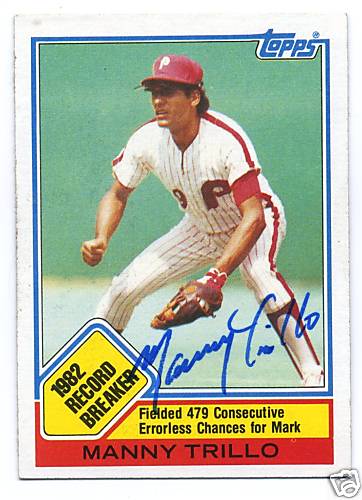
#90 Manny Trillo


Who is this player?
Manny Trillo, second baseman, Philadelphia Phillies
Acquired prior to the 1979 season, Trillo solidified a Phillies infield that was widely predicted to win the NL East. Philadelphia disappointed that year, and Trillo missed over a month with a broken wrist. Despite that, Trillo still earned the Gold Glove. In 1980, Trillo won the Silver Slugger at second base as he hit a career high .292 and helped lead the Phillies to the NL East title. In the NLCS he hit .381 in their win against Houston and was named the MVP. The Phillies rode that momentum to their first World Series championship.

Originally signed by the Phillies in 1968, he was selected by the A's a year later as a Rule V choice. In the minors, Trillo developed his reputation as a solid hitter and an outstanding glove man. His defensive prowess got had the attention of his owner, Charlie Finley. Finley badly wanted Trillo on the postseason roster and Manny unwillingly found himself in the middle of controversy in the 1973 World Series. During Game 2, A's second baseman Mike Andrews made two crucial errors and Oakland lost the game. Finley essentially fired Andrews and wanted to replace him on the roster with Trillo. The move was not allowed by the Commissioner.

At the end of the following season, Trillo was traded to the Cubs for future Hall of Famer Billy Williams. He was instilled at second base and became a reliable player and popular for the Cubs for the next four years. He placed in the Rookie of Year voting in 1975 and was the Cubs representative in the 1977 All Star Game.

Trillo won three Gold Gloves with Philadelphia and again helped lead the Phillies to the playoffs in 1981. They were unable to successfully defend their title when the lost the NLDS to the Montreal Expos. The following season, Trillo was selected to start the All Star Game for the NL and he set a major league fielding record. However, at the end of the season, the Phillies traded him to the Indians in a package for the highly-touted Von Hayes. He was again selected to start the All Star Game, this time for the AL, and was Cleveland's first All Star starter in 15 years. The Indians did not keep him long as Trillo would be a free agent at the end of the year and they shipped him to the Montreal Expos.

He signed a contract with the San Francisco Giants in 1984 and spent two years by the Bay before he was traded back to the Chicago Cubs. He spent the three seasons (1986-1988) as a utility infielder in Chicago, twice hitting over .290. Manny briefly appeared with the 1989 Cincinnati Reds where he batted only .205 in 17 games and was released, ending his 17-year career. In recent years, Trillo was served as a minor league coach in the Cubs, Phillies, New York Yankees, and Milwaukee Brewers organizations. He is currently an infield instructor in the Chicago White Sox farm system.

Why I love this card
Yes, I wanted the Astros to win the ALCS in 1980. And yes, I wanted the Royals too. However, I learned at a young age that if a team was to be successful they had to have a guy like Trillo around. His performance in the postseason this year was very impressionable to me. Not a superstar in mold of Rose or Schmidt, but no less valuable to the overall team effort. From then on, guys like Trillo (solid defensively, clutch hitter, doing little things well) had always caught my attention.

Something else....
As much as I respected Trillo, I was pissed at him for being named as the starter in the 1983 All Star Game. Lou Whitaker was among the league leaders at the break in batting and was coming into his own as a star player. I really wanted him to be the starter and stuffed the ballot box, going so far as to take several ballots from the Gillette display at Great Scot! supermarket and personally deliver them to Tiger Stadium on Kids Day. Oh well, at least Manny got to be on base when Fred Lynn delivered his historic grand slam.

Wednesday, June 3, 2009

#52 Warren Brusstar


Who was this player?
Warren Brusstar, relief pitcher, Philadelphia Phillies
At his best, Brusstar was exactly the type of pitcher that every staff needs. While the term “setup man” was not widely circulated at that time, Brusstar fit the role with the Phillies, usually serving as the bridge to closer Tug McGraw. The 1979 season saw him miss much playing time with a sore shoulder, an injury that would reoccur in 1980 even as the Phillies would go on to win a World Championship.

Drafted three different times in three different years, Brusstar signed with the Phillies in 1974 after finishing his college career at California State University. He put together solid numbers as a starting pitcher in the minor leagues before eventually being converted to a relief pitcher. He made his debut with the Phillies early in 1977 and appeared in 46 games, winning seven and saving three as Philadelphia won the National League East. The following year, he appeared in 58 games notching a 2.33 ERA as the Phillies again won their division. Unfortunately, Philadelphia lost the NLCS both years to the Los Angeles Dodgers.

He started the 1980 season on the disabled list and made his debut that season in late July. His return helped solidify the bullpen as the Phillies again won the NL East. In the playoffs against Houston, Brusstar appeared in two games, and was the winning pitcher in the crucial fourth game. The Phillies would go on to win the NLCS and later the World Series against the Kansas City Royals.

Brusstar pitched the next few seasons with periodic arm troubles and in August 1982, he was sold to the Chicago White Sox. He only appeared in 10 games for the Sox, who dealt him to the Chicago Cubs when the season was over. In Chicago, he was healthy and pitched in at least 40 games every season, culminating with the Cubs 1984 NL East Championship. He set a Cubs record for relievers when he posted 32 2/3 consecutive scoreless innings in 1983. He was hit hard during the 1985 season, posting a 6.05 ERA and he did not make the team out of Spring Training in 1986, ending his 9 year major league career.

Today, Brusstar is the pitching coach for Napa Valley College. His wife Jennifer, took care of Warren’s teammate Tug McGraw as he was dying from cancer. She is the CEO of the Tug McGraw Foundation.

Why I love this card
The pinstriped Phillies unform is on full display. The large stripe is almost in perfect symmetry from Brusstar's shoulder to his knee. Does anybody wear the stirrups and sanitary socks anymore that Brusstar is sporting here?

Something else...
The pose in this photo is nearly identical to the one used in his 1986 Topps card. Either it was the same photographer or somebody at Topps was really lazy. Oh well, it's not as bad as his rookie card with the unibrow and protruding cheek

Saturday, May 2, 2009

#27 Del Unser


Who was this player?
Del Unser, utility player, Philadelphia Phillies
Unser's 1979 season was previewed in a previous blog for his "Highlights" card. I won't recap that again here.

Born the son of a major league catcher, Delbert Bernard Unser enjoyed a 15-year career with five teams, primarily with the Phillies. Unser broke in with the Washington Senators in 1968 and won the Sporting News Rookie of the Year award that season. The following year, he led the American League in triples and was ninth in the league in hits. Unser was the Senators regular center fielder for four seasons before he was traded to the Cleveland Indians in 1972 and was the Phillies CF in 1973 and 1974.

He was part of the trade that brought Tug McGraw to Philly when he was shipped to the Mets in 1975. In New York, he reached his career best in batting (.294) but was traded again in mid-season 1976, this time to the Montreal Expos. It was in Montreal that Unser's playing time as a regular began to diminish. He went back to the Phillies as a free agent for the 1979 season.

After establishing himself as a record-setting pinch-hitter, he helped the Phillies win the World Series in 1980. In the decisive Game Five of the LCS, he went 2-for-2 after coming in as a pinch hitter and then staying in the game, and he drove in a run and scored two, including the game winner in the tenth inning. In Game Two of the World Series, he hit a pinch double off Royals relief ace Dan Quisenberry in the Phillies' eighth-inning come-from-behind rally. In Game Five, another pinch double off Quisenberry in the ninth inning tied the game; Unser moved to third on a sacrifice fly and scored the game winner on an infield single. Unser retired after the 1982 season.

Why I love this card
The previous post, I commented on Marty Pattin's hat. With this card, Unser is the first player featured to not be sporting any headwear. While Unser doesn't sport the traditional 1970s hairstyle it does have a REO Speedwagon look to it.

Something else...
Unser threw out the ceremonial
first pitch at the first game of the Washington Nationals. It was fitting since Unser began his career in Washington, and Nationals were the recently transplanted Montreal Expos (another of Unser's former teams). To complete the theme, the Nationals were hosting the Philadelphia Phillies.

Sunday, April 19, 2009

#6 1979 Highlights: Del Unser


Who was this player?
Del Unser, pinch-hitter extraordinare of the Philadelphia Phillies. 1979 was Unser's transition year from an everyday player to a subsitute and he established a pinch-hitting record mentioned on this card. It happened in three times at bat He would be a hero of the 1980 Phillies World Champion team.

Why I love this card:
As I have already professed my love for the Phillies road unis of this period (see card #4 Pete Rose), you have to love that pinch-hitters are featured prominantly in 2 of the first 6 cards of the set. Make it three if you count the McCovey card, who accomplished his highlight as a pinch hitter as well.

Something else.....
Unser is not alone in this record, although you would not get that by reading the card. Lee Lacy accomplished this same feat the year before (1978) yet did not get a card in the 1979 set.

Saturday, April 18, 2009

#4 1979 Highlights: Pete Rose


Who was this player?
Pete Rose, the all-time hits leader. The unfortunate demise of his legacy by his own hand has obscured if not outright dwarfed his achievements on the field. Take this card for example. 10 seasons of 200 or more hits? That's pretty impressive, considering he beat out Ty Cobb to do it. But don't look now - Ichiro has done it 8 times.

Why I love this card:
The Phillies toilet-water blue road unis on full display. I don't know why, but sometime during the late 1970s and early 1980s it was fashionable to trade in the road greys for this color, especially in the NL East. Chicago, St. Louis, Montreal, Philly all had them as did Kansas City, Seattle, Texas, Minnesota, Milwaukee and Toronto. That's 10 of 28 team folks, nearly half the teams.

Something else.....

Consider this too: the blue roads were considered conservative for the time with Pittsburgh, Houston, San Diego and Oakland all out there. There were a lot of color combinations out there. Consider the defending World Champion Pirates: