Monday, June 20, 2016

#369 Jim Kern


Who is this player?
Jim Kern, closer, Texas Rangers

If you opened a pack of cards during the 1980 season and got this Jim Kern, you had not yet heard the word "closer" yet associated with his position.  In an era where the role of relief specialist was still evolving, Kern had averaged 90 innings pitched a season and was making a strong case as one of the premier "firemen" of the day. Kern's heavy workload proved to be problematic in 1980.  Despite beginning the season in All-Star form, the hard throwing right hander struggled through elbow and then neck injuries. Perhaps the most bizarre occurrence came in August when Kern was hit in the mouth on a return throw from catcher Jim Sundberg. Apparently, Kern was looking into the crowd when the throw struck him in the mouth, knocking him off the mound resulting in a concussion, temporary amnesia and nine stitches in his mouth. Kern struggles were widely seen, perhaps unfairly, as a major reason for the poor performance of the Rangers in 1980.


Growing up in Gladwin, Michigan,  the natural environment of his hometown led a young Jim Kern to be as passionate about the great outdoors just as much as the National Pastime. His path to the majors began in 1967 when he was drafted by the Cleveland Indians with a brief exception in 1969 due to military duty. He would spend seven years in the minor leagues, getting a chance at the majors after going. 17-7 for a 1974 Oklahoma City team that finished 22 games under .500.  That would lead to his major league debut near the end of the 1974 season.

The Indians of the 1970s were not a good team, but by 1976, there was reason for optimism. Led by many young players, including Kern and under manager Frank Robinson, it appeared that the Indians fortunes could be changing. However, poor management in the dawn of the free agent era led to things never quite coming together in Cleveland and Kern saw his way to Texas, traded for Bobby Bonds despite two straight All Star appearances in 1977 and 1978. Kern famously summed up his time in Cleveland with an all-time zinger: 

The first thing they do in Cleveland, if you have talent, is trade you for three guys who don't.
In Arlington, there was much optimism as the season began as Kern was poised to team with Sparky Lyle in the Rangers bullpen. Indeed, Kern responded with the best season of his career. Appearing in 71 games, Jim won 13, saved an additional 29 and posted a miniscule ERA of 1.57. The 29 saves was the second-best mark in the American League and he finished fourth in the AL Cy Young voting and won the 1979 Rolaids Relief Man of the Year award. He also played an instrumental role in that year’s All Star Game, allowing an eighth inning, game-tying home run to the Mets’ Lee Mazzilli in what was the first pinch-hit home run in All Star history. The NL would win the game 7-6 with Kern taking the loss.


After an injury-plagued 1980, Kern worked out three hours a day six days a week in the off-season, running, exercising, lifting weights, and reported to camp carrying 17 extra pounds of muscle. He told the press:  "I'm in the best shape I've been in since I was with the Marine Corps at Parris Island in '69." Despite this promising start, injuries and the 1981 Players Strike limited Kern that season, although he pitched very well in a limited role. The Rangers, meanwhile, traded Kern to the Mets in the offseason and before he ever suited up, flipped him in a deal to the Reds that netted New York George Foster.


Kern pitched well in Cincinnati, but the team played poorly, prompting public criticism by club officials. This didn’t sit well with the self-dubbed “Emu” and he challenged the Reds policy of no-facial hair. Consequently, he was dealt to the Chicago White Sox before the 1982 season was over. Injuries significantly limited his time in Chi-Town and by early 1984, Kern accused the Sox of ruining his arm during rehab from an injury. Kern was one of several pitchers of this era, who had they pitched today, would have been treated quite differently in regards to their injuries.


Over the last three years of his 13-year major league career, Kern would pitch with the Phillies, Brewers and return to the Indians in 1986. In one of his last games in the majors, with a bad Cleveland ballclub, fans directed their frustrations at him during one particularly ugly loss. Kern, in his irreverent style, tipped his hat to the crowd as he exited the field.


In retirement, he founded and continued to run The Emu Outfitting Company, consistent with his love for the outdoors. He also shares his passion for photography at http://www.jimkernphotography.com/

Why I love this card
Ok, I will admit that I love this card more now than I did then. Probably because Jim Kern reminds me of Tommy Benvenuti. Tommy was a year older than me, but he looked like he was four years older than me. Even had facial hair similar to Kern as an 11-year old. Ok, maybe not facial hair. But he threw hard, like Kern, and like the batter in the cartoon on the back of this card, scared me to death. I could totally related with the shivering in fear at the thought of getting plunked by an errant Tommy pitch and was comforted in the fact that maybe, just maybe, professional hitters felt the same way.


Something else…
The 1980 Texas Rangers, a popular pre-season selection for AL West Champions used 41 players during the season. 15 of them were an All-Star selection at one point or another during their career.

Friday, June 17, 2016

#368 Willie Aikens


Who is this player?
Willie Aikens, first baseman, California Angels

During the summer of 1980, Willie Aikens was now a key member of the Kansas City Royals. As the Royals were on their way to another AL Western Division Championship and their first World Series appearance, Aikens was their left-handed slugging first baseman. In his second full season in the major leagues, the 25-year old crashed 20 home runs and plated 98 teammates while batting .278. It was in the postseason, however, where Aikens would make his greatest contribution. He batted .364 in the Royals' three game sweep of the New York Yankees in the ALCS, but made a bigger splash in the World Series, becoming the first player ever to hit two home runs in a World Series game twice, in Game 1 and Game 4. Behind the scenes, however, Aikens was at the beginning of a substance abuse problem that would evetually alter his life and career. He would admit to using cocaine after games, even World Series contests. But at that moment, the future looked bright for the World Series hero, unaware that what would unfold was still light years away as the 1980 season came to a close.

Today, Willie Mays Aikens is predominantly remembered for those World Series home runs and his long substance abuse issues and incarceration. His story is now about redemption, one that he tells in an autobiography, "Safe At Home."  However, there is much more to the man and the ballplayer.

Rather than write up the traditional player summary that has accompanied these posts, this can be best served by spending some time with this video currently on-line:


Why I love this card
Like most, it has to be the inclusion of his complete name. How can any kid not be infatuated with a player named Willie Mays Aikens. The questions were numerous. Are they related? Is he as good as his namesake? Regardless, it was a cool card to have.


Something else....
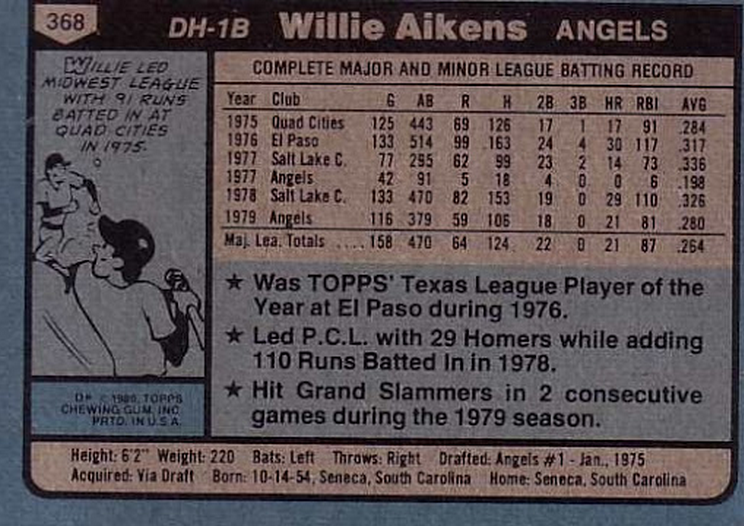
Aikens 1981 Topps card discussed the naming issue as well in the cartoon on the reverse:


Thursday, June 16, 2016

#367 Billy Smith


Who is this player?
Billy Smith, second baseman, Baltimore Orioles

Coming off a season as a reserve for the AL Champion Orioles, Billy Smith began the 1980 season looking for a raise in pay.  After a season where he posted career highs in home runs and RBI, Billy was looking to more than double his salary of  $47,000 at salary arbitration. In those early days of free agency and escalating salaries, negotiations were often times contentious. In what Smith called "the only thing I ever regretted," the arbitration hearing left Smith feeling unappreciated and he took his frustration to the media. He was quoted in the newspapers that if the Orioles didn't value his contributions, he wanted to be traded. His performance in Spring Training was effected and it left him vulnerable. Shortly before Opening Day, the Orioles cut him loose. He was without a job until mid June when he was signed by the Philadelphia Phillies. The Phils sent him to Triple-A Oklahoma City where he spent the remainder of the summer.

A fairly comprehensive biography on Billy Smith currently exists on the SABR website. There is great detail on his early life and prep career in San Antonio, his draft into Major League Baseball and his minor league days. Billy made his major league debut for the California Angels on April 13, 1975 as a pinch runner against the Chicago White Sox. Even though he was thrown out at the plate later that inning, he had a reputation as a speedy switch-hitter with a good glove. While he didn't hit for high average that first season, he appeared in 59 games, but errors in the field proved to he his undoing in Anaheim.

Billy appeared in only a handful of games the following year, spending the majority of the season in the minor leagues. His career took a turn for the better at the end of the season when he was signed by the Baltimore Orioles. Free agency had taken a toll on the Orioles and there was a opportunity for many young players, including Billy. He took full advantage in April 1977, earning him a starting position for a while and placing among the league leaders. A nice article about this time in Smith's career can be read here. He was a fan favorite with the O's, appearing on a local radio show as a weekly guest.

Billy spent the next two seasons in Baltimore, primarily as a reserve, and often times as a reserve for second baseman Rich Dauer. He earned national exposure during the 1979 postseason, appearing in four games during the World Series, collecting a couple of hits and scoring a run. Billy returned to the major leagues for his fifth and final season in 1981 as a member of the San Francisco Giants. He struggled with the bat, hitting only .180.

Shortly after his retirement, Smith was a witness in a drug conspiracy trial of his former agent. Testifying under immunity, Smith indicated that cocaine use was very prevalent among members of he 1979 Orioles and specifically named pitcher Don Stanhouse as a user.  Since his career ended, Billy worked in sales and owned his own roofing company. As of 2015, Billy was employed with a roofing wholesaler and participating in youth baseball clinics.

Why I love this card
As a young kid opening packs, some cards just jumped out. All Star cards of course were a natural. So where league leader cards and Hi-light cards. Checklists too, but for the wrong reasons. Sometimes though, your heart would race when you came across a card of a star player. For a millisecond, that happened with me and Billy Smith's card. Why? Because when I first saw this card, I thought it was of reigning Cy Young winner Mike Flanagan. I just thought they looked similar. Here's a side by side:


Something else....
At Jay High School in San Antonio Billy played on the same high school team as two other future major leaguers, Mickey and Rick Mahler.

Wednesday, June 15, 2016

1980 Street and Smith Baseball Preview


Every now and again, something will pop up at a card show that will surprise me.

But before I get into that, I have to go into Abe Simpson-mode and talk about the way things used to be. For those who can remember, card shows are not what they were. At least not how I remember them.

Last weekend, I went to a card show at Gibraltar Trade Center in Mount Clemens, Michigan. 25 years ago, it was one of the largest in the area and very well attended regardless of the time of year. Hundreds of dealers and top-notch autograph guests. In the past, Pete Rose, Muhammad Ali, Jim Brown, Hank Aaron, Joe Namath, Kareem Abdul Jabbar, Gordie Howe, and scores of other Hall of Famers and legends would visit the show bringing huge crowds and dealers with them. Trying to explain this to my 14-year old son was akin to explaining rotary phones, the VCR or a card catalog.

The internet killed most of the business off, similar to the card shops that used to dot the landscape. There were barely two dozen dealers and for a beautiful Sunday afternoon, I could understand why.

However, today I found something that I had never seen before and scooped up for a dollar.


The 1980 Street and Smith Baseball Preview. Show on the cover is the Orioles Mike Flanagan, the 1979 AL Cy Young Award Winner. I presume that because I lived in an American League town, my area had Flanagan on the cover. A quick Google search showed that alternate covers included Joe Niekro of the Houston Astros or Brian Downing of the California Angels.

Later on, as my baseball obsession grew, I would get one of these every year and devour the information inside. I had never seen a 1980 one before and will add this to my collection.

On of the sections that they included every year was called "Player Targets" that listed active players totals with the All-Time Greats. You could see, for example, how far away Pete Rose was from Ty Cobb or Gaylord Perry was to Walter Johnson. It was often an argument-ender.  I found the list of names on the active player list curious, so I thought I would include them here:


Top 10 Active Hit Leaders (starting 1980)
Pete Rose - Phillies - 3,372
Carl Yastrzemski - Red Sox - 3,009
Rusty Staub - Expos - 2,445
Tony Perez - Red Sox - 2,238
Rod Carew - Angels - 2,215
Willie McCovey - Giants - 2,188
Willie Stargell - Pirates - 2,145
Bert Campaneris - Angels - 2,129
Joe Morgan - Free Agent at press time - 2,015
Lee May - Orioles - 1,933

Home Runs
McCovey - Giants - 520
Stargell - Pirates - 461
Yaz - Red Sox - 404
Reggie Jackson - Yankees - 369
May - Orioles - 344
Johnny Bench - Reds - 332
Perez - Red Sox - 323
Bobby Bonds - Cardinals - 321
Willie Horton - Mariners - 317
Reggie Smith - Dodgers - 280

Victories 
Gaylord Perry - Padres - 279
Jim Kaat - Free Agent at press time - 264
Fergie Jenkins - Rangers - 247
Tom Seaver - Reds - 235
Jim Palmer - Orioles - 225
Steve Carlton - Phillies - 225
Phil Niekro - Braves - 218
Don Sutton - Dodgers - 217
Luis Tiant - Yankees - 217
Tommy John - Yankees - 192

Strikeouts
Perry - Padres - 3,141
Nolan Ryan - Astros - 2,909
Seaver - Reds - 2,887
Jenkins - Rangers - 2,770
Carlton - Phillies - 2,683
Sutton - Dodgers - 2,524
Niekro - Braves - 2,402
Kaat - FA - 2,362
Tiant - Yankees - 2,270
Bert Blyleven - Pirates - 2,082

Tuesday, June 14, 2016

#366 Rob Dressler


Who is this player?
Rob Dressler, pitcher, Seattle Mariners

For the first time in his career, Rob Dressler began the 1980 season on a major league roster. Slated for the Mariners bullpen, Rob was a right-handed control pitcher who most often depended on the ground ball outs. Early in the season, many of his appearances were typically in a mop up role, but for a team that lost 103 games that happened quite often. Add to the fact that the Mariners were second in the AL in errors, many of the ground balls that he was counting on did not become outs. Despite a bloated ERA, he replaced Mike Parrott in the Seattle rotation in late July, and actually did quite well. While he won only four games and lost six in 13 starts down the stretch, he crafted a 3.38 with a 1.189 WHIP and seven quality starts (even if those stats didn't exist in 1980). By the end of the season, he reached career highs in innings pitched, appearances, strikeouts and victories.

A Portland, Oregon native, Bressler was a graduate of Madison High School which also boasts All Star hurlers Rick Wise and Kent Bottenfield as alumni.  He was a first round selection of the San Francisco Giants in June 1972 and reported Great Falls of the Rookie League shortly after his graduation. It was then that Rob began the long odyssey throughout the minor leagues in pursuit if his major league dreams.

Decatur. Amarillo. Lafayette. Phoenix. Phoenix. Phoenix again. Phoenix for four seasons.  Yes, Rob did have a cup of coffee with the Giants in late 1975, and he spent a good chunk of the 1976 season in San Francisco, starting a career-high 19 games, with a 3-10 record and a 4.43 ERA. Somewhere along the line, however, the Giants lost confidence in him as he was relegated to the minor leagues for all of the 1977 and 1978 seasons and was traded to the St. Louis Cardinal organization in July, 1978. Rob was a starting pitcher for much of his minor league career and could be a streaky performer. He was also plagued by inconsistency.

In an interesting transaction, the Cardinals loaned him to the Seattle Mariners in 1979 and the pitching-starved expansion team found a spot for him at the major league level. Starting and relieving, Dressler finished the 1979 season with some good outings and a chance to make the 1980 staff. After his high-water marks in 1980, he pitched poorly in Spring Training 1981 and was released. He did not catch on with another organization and it was the end of his four year major league career.

Today, Rob Dressler still lives in the Oregon area although not much has been reported about his post-baseball career. Any information that can be shared as to his activities over the last 36 years would be most appreciated.

Why I love this card
The All Star uniform on the cartoon pitcher. It has that Bingo Long vibe going even if the pitcher looks more like he is auditioning for Dance Fever than deliver a pitch.


Something else....
In researching Dressler's 1980 season, I was really surprised that he was cut loose by the Mariners. Then as now, pitching was at a premium and at 26 years old, it appeared the Dressler found a groove in the latter part of the 1980 season. It didn't appear that he was injured or something drastic occurred. It is just puzzling that he was given up on so quickly.

Sunday, June 12, 2016

#365 Bobby Murcer


Who is this player?
Bobby Murcer, reserve outfielder, New York Yankees

A popular fan favorite in the Bronx, the 1980 season was one of mixed emotions for Bobby Murcer. Part of a crowded Yankee outfield picture, a lack of consistent playing time initially frustrated Murcer. Coupled with the illness and passing of his father, Bobby was struggling, batting less than .200 as June began. He heated up with five home runs during the month including a dramatic home run against Oakland and a two-homer day against Cleveland. Bobby played an integral role in the number retirement ceremony of his friend, the late Thurman Munson in September and days later he celebrated the Yankees AL East championship. It was Murcer's first taste of the postseason, but he went 0-4 in a three game sweep of the Kansas City Royals.  The year ended with Murcer touring Japan with a major league All-Star team and opening a short-lived baseball academy in Florida.

Bobby Murcer's life and career in pretty well documented on the web, both on his Wikipedia page as well as a comprehensive biography on the SABR website. Depending on when you were born, you likely think of one of three distinct phases of Bobby Murcer's life and career:

The first is the Oklahoma kid, the heir apparent to Mickey Mantle in the Yankee legacy. Murcer idolized Mantle and achieved a thrill playing alongside him during the mid 1960s. After a stint in the army, he certainly delivered on much of this promise, hitting for power and average as the Yankees slowly started becoming a contender. A five-time All-Star, he was a legitimate MVP candidate, among the league leaders in several categories, leading the the league in on-base percentage in 1971 and runs in 1972. When Bobby clubbed four consecutive home runs in a double header against the Cleveland Indians in 1970, he was on his way to becoming a superstar in the media capital. Bobby appeared on Beat the Clock, Hee Haw and What's My Line (below). His trade to the San Francisco Giants for Bobby Bonds in 1975 was a shocker, but this was the Murcer National League fans were expecting. While he never did match his production with the Giants and later the Cubs, he was still a respected and dangerous bat.


The second phase came upon his return to the Yankees where he performed as a reserve outfielder and designated hitter. However, the most indelible image of Murcer, during this time, if not during his entire career where the events of Monday, August 6, 1979. Yankee captain and Murcer's friend Thurman Munson was being buried after a tragic plan crash. Murcer delivered the eulogy that afternoon and later that night hit a home runs a delivered the game winning hit on a nationally televised game against the Baltimore Orioles. This moment established Murcer as a Yankee legend, a elder statesman and leader in the clubhouse and on the field.


The final phase was as Yankee broadcaster, where he endeared himself to a new generation of Yankee fans. He was also instrumental in several causes, such as the Baseball Assistance Team and becoming an anti-tobacco advocate.

Murcer fought a courageous battle against cancer the final two years of his life, passing away on July 12, 2008. Earlier that year, his biography "Yankee For Life" was released. A moving and inspirational memoir, Murcer wrote with incredible determination, positivity and courage in the face of a deadly disease. It stands as a testament to what kind of human being Bobby Murcer was.

Why I love this card
I am not then, nor am I know a Yankee fan. I don't know why, but getting a Murcer card was different. He was from a different era, played in the old Yankee Stadium with Mantle, Maris and Ford. I respected his longevity at that point but what really stood out was his shin guard. You really didn't see that often in 1980 and it jumped out at me. I played soccer and had shin guards like this and had no clue why Murcer would wear one. Just another source of endless childhood debate.

Something else....
In his autobiography, Murcer writes about his ill-fated baseball school. With big names such as Lou Piniella, Rick Cerone and Charlie Lau, the camp nonetheless underestimated expenses and failed to make money. There was one success story, future major league All Star Mike Stanley was a the most famous graduate, enjoying a 15-year major league career.

Friday, June 10, 2016

#364 Ray Burris


Who is this player?
Ray Burris, starting pitcher, New York Mets

During a rebuilding period for the New York Mets, right-handed hurler Ray Burris was looked to provide veteran presence to the starting rotation as the 1980 season began. Ray pitched well to start the year, fashioning an ERA under 3.00 as spring turned into summer. Despite this, he had just a .500 W-L record on the morning of July 3, when he started a game against the Montreal Expos. In the second inning, he was trying to bunt Alex Trevino to third when the pitched from Charlie Lea hit him in the hand and broke his thumb. He spent a month on the disabled list and returned in dramatic fashion, defeating division front-runners Montreal and Pittsburgh Pirates in back-to-back starts. Burris lost his last six starts of the season unfortunately, but still led the team in starts and innings pitched.

Like many players of his era, Oklahoma native Ray Burris was a high school star at Duke High School and played semi-pro ball for the Lawton Oklahoma Pepsis. He helped lead his team to the 1970-71 championship and was named all-state both seasons. He enrolled at Southwestern Oklahoma State University, where he played basketball, earned four varsity letters on he diamond, and received a Bachelor of Arts degree in Recreational Leadership. He still holds most school career pitching records and in 1972 he set a NAIA record with 150 strikeouts in a season. His performance drew attention for the major leagues and the Cubs selected him in the 17th round of the 1972 free agent draft.

He ascended quickly in the minor leagues, and was invited to Spring Training by the Cubs in 1973. He made the staff as a relief pitcher but split times between the Chicago and the minor leagues his first two seasons. He was inserted into the starting rotation in 1975 and spent the next four seasons taking a regular turn on the hill for the Cubs. Highlights of Ray's tenure as a Cub include turning a 3-11 start in 1976 to go 12-2 the rest of the way to finish with a winning record and exceptional ERA. Ray was also on the mound at Shea Stadium the night of the 1977 New York blackout in July and Burris earned the complete game win two months later when the game was resumed.

When the 1979 season started slowly, Ray was shipped to the New York Yankees, where he only pitched in 14 games before being dealt again this time across town to the Mets. A free agent after the 1980 season Ray left New York for the Montreal Expos, who were looking for more pitching after they failed to land Don Sutton. Ray pitched very well in the strike-shortened '81 season, helping lead the Expos to their first and only post-season appearance. If not for Rick Monday, Ray would likely have been named MVP of the NLCS, besting rookie sensation Fernando Valenzuela with a complete game shutout over the Dodgers in Game Two and allowed only one run over eight innings in Game 5 before giving way to Steve Rogers and the impending Monday heroics.

Burris never pitched that well in Montreal again and was traded to he Oakland A's after the 1983 season. Rejuvenated by a change in scenery, Ray was the A's most reliable starting pitcher in 1984, leading the club in victories, innings, complete games and shutouts, while fashioning the best ERA of all Oakland starting pitchers. Despite this output he was traded to the Milwaukee Brewers for Don Sutton. He had a disappointing season in 1985, finishing with a losing record in his final season as a starting pitcher. Ray pitched for the Cardinals and Brewers his final two seasons, ending his 15 year career after the 1987 season.

After his playing days, Ray turned to the coaching ranks for several different teams and organizations, most recently in the Philadelphia Phillies chain with the Lehigh Valley Iron Pigs. He was considered a strong candidate to be the Phillies pitching coach under manager former Ryne Sandberg.

Why I love this card
Bertram Ray Burris. There was something magical about a player's full name. When I was a kid, whenever my full name was spoken, it usually meant that I was in trouble. To see a players full name spelled out in a similar fashion reminded me that they were human too. It gave them personality and commanded intrigue. A simple yet effective way to pull a young kid into the world of baseball and collecting.

Something else.....
One has to wonder when looking at a player like Ray Burris. With the exception of his three seasons in Montreal, Ray's entire career was with losing clubs. Particularly his time with the Cubs and Mets, what if a pitcher of Burris' talents was with say the Pirates and the Dodgers. I'm not suggesting that Burris would he a Hall of Fame candidate, but it is just one of those "what ifs" that are scattered across the history of this great game.

Wednesday, June 8, 2016

#363 Wayne Gross


Who is this player?
Wayne Gross, third baseman, Oakland A's

When the 1980 season began, not much was expected from the Oakland A's. Fresh off of a 108-loss season, new manager Billy Martin inherited a young club with several talented players. One of these was players was third baseman Wayne Gross. Like several of the A's, Gross thrived under his new manager as Oakland was one of the surprises of the 1980 season.  He raised his batting average over 50 points for a career high .281 and stole five bases included one of home on May 3. Wayne even demonstrated some of his manager's legendary temper, when he was ejected from a game against the Angels and bumped umpire Jerry Neudecker. Gross finished the satisfying season improving on nearly every offensive category and having the best defensive season of his career to that point.

Wayne Gross was born in Riverside, California and was a prep star at Riverside Poly High, whose alumni includes former major leaguers Bobby Bonds and Gary Lucas as their alumni. Wayne attended Cal Poly State University where he played both baseball and football. In 1972, Gross was third in the nation in punting with a 42.1 average, was named All-Conference and All-American Honorable Mention. On the baseball diamond,  Wayne met his future wife at Cal Poly who was the team's official scorer.

Selected in the 9th round of the 1973 draft, Wayne was selected by the Oakland A's during the height of their dynasty and began a rapid rise through the minor leagues. He clubbed 52 home runs on his way up and was looked to be one of the replacements as Charlie Finley dismantled the five-time AL West champions. He made his major league debut late in the 1976 season, and earned a starting position as the A's third baseman.

Gross started off the 1977 season clubbing 15 home runs by mid-June and being among the league leaders in home runs and RBI. He was rewarded with a selection to the American League All Star team. He cooled off somewhat in the second half, but his 22 home runs represented nearly one-fifth of the A's team total. Wayne was still learning the defensive nuances of the position and led the league with 27 errors.

The following year was a bit of a struggle at the plate as he was sent to the minors to refine his batting stroke. He began wearing glasses and his power stroke returned. In 1979, he reclaimed his  hold on the position and steadily improved in the field. He started three triple plays, tying a major league record.  By 1980, Wayne established himself as a solid major league third baseman just as the A's we're ascending back to the AL West crown.

With the 1981 West champions, Wayne slumped at the plate during the regular season, but he still played a key role in the postseason. His three-run homer in Game 1 of the ALDS against the Royals help lead the was to a win and series sweep before the Yankees defeated the A's in the ALCS.

Wayne remained the A's third baseman until Oakland traded for Carney Lansford after the 1982 season.  He moved on to Baltimore for the 1984 campaign, becoming the regular third sacker for the defending World Champions. He responded with career highs in home runs and RBI. Injuries hampered him during the 1985 season and he returned to Oakland for three games, the final ones of his 11 year career.

In retirement, he coached his son Kyle's Little League team, helping them reach the Little League World Series in 1991. Kyle would go on to play ball in the Giants minor league chain. In 1994, he appeared as a pitcher in the movie Angels in the Outfield (below), a spot recommended by old friend and teammate Carney Lansford. Today, Wayne is enjoying retirement in Danville, California.


Why I love this card

Some shots just looked major league, and Wayne Gross' card here was one of those for me. Whether it was the action shot, the A's colorful uniforms or Gross' concentration on something other than the camera, this is what a major leaguer looked like in 1980. Bonus points go toward capturing the shadows and sunlight around the third base bag giving the A's banner a a natural accent.


Something else....

Gross had a very curious 1985 season. In 103 games with the Orioles, he hit 11 home runs. Decent, if not unspectacular production. Curiously, he drove in only 18 runs despite those 11 dingers. That's 9 solo shots, and two three-run jobs. That's three RBI for the entire remainder of the season.


Monday, June 6, 2016

#362 Danny Goodwin


Who is this player?
Danny Goodwin, designated hitter, Minnesota Twins

While Danny Goodwin began the 1980 season as the Opening Day designated hitter, he started slowly with only one hit in his first four games. As would seem to be a consistent theme throughout his career, the Twins were not patient with Goodwin and he was relegated to the bench. Glenn Adams took his place as Minnesota's left-handed DH and Danny was unable to gather much momentum throughout the season. Even though he batted only .200 in 55 games, a highlight game on June 27 when he had the go-ahead single to defeat the Boston Red Sox.

The pride of Peoria, Illinois, Danny Goodwin is best known for being the only man to be taken with the first overall selection in the amateur draft on two separate occasions.  He crafted a stellar reputation at Peoria Central high school, clouting monstrous home runs while batting .488 in his senior year as a catcher. His number was retired even before his graduation and he was named Topps High School All American catcher. 20 scouts saw him in action, including the Chicago White Sox, who held the first pick in the 1971 draft. Predictably, the White Sox chose him even ahead of future All-Stars such as Frank Tanana, Rick Rhoden and Jim Rice.

However, even before his selection, Goodwin stressed education over athletics. The son of a government chemist and high school counselor, Danny demonstrated that he understood the value of a college education, especially in the times of the early 1970s. Goodwin even indicated that he may he interested in pursuing a degree in dentistry. Irregardless, Danny enrolled at Southern University in Louisiana and had success on the field and in the classroom. While he was named Collegiate Player of the Year is senior season, he also earned a degree in zoology.

With the California Angels now holding the top choice in 1975, Goodwin entered the draft even more credentialed than before.  In addition to his Player of the Year honors, Danny played on the 1974 Pan American world championship team and was named All World at catcher. Like the White Sox four years before, the Angels made him the top selection at $125,000 and he reported to Double-A El Paso. The Angels thought so much of him that he was called up to the parent club and made his major league debut on September 3, 1975, the day after his 22nd birthday.

After a quick ascent through the minor leagues in 1976, Goodwin was establishing himself as a major-league hitter, but a series of injuries to his arm hindered his progress behind the plate.  Despite impressive minor league numbers, it was difficult for Danny to find playing time in Anaheim. A little over three years after drafting him, the Angels traded Danny and Ron Jackson to the Minnesota Twins in exchange for Dan Ford.

In 1979, he split time between the Twins and Triple-A, he put up his best numbers and earned a spot on the Opening Day roster for the first time in 1980. However, limited playing time and struggles at the plate led to his release after the 1981 season. The Oakland A's signed him where he spent 17 games, the last of his seven year major league career.

Danny's baseball dreams were by no means over, however. Making the most of his assignment,  Goodwin performed well at Triple-A Tacoma, even being named the Tigers team MVP in both 1983  and 1984.  Unfortunately, it was not enough to earn a return ticket to the big leagues and Danny moved on to Japan for one final season in 1986.

Hired by the Atlanta Braves in 1989, Danny worked in community relations and was president of the Atlanta Braves foundation. Today, he is the president of First Choice Management Services in suburban Atlanta.

Why I love this card
I have talked before about the first game I ever attended in July, 1979. Goodwin was one of the handful of players that signed an autograph for me, long before I really knew why that was important. But what stuck with me the most was not the signature but Goodwin's awesome mustache that he sports here

Something else....
In 1989, Goodwin was inducted into the Greater Peoria Hall of Fame and in 2011 was enshrined in the College Baseball Hall of Fame.

Wednesday, June 6, 2012

#361 Wayne Garland


Who is this player?
Wayne Garland, starting pitcher, Cleveland Indians
The 1980 season for Wayne Garland began much as the previous three; frustrating and in pain. So much so, that as Spring Training wore on, his future with the Cleveland Indians seemed questionable. Likely due to his historic contract, Wayne earned the final spot on the Indians' staff and was used sporadically to start the season. He even tried adding a knuckleball to his repertoire in an effort to earn a spot back in the starting rotation. Garland was given his first start on June 16th and he responded with a complete game victory against the Chicago White Sox. Three weeks later, he fired a two-hit shutout against the New York Yankees before 73,096. Naturally, the optimists hailed a return to form, but Garland was still cautious. He was unable to build upon these performances and lost his final five decisions of the season. Garland finished 1980 with a 6-9 record and a 4.61 ERA.

A native of Nashville, Tennessee, Wayne Garland was drafted as a 18-year old graduate of Cohn High School by the Baltimore Orioles in 1969. During this period, the Orioles farm system was one of the finest in Major League Baseball, with an emphasis on signing and developing young pitchers. Garland was certainly no exception. He had a fabulous 1971 season at Double-A Dallas-Fort Worth, winning 19 games, posting a 1.71 ERA and leading the Spurs to the Junior World Series. However, he was unable to crack the Orioles deep pitching staff during a times when the O's owned the American League East. When he fired a no-hitter at Triple-A Rochester early in the 1974 season, he was brought up to the Orioles for good.

Wayne spent the 1974 and 1975 seasons in the Orioles bullpen, occasionally given a shot as a spot starter and occasionally earning a save or two. More importantly, Garland established a pattern by hiring an agent and not quickly signing a contract for 1974 as well as 1975. At this time in the game's history, players who had agents were treated with skepticism and criticism by management. By the time 1976 rolled around, Garland again did not sign a contract and since he was not an integral part of the Orioles, it did not appear to be their top priority.

As is now well known, Garland took advantage of the opportunity presented to him in 1976 when the Orioles had a shortage of starting pitchers early in the season. He would go on to win 20 games and post a 2.67 ERA and was among the league leaders in nearly every pitching category. At 25 years old, the righthanded Garland was widely acknowledged as as a coming star and since he finished 1976 without a contract, one of the most desirable free agents. Free agency was new that winter and was by no means as routine as it was today. What happened would stun the media, the baseball world and even Garland himself.

The Cleveland Indians signed Garland to a $2.3 million dollar contract for ten years and the entire landscape changed for major league baseball. Although most point to this contract as an example of free agent "busts" Garland blazed a new trail that generations following him would benefit from. As he often said that year and after why would he turn it down?

However, Garland received criticism from the moment he signed the deal, even from former teammates such as Jim Palmer. He was even criticized for wearing number 23, which was a constant, unfortunate reminder of his contract. Needless to say he was eager to prove that he was "worth it." Unbeknownst at the time, Garland suffered a shoulder injury in his first Spring Training game with the Indians. It was later revealed that he tore his rotator cuff, a death knell for pitchers during this era. Nonetheless, he played through the injury, trying to earn his contract; pitching 282 inning with 21 complete games. However, his cast behind him in Cleveland wasn't the same as Baltimore and he lost 19 games.

The following year, he attempted to again pitch through the pain until he succumbed to surgery. Instead of taking time off to heal, he returned 10 months after surgery in what proved to be a mistake as he never again was able to pitch consistently effectively. It was a testament to his will and courage that he was even able to return to pitch at all even with the added pressure of "the contract" and the fans of Cleveland which by now had grown impatient. So too did Cleveland management, who released him after the 1981 season, effectively ending his 9-year career. He attempted a comeback with Nashville in the Yankees organization, working on his knuckleball with Hoyt Wilhelm. Eventually though, Garland decided to retire outright.

Garland worked in the Milwaukee Brewers farm system as a coach and was named the head coach at Aquinas Junior College in Nashville in 1984. He also coached in the Cincinnati Reds organization. However, health issues continued to plague Garland as six back surgeries by 2003 curtailed his coaching career as well. Today, Wayne Garland is living the Lakeland, Florida area.

Why I love this card
I have mentioned this before, but this card reminds me of Sunday, August 24, 1980. My grandpa had been sick for some time and died that day. I had just bought a pack at the 7-11 and was sitting on the curb with some buddies and this card was inside. My dad and uncle came around the corner in my dad's huge 1978 Buick and gave me the "better get home" look. There are a handful of cards from this pack that I associate with that day and Garland is one. Sorry to be so morbid, but Garland reminds me of Grandpa today.

Something else....
Three of the top pitchers in 1976 were Mark Fidrych, Randy Jones and Wayne Garland. Before Opening Day 1977, all three would have suffered injuries that significantly shortened and ultimately ended their careers. Interesting to ponder what the late 1970s would have been like had all three remained healthy and had longer careers.

Tuesday, June 5, 2012

#360 Darrell Porter


Who is this player?
Darrell Porter, catcher, Kansas City Royals
After posting one of the best offensive seasons by a catcher up to that point, Darrell Porter of the Kansas City Royals shocked the baseball world during Spring Training 1980 when he disclosed substance abuse problem. Initally, only alcohol was cited as a problem, but Porter also acknowledged a cocaine addiction. He spent the next six weeks in a rehabilitation facility and his return to the diamond was seen as an example of his will and courage. However, his performance was effected by the lack of Spring Training, hostile opposing fans and a brief hospitalization. Despite this adversity, he was still able to help the Royals advance to their first World Series in franchise history. When the season ended, Porter followed former manager Whitey Herzog to St. Louis when he signed a large free agent contract with the Cardinals.

A Midwestern boy, Darrell Porter was born in Joplin, Missouri and became a prep star at Southeast High School in Oklahoma City, Oklahoma. A standout on the diamond and the gridiron, Porter received scholarship offers from 40 schools as a football candidate. Blessed with a powerful throwing arm, he initially signed a letter of intent with to quarterback at the University of Oklahoma before deciding on a baseball future. The Milwaukee Brewers made him their first selection of the amateur player draft in June 1970 and offered him a reported $70,000, a large sum for its time. The left-handed hitting Porter homered in his first professional at bat later that summer and was immediately tabbed as a major league prospect.

Darrell made his major league debut the following season and lived up to his billing by crashing a home run against AL MVP and Cy Young Vida Blue. At the time, he was the youngest player in the major leagues. However, he required some more seasoning in the minor leagues before returning to the bigs for good in 1973. That rookie season his .257 batting average and 16 home runs, placed him third in the Rookie of the Year voting and he was named to the American League All-Star team in 1974. However, Porter began to be plagued by the pressure to live up to his advance billing, and this ultimately was a major part of his substance abuse issue. He was traded to the Kansas City Royals following the 1976 season in a curious move, partly because of Brewers' owner Bud Selig decision to rid the team of a potential problem.

Blessed with a new start in Kansas City, Porter's offensive production increased. He was named an All-Star three seasons in a row (1978-1980) and helped the Royals reach the postseason three out of the four seasons he was a Royal. The one season Kansas City didn't reach the playoffs was Porter's finest (1979) which saw Darrell become only the sixth catcher in Major League history drive in and score 100 runs in the same season. He also led the American League with 121 walks and reached base a league-leading 284 times. For good measure, he also placed among league leaders in sacrifice flies, hit by pitches and triples.

While with the Cardinals, Porter was never able to regain his offensive production of 1979, but he was still a solid catcher able to draw walks and get on base. Despite this, he was given a hard time by the St. Louis fans, even as the Cardinals drove towards a postseason appearance in 1982. Porter rewarded them with a scintillating performance in the NLCS, batting .556 (5 for 9) in the Cardinals three game sweep of the Atlanta Braves. He followed that with a similar performance in the World Series against Milwaukee. With several timely hits, including the game-winner in Game 7, Porter was again named the Most Valuable Player. He was also an inspirational figure, often re-telling the story of his addictions and his conversion to a born-again Christian. His autobiography, Snap Me Perfect! was released prior to the 1984 season.

Porter had his best statistical season in St. Louis in 1983 but the Cardinals were unable to return to the postseason. Injuries began to take their toll as he fractured a finger in '83 and suffered a broken collarbone and thumb in 1984. St. Louis returned to the World Series again in 1985, with Porter again having a good NLCS, this time against the Dodgers. However, Darrell and the Cardinals struggled offensively in the World Series against Porter's old team the Royals, and St. Louis came up short in seven games. Porter would spend the final two seasons as a part-time player with the Texas Rangers before retiring after the 1987 season and 17 major league campaigns.

In retirement, Porter, like many of his contemporaries became a broadcaster for a time, was heavily involved in charity world and dabbled in antiques. On August 5, 2002, Porter was found dead in Sugar Creek, Missouri outside of his vehicle. It was initially believed that Porter's car was stuck on a tree stump and the high heat and humidity played a role in his death when he attempted to push the car. An autopsy concluded that he died of "toxic effects of cocaine" consistent with recreational use and induced a condition called excited delirium that caused his heart to stop. He was only 50 years old.

Why I love this card
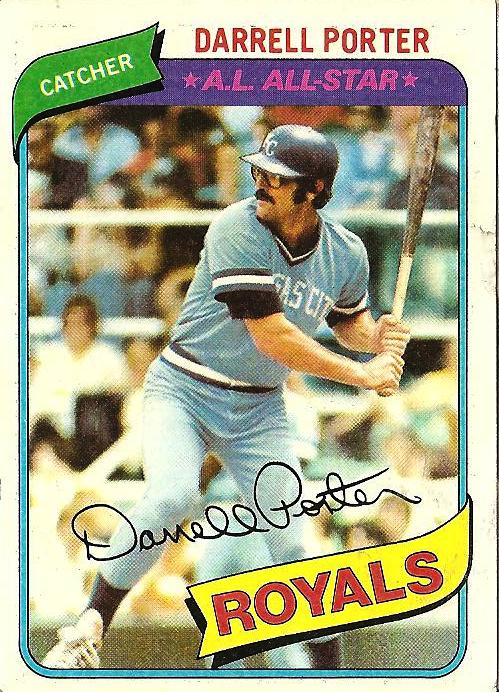
First, any All-Star card commanded my immediate respect. Something about the All-Star banner that was on these cards elevated the players in my young mind as a future Hall of Famer. Secondly, I was drawn to the fact that Porter went to bat without any batting gloves. For an aspiring Little Leaguer, this was affirmation, especially during a time when batting gloves were becoming the rage. They are pretty standard now at all levels, but back then it was kind of cool to see an All-Star buck the on-coming trend.

Something else...
Porter and Hall of Famer Mickey Cochrane are the only catchers in American League history to draw 100 walks, score 100 runs and drive in 100 RBI in the same season. Porter of course in 1979, Cochrane in 1932.

Also included below is Porter's 1980 Topps Super card. Unfortunately, this was not something that I obtained during the summer of 1980, rather it was something that I stumbled across years later when I stumbled across the whole set.


Thursday, May 31, 2012

#359 Randy Moffitt


Who is this player?
Randy Moffitt, relief pitcher, San Francisco Giants
After spending most of the 1970s as one of the San Francisco Giants' most reliable relief pitchers, Randy Moffitt entered 1980 battling a mysterious ailment. He had lost nearly 25 pounds since the start of the 1979 season and doctors had been telling him that it was all in his head. Others thought that his arm simply went dead. He went through frequent bouts of vomiting, bleeding ulcers and had difficulties with his stamina. However, Randy was found to be suffering from a rare and frequently fatal intestinal parasite, Cryptosporidia enteritis.  Only 100 humans are known ever to have contracted this lethal disease which is typically found in barnyard animals. Moffitt was told that, if he lived, it might take him two years to recover and was advised to rest and return for periodic tests. The Giants put him on the disabled list and he appeared in only 13 games in 1980.

Randy Moffitt came from an athletic family as his older sister was tennis star Billie Jean King. He was a prep star in Long Beach, California, winning the Connie Mack World Series. Randy was a two-time all league choice in three seasons at Long Beach State University where he set career records for innings pitched and strikeouts. The Giants made him their first pick of the 1970 amateur draft.

As a slider-sinker specialist, Randy's reputation was a ground ball pitcher. He also was known to deliver his pitches from a variety of angles, including sidearm. He was converted into a reliever after his first professional season and within two years he was in the major leagues. Moffitt quickly became the Giants' most reliable short reliever. In an era where saves are not as emphasized as much as today, he notched 54 in a four year stretch (1973-1976) that saw him place in the top ten in the league each season. For example, his fifteen saves in 1974 was second best in the National League.

He was also a very durable pitcher, averaging 61 appearance a season between 1973 and 1978. However, most of these achievements were done in anonymity as the value of a reliable late inning reliever would not be recognized often during Randy's career. By the time it began to, he began to fall ill with the fungus that would essentially cost him three seasons of his career. Moffitt, a horse enthusiast, surmised that he contracted the virus hot walking racing horses. At one time, he worked on the backstretch of Bay Meadows track near San Francisco and also earned a groom's licence.

While still on the disabled list during the 1981 season, the Giants released him, figuring his career was over. But he signed a minor-league deal with the Houston Astros and made a comeback with them late in the 1982 season. The Astros did not keep him as they were going towards younger players and he was recommended to the Toronto Blue Jays. He had a fine season with Toronto in 1983, appearing in 45 games and saving 10. Curiously, he did not appear again in a major league uniform after that season, ending his 12-year major league career.

Why I love this card
At the time, I loved the idea of an All-Star jersey like the one shown on the back of Moffitt's card, but I'm glad I changed my mind about that. I also had no idea about the Billy Jean King connection at the time, not that it would have mattered to me, though. In looking at this card today, and knowing what I know about what he went through during this period, he does look like he was ill when this picture was taken. However, I could say the same about alot of players who have made ugly faces elsewhere in this set.

Something else....
At the time of Randy Moffitt's release from the Giants in 1981, only two other pitchers in franchise history (Christy Mathewson and Carl Hubbell) appeared in more games than Moffitt. He has since been passed by Greg Minton and Gary Lavelle, but that is still impressive nonetheless. I definitely would have got the trivia question wrong.

Wednesday, May 30, 2012

#358 Lou Whitaker


Who is this player?
Lou Whitaker, second baseman, Detroit Tigers
After the trade of Ron LeFlore, Sparky Anderson tabbed second baseman Lou Whitaker to be the Detroit Tigers' leadoff batter. Whitaker had difficulty adjusting to the role and slumped badly. He was moved to the ninth position in the order when his average dropped under .200 in early June and the chants of "Loooo" at Tiger Stadium turned into boos. The slump and vision problems kept in out of the lineup for two weeks and he was momentarily replaced in the hearts of fans by Stan Papi. This bothered the normally affable Whitaker who displayed his frustration by hinting at a trade. "Sweet Lou" had modest improvement for the remainder of the season, but his 1980 season was clearly the most disappointing of his career to that point.

Louis Rodman Whitaker was born in Brooklyn, New York but raised in Martinsville, Virgina where he had some success in high school initially as a pitcher. As an 18-year old high school senior, he was selected by the Tigers in the June 1975 amateur draft. The left-hand hitting Whitaker played third base for Lakeland in 1976, earning Most Valuable Player honors. The following year he was promoted to Montgomery, Alabama, where he was switched to second base to team with Alan Trammell. The two would spend the next 19 years as double play teammates. After a solid season with Montgomery, both Whitaker and Trammell made their major league debuts and got their first hits in the same game on September 9, 1977.

The following season, Whitaker broke camp with the Tigers and won the second base job outright before April ended. That first year he demonstrated excellence in the field, a quick bat and speed on tha basepaths. At season’s end, Lou finished the season batting .285 with 71 runs scored and led the league in double plays with Trammell. Whitaker was named American League Rookie of the Year, edging out future Hall of Famer Paul Molitor. Another solid season followed in 1979 and the Tigers, in part because of Whitaker, was considered one of the best young teams in baseball.

After a 1980 setback, Lou settled into the bottom of the Detroit batting order and slowly rebuilt his confidence at the plate. By mid-1982, the Tigers, and Whitaker in particular were ready to rise to prominence. Now moved to the leadoff position, Whitaker had arguably his best statistical season in 1983, banging out 206 hits and finishing third in the American League with .320 batting average. He was named an All-Star and won a Gold Glove for the first time in his career. The Tigers meanwhile, won the most games since winning the World Championship in 1968 and great things seemed to be on the horizon.

Whitaker was the catalyst for the 1984 World Series champions and although it appeared that his statistics did not match the previous year, he started his first All Star Game, provided excellent defense and clutch hitting and saved his best for the postseason. That fall, Whitaker showed the nation his skills as a leadoff batter, reaching base six times in the first inning of the Tigers' eight postseason games. He was also a tremendous fan favorite in Detroit, receiving thunderous ovations of "Looooo" on each trip to the plate. His popularity transcended Detroit, as he even appeared on an episode of "Magnum P.I."

For the remainder of the decade, Whitaker was one of the premier second basemen in the game. During one of his All-Star appearances, he forgot to pack his uniform and had to make due with a substitute that is now in the Smithsonian Museum. His power numbers peaked during the middle and late 1980s, averaging 20 home runs a season from 1985-1991. In 1987 the Tigers returned to the postseason, as Lou set a career-high with 110 runs scored. However, Detroit lost the ALCS to the Minnesota Twins. The Tigers contended late into the 1988 season, when an ill-fated dance move cost Whitaker the remainder of the season and the Tigers an opportunity at the post-season.

As the 1990s began, Whitaker remained a fixture in Detroit as his playing time slowly began to diminish. He retired after the 1995 season after speculation that he may return for one final season with teammate Alan Trammell, but the two had already set a major league record by appearing in 1,918 games together. but the two had already set a major league record by appearing in 1,918 games together. He joined Rogers Hornsby and Joe Morgan as the only second basemen to score 1,000 runs, drive in 1,000 runs, and collect 2,000 hits and 200 homers. Incredibly, he received virtually no support for the Hall of Fame and he was dropped from the writer's ballot after only one season.

Whitaker has periodically returned to Detroit for special appearances and even served as a Spring Training instructor at Alan Trammell request when Tram managed the Tigers in 2003.

Why I love this card
A great shot of Whitaker at Tiger Stadium, apparently during pregame warmups. As a kid growing up in the Detroit area in 1980, all Tiger cards were special, but getting a Whitaker was like having a second birthday.

Something else....
Two things actually, Whitaker became a Jehovah's Witness midway during his career; introduced to the religion by teammate Chet Lemon. As part of these beliefs, Lou would not stand for the national anthem. I found a video of this here:


Secondly, it boggles my mind that Whitaker was not seriously considered for the Hall of Fame. He did nearly everything a middle infielder from his era could do, with the exception of being named MVP. His numbers are very similar to contemporary Ryne Sandberg, who did win the MVP. It is a shame that he is so overlooked.