Tuesday, February 2, 2010

#239 Don Aase


Who is this player?
Don Aase, starting pitcher, California Angels
Beset by injuries, the California Angels were unable to defend their AL West crown in 1980, slipping instead to sixth place. Righthanded pitcher Don Aase was one of the only healthy pitchers in Anaheim and he started and relieved, depending on the needs of the team. Aase started 21 games and was moved to the bullpen at mid-season. He was 3-0 and posted a 2.07 ERA in 19 appearances as a reliever, six of which were four innings or more.

The righthanded Aase was originally a selection of the Boston Red Sox in 1972. His professional career began dubiously as he went 0-10 with a 5.81 ERA with Williamsport and followed with a 15-loss season in 1973. However, Aase turned things around the following year as he was the best pitcher in the Carolina League, leading the circuit in wins, ERA and innings pitched. That performance earned him a promotion to Triple-A Pawtucket where he spent two seasons before earning a spot in the Boston rotation after the All-Star break in 1977.

Aase began his major league career with three straight wins, including a complete game shutout against the California Angels. He won six games, threw two shutouts and four complete games. However, the Red Sox traded Don to the Angels for Jerry Remy and won 11 games. He was a major part of the AL West division champions in 1979 and won the first postseason game in franchise history when he won Game 3 of the ALCS against the Baltimore Orioles.

He became the Angels closer in 1981 and spent the remainder of his career pitching out of the bullpen. An elbow injury in 1982 cost him almost two full seasons but Aase rebounded nicely, returning in 1984 to record 8 saves with a 1.62 ERA in 23 appearances. He became a free agent and signed with the Baltimore Orioles prior to the 1985 season. Installed as the Orioles closer, Aase was an All Star in 1986 and earned the save in the AL's win in Houston. He finished the year with 34 saves, the second most in the American League.

Injuries returned in 1987 and Aase never regained closer status, bouncing to three teams in the last four seasons of his 13-year career. He ended his career following stints with the New York Mets in 1989 and the Los Angeles Dodgers in 1990. Of all of the players in major league history, Don is listed fourth alphabetically behind David Aardsma, Hank Aaron, and Tommie Aaron. Today, Aase is enjoying retirement and his son is playing baseball for UNLV.

Why I love this card
When I first got this card, I first thought that Aase was photographed picking something up off the ground. The football stands in the background also reminded me of the local high school stadium. Today, I realize that this photo was likely taken in 1978 since the Angels had names on the back of their uniforms in 1979.

Something else....
Until today, I never knew that the correct pronunciation is AW-see. When I was a kid, I pronounced it ASS-ee, simply because it was a cheap reason to say "ass." My dad saw right through that. Since then, I had been pronouncing it Ah-see. Shows what I know.

On this day in 1980:
Today would have been the final day of the Star Trek Meal at McDonald's a cross promotion of Star Trek: The Movie. You can watch the commercial here. Notice that it is not called a Happy Meal - I think that this may be one of the first examples of a movie-themed combination at McDonald's.

Monday, February 1, 2010

#238 Rob Wilfong


Who is this player?
Rob Wilfong, second baseman, Minnesota Twins
In just his second full season as an everyday player, the sure-handed Rob Wilfong set an American League record for second basemen in 1980 when he posted a .995 fielding percentage. He made only three errors all season, but incredibly, did not win the Gold Glove Award for his fielding prowess. Wilfong tumbled at the plate, however, as his batting average dropped 65 points from the previous year. While his decline at the dish raised some eyebrows, Wilfong ended the 1980 season as the clear incumbent at his position for the Twins.

The Pasadena, CA native was selected by the Minnesota Twins in the 1971 amateur draft and hit a home run in his first professional at-bat with Charlotte. He was a Southern League All-Star with Double-A Orlando and batted over .300 at the Triple-A level. A strong Spring Training 1977 earned him a spot on the major league roster and he traveled north with the Twins, making his debut in April, 1977. Wilfong spent two years as an understudy before finally winning the position from Bob Randall in 1979.

He responded with the best statistical season of his career. The lefthanded hitting Wilfong led the team with a .313 average and achieved career highs in home runs (9) and RBI (59). An adept bunter and contact hitter, Wilfong had 22 bunt hits in 1979 and led his league with 25 sacrifice hits. At the time, it was thought that he, along with Roy Smalley and John Castino would be part of a core of young players that would lead the Twins in the 1980s.

Alas, it was not to be. By 1982, Wilfong was gone, traded to the California Angels. The Twins received Tom Brunansky in the deal who would go on to be a major part of the 1987 World Champions. But it would be Wilfong who would taste the postseason first, in 1982 and again in 1986 as the Angels won two AL West crowns. Meanwhile, Wilfong served primarily as a defensive replacement and utility man in his five seasons in Anaheim.

In the classic '86 series, his role in the famous Game 5 has largely been forgotten. After Dave Henderson shocked Donnie Moore and the Halos with his famous home run, the Angels, led by Wilfong's clutch RBI in the 9th, tied the game. Unfortunately, California lost the game and the series to Boston in seven. He made a brief cameo with the Giants in 1987 before retiring after 11 years in the majors. In retirement, Wilfong was a scout, most recently with the Detroit Tigers.

Why I love this card
We loved saying his name when we were kids. Nothing more, really. Just riding our bikes, Slurpees in hand and screaming "WILLLLLLFONNNNNG" for reasons only known to 9-year olds.

Something else.....
Wilfong's last professional hit was a home run with the Giants on May 7, 1987. With home runs as his first and last pro hit, Wilfong has nice bookends to his baseball career.

On this date in 1980:
The soap opera "Love of Life" came to an end after 30 years on the air. Here is a CBS World News report with the incomparable Walter Cronkite.

Friday, January 29, 2010

#237 Scott McGregor


Who is this player?
Scott McGregor, starting pitcher, Baltimore Orioles
Pitching in the shadow of more heralded teammates, Scott McGregor of the Baltimore Orioles proved to be one of the best pitchers in the American League in 1980. The reliable southpaw was very consistent throughout the year, winning 20 games and finishing in the Top Ten in seven categories. He earned his twentieth victory on the final day of the season, the Orioles 100th win of the season. Unfortunately, Baltimore finished three games short in the AL East division race to the New York Yankees.

McGregor played baseball for El Segundo High School and was a teammate of future Hall of Famer George Brett. He was selected by the New York Yankees with the 14th pick of the 1972 draft and in time was considered one of the Yankees top minor league prospects. Scott was involved in a major blockbuster trade in mid-1976, when he, along with Rick Dempsey and Tippy Martinez came to Baltimore and the trio helped the Orioles to two AL pennants. McGregor made his major league debut later that season.

By 1978, McGregor had worked his way into the Orioles starting rotation and he won 15 games. The next year, he missed over a month early in the season but returned strongly to win 13 games as the Orioles won the AL East. Before Game 4 of the ALCS against the California Angels, McGregor guaranteed his teammates a victory. He proved good to his word with a six-hit shutout as the Orioles clinched the American League Pennant. He won Game 3 of the World Series, but Scott and his Orioles teammates fell short in Game 7 as the Birds fell to the Pittsburgh Pirates.

He was named to the All Star Game in 1981 and the finesse, groundball pitcher finished fifth in the league in victories. In 1983, he won 18 games as the Orioles again advanced to the World Series. In the 1983 postseason, McGregor allowed only 2 runs in both Game 1 of the ALCS and Game 1 of the 1983 World Series, however, he lost both games by scores of 2-1. However, in the deciding Game 5 of the World Series, he pitched a complete game shutout as the Orioles defeated the Philadelphia Phillies.

In the following years, McGregor's fortunes seemed to match that of the Orioles. While still a formidable competitor, he was no longer the standout pitcher he had once been. He could still be counted on to take his turn in the O's rotation, but his ERA rose considerably and his record was only a little over .500. Injuries ruined most of the 1987 season and the career Oriole was released in May 1988 after a 13-year major league career. Today, McGregor is an ordained Pentecostal minister and will spend the 2010 season as the pitching coach of the Aberdeen IronBirds.

Why I love this card
I was completely fascinated as a kid with the stat on the back of this card. The fact that he earned a save without throwing a pitch was amazing to me. In an era before Retrosheet my imagination ran wild as to how this actually happened. This was reinforced by my Dad who acknowledged that he had never heard of that happening before. That alone made it special. Bonus points for Eddie Murray in the background.

Something else....
Here is a 2003 interview with McGregor in which he reflects on his major league career.

On this date in 1980:
The top five watched television shows at this particular moment:
1. 60 Minutes
2. Three's Company
3. Dallas
4. Real People
5. The Dukes of Hazzard

Thursday, January 28, 2010

Calendar Time

Ok, it's show and tell time.

My third grader has been following along with this blog periodically. Typically, he likes to see what player and/or team we are currently on, sometimes offering suggestions, more often asking questions.

For Christmas, he recevied from Santa a really cool desk calendar, produced by the Baseball Hall of Fame. On each day is a shot of museum exhibits, memorbilia or Hall of Famer plaques.

Yesterday, this was featured on his calendar:


He was so excited to see a card from "Dad's set" and he wanted it to be included in the blog. Here it is.

Funny....the whole reason I started this blog was that it was "Dad's set" for me too.

Wednesday, January 27, 2010

#236 Marc Hill


Who is this player?
Marc Hill, reserve catcher, San Francisco Giants
After a little more than six seasons as a catcher for the San Francisco Giants, Marc Hill was sold to the Seattle Mariners on June 20th. The righthand hitting Hill appeared in only 17 games for the Giants before switching leagues. He backed up starter Larry Cox and provide excellent defense to a young Mariner pitching staff. He was offered a one-year deal by the Mariners after the season as a free agent but Hill rejected the offer. When the year ended with no teams looking for his services, Hill finished 1980 concerned that his career may be over.

The son of a former St. Louis Browns farmhand, Marc Hill was drafted by the St. Louis Cardinals in 1970. His defensive prowess earned comparisons to Johnny Bench but his bat never followed suit. He made his major league debut on the final day of the 1973 season as St. Louis allowed two hits in a 3-0 win over the Philadelphia Phillies. He appeared in only 10 games in 1974 and with Ted Simmons and Tim McCarver ahead of him, he was traded to the San Francisco Giants.

It was by the Bay that Hill earned a spot as a starting catcher. He was the Giants regular in 1977 and 1978, when the surprising Giants challenged for the NL West title. However, a broken wrist in 1979 cost him his job that he never reclaimed. Typically the eighth batter in the San Francisco lineup, Hill's defensive abilities were his strongest assest. He was an intellegent catcher, calling good games and possessed one of the more feared throwing arms in the league. He was also lauded as an excellent teammate and a great influence in the clubhouse.

The Chicago White Sox signed him in February 1981 and he stayed in Chicago for six years, primarily as Carlton Fisk's backup. He was a member of the 1983 AL West division champions, but did not appear in the post-season. He was known throughout his career as "Booter," a nickname given to him by former teammate Willie McCovey who opined that no one had heard of Marc Hill, but they'd heard of Boot Hill and Bunker Hill. McCovey merged the two into "Booter Hill."

Hill played his final game in 1986, squeezing out an impressive 14-year major league career. He immediately became a manager in the minor leagues and eventually served on the coaching staffs of the Houston Astros and New York Yankees. Hill managed the Peninsula Pilots to the Carolina League title in 1992 and then managed several other minor league teams until 1997. He briefly returned to managing in the Frontier League in 2003. After his managing days, Hill also worked as a landscaper at Lovelace Tree Farm.

Why I love this card
In retrospect, what I have learned about Hill contradicts what I thought about him at the time I got this card. I thought that he looked so angry and irritated. It confused me that a guy so lucky to be in the major leagues would be so upset about it. Quite the contrary, as Hill was one of more affable players in the game and actually a prankster. You have to love a guy that considered it a duty to give hotfoots. Or is it hotfeet?

Something else....
Often times, Hill was mistaken for fellow Sox LaMarr Hoyt and Greg Luzinski - he said he signed many autographs as "LaMarr Hoyt" in those situations in 1983. Check your autographs folks.

On this date in 1980:
In the first ever Pro Bowl in Hawaii, the NFC defeated the AFC 37-27 behind MVP Chuck Muncie of the New Orleans Saints. Muncie led all rushers with 71 yards and threw an option pass for a touchdown to Dallas' Tony Hill. Here are a couple pictures from that game:


Friday, January 22, 2010

#235 Andre Dawson


Who is this player?
Andre Dawson, centerfielder, Montreal Expos
Hall of Fame, Class of 2010
The newest member of the Baseball Hall of Fame was in the process of establishing himself as one of the great young stars of the game in 1980. Andre Dawson led his team in hits, doubles, batting average and runs scored as the Expos contended for the NL East title. In addition to his bat, Dawson established himself as an excellent fielder. He won the first of eight Gold Gloves in 1980 and his throwing arm was one of the most feared in the league. While the Expos lost out on the division title, it was clear that Dawson would be one of the best players of the coming decade.

The proud Miami native was drafted by the Montreal Expos in the 11th round of the 1975 amateur draft and made his major league debut the following season. His breakthrough season came in 1977 when he was named National League Rookie of the Year. Dawson helped lead the Expos to respectability and then contention in the late 1970s and early 1980s by showing a blend of power and speed that was unusual for his era. During his Montreal career, he was twice the NL runner-up for Most Valuable Player (1981 & 1983) and is the only Expo to hit 200 home runs and steal 200 bases.

Nicknamed "The Hawk," Dawson appeared in the postseason for the first time in 1981 and batted .300 in the NLDS against the Phillies. However, Dawson's bat went cold in the NLCS, batting only .150 in the Expos five game loss to the Los Angeles Dodgers. During this era, Dawson continuously found himself among the league leaders in many offensive categories, consistently found himself representing his team in the All-Star Game and was a multiple winner of the Silver Slugger and Gold Glove Award

However, the hard artificial turf in Montreal's Olympic Stadium took its toll on Dawson's knees and he signed with the Chicago Cubs prior to the 1987 season. Hawk responded with the best statistical season of his career and was named National League MVP. Even though the Cubs finished in last place, Dawson led the league by slamming 49 home runs and drove in 137 runs. In six seasons in Chicago, Dawson averaged 29 homers and 98 RBI a year and Andre was a major reason the Cubs won the NL East title in 1989. Dawson again had a miserable NLCS, batting a mere .105 in Chicago's loss to the San Francisco Giants.

Dawson moved on to Boston in 1992, where he began the transition to a part-time player. Hampered again by knee injuries, he spent two years in Beantown before moving back home to Miami. He spent the final two seasons (1995-96) of his 21-year career with the Florida Marlins. He moved into the Marlins front office where he currently serves as as special assistant and was elected to the Baseball Hall of Fame in 2010, his ninth year on the ballot. He will be inducted formally later this summer.

Why I love this card
I know I'm not the smartest guy in the world, but I could never, ever see the "M" on Dawson's helmet in 1980. In many ways that logo is and will always be "ELB" to me.

Something else....
Andre Dawson is one of only three playes in Major League history to hit 400 career home runs and steal 300 career bases. The other two? Willie Mays and Barry Bonds. Not bad company.

On this date in 1980:
The #1 song in the country at this moment in 1980 was Michael Jackson's "Rock With You" from his album "Off the Wall"

Wednesday, January 20, 2010

#234 Vern Ruhle


Who is this player?
Vern Ruhle, starting pitcher, Houston Astros
Probably the least heralded member of the Houston Astros' starting rotation, Vern Ruhle's contributions in 1980 were invaluable. Pitching as the #4 starter behind J.R. Richard, Nolan Ryan and Joe Niekro, Ruhle won a career-high 12 games as the Astros claimed the NL West title. After a stroke fell Richard, Ruhle posted a 1.71 ERA in six August starts and entered the postseason with the leading ERA on the team. Ruhle was involved in the most controversial play of the NLCS that you can read about here and listen to here. Unfortunately, the Astros lost the Series in five games.

Born in Coleman, Michigan he attended nearby Olivet College and was drafted in the 1972 amateur draft by the hometown Detroit Tigers. The righthanded Ruhle made an impressive debut at the end of the 1974 season that earned him a spot in the Tigers rotation. He put up a respectable 11 wins for a Detroit team that lost 102 games in 1975. Ruhle struggled overall as a Tiger as Detroit consistently finished in the second division. With an influx of young pitchers moving upward in the Tigers organization, Ruhle was released during Spring Training 1978.

He was unemployed for only one day, signing on with the Houston Astros and began the season at Triple-A. He worked his way back to the major leagues by posting a 2.12 ERA in 13 appearance with the Astros. He was inserted into the rotation in 1979 but missed some time during the summer due to injury. Several of his teammates attributed his absence from the rotation as one of the reasons the Astros lost out on the NL West title that season. Ruhle and the Astros again appeared in the postseason in 1981 and although he pitched well, he and Houston again fell short in the playoffs.

Ruhle spent seven seasons in Houston, winning 39 games and eventually being moved to the bullpen full time in 1983. He was granted free agency following the 1984 season and he spent one year with the Cleveland Indians. He was on the move again and spent his 13th and final season with the AL West Champion California Angels in 1986. Ruhle's last appearance was Game 4 of the ALCS. Vern spent many years as a pitching coach with Astros, Phillies, Mets and Reds. In Cincinnati he was diagnosed with multiple myeloma and Ruhle passed away on January 20, 2007 at the age of 55.

Why I love this card
I was convinced that the Astros got robbed out of a triple play during the NLCS that year. I used to watch the games with all my cards out and I distinctly remember reading the back of Ruhle's card during the confusion and delay over the triple play. I was shocked that he was a Tiger and couldn't understand why the Tigers would have gotten rid of him. My dad's explanation of "he wasn't any good when he was here" didn't help matters.

Something else....
Purely coincidental that this post is going up on the third anniversary of Vern's passing. Rest in peace Mr. Ruhle.

On this date in 1980:
The Pittsburgh Steelers defeated the Los Angeles Rams 31-19 in Super Bowl XIV. One of my favorite sports photos of all time came from this game, capture on the Sports Illustrated cover of John Stallworth.

Tuesday, January 19, 2010

#233 LaRue Washington


Who is this player?
LaRue Washington, reserve outfielder, Texas Rangers
As Spring Training 1980 opened, LaRue Washington had a decent shot to make the Texas Rangers' roster as a fourth outfielder. Showing excellent speed and a decent glove, he was penciled in to be a reserve. However, the Rangers had an opportunity to obtain Rusty Staub and they traded Washington along with other players to Montreal on March 31, 1980. With the Expos rich in outfielders and contending for a division title, LaRue did not play in the major leagues in 1980.

A native of Long Beach, California, Washington was drafted in 1975 by the Texas Rangers off of the campus of Cal State Dominguez Hills. His skills almost immediately earned him a promotion to Triple-A Tuscon, where he batted .300 and stole 43 bases in his first season. He followed that with a .327 average with 50 swipes in 1978. He played a variety of infield positions with the Toros, primarily second base. The Rangers promoted him to the parent club in September 1978, and he was given a brief look.

He began the 1979 season at Triple-A and spent the majority of the season shuttling between Tuscon and Arlington. While in the minors, he again batted .300 but did not receive a full-time opportunity in his time with the Rangers. LaRue did have two hits in the first game he started against the A's, but was used primarily as a pinch runner. He did not return to the major leagues after the 1979 season, ending his brief two-year career.

He lasted two more years in the minor leagues and was traded to the Baltimore Orioles organization for the 1981 season. However, I was unable to find out his whereabouts after his playing days ended. Any help here would be most appreciated.

Why I love this card
When I was a kid, my little sister was in dance class. I think that everybody's sister was in dance class at one time or the other (ballet, tap, etc.). The school that the girls in my neighborhood went to was the "LoRu School of Dance." You can probably figure out the rest in regards to how this card fit in at some point.

Something else....
If you ever search for Washington at baseball-reference.com, make sure that you put a space between "La" and "Rue" otherwise it will not search for him. Just in case you were wondering.

On this date in 1980
Former Supreme Court Justice William O. Douglas passed away, he was 81 years old. With a term lasting 36 years and 209 days, he is the longest-serving justice in the history of the Supreme Court.

Sunday, January 17, 2010

#232 Alan Trammell


Who is this player?
Alan Trammell, shortstop, Detroit Tigers
As the decade began, the consensus was that the Detroit Tigers were one of the best young teams in baseball. As one of manager Sparky Anderson's favorites, the 22-year old Alan Trammell was looked upon as one of the players that would lead the team. In just his third full season, he was among the league leaders in batting in the first half and was selected to his first All Star Game. By the end of the season, he had established himself as one of the best shortstops in the game, winning his first Gold Glove Award and finishing the year with a .300 batting average.

Alan Trammell was a San Diego native and was drafted by the Detroit Tigers out of high school in 1976. Within a year, he was promoted to the Tigers, where he would spend the next 20 seasons. Only legends Ty Cobb and Al Kaline would play with the Tigers longer. In his early years, Trammell gained more attention for his glove, winning consecutive Gold Gloves in 1980-81. He provided a little pop with the bat, and actually spent the majority of the 1982 season batting ninth in the Tiger lineup.

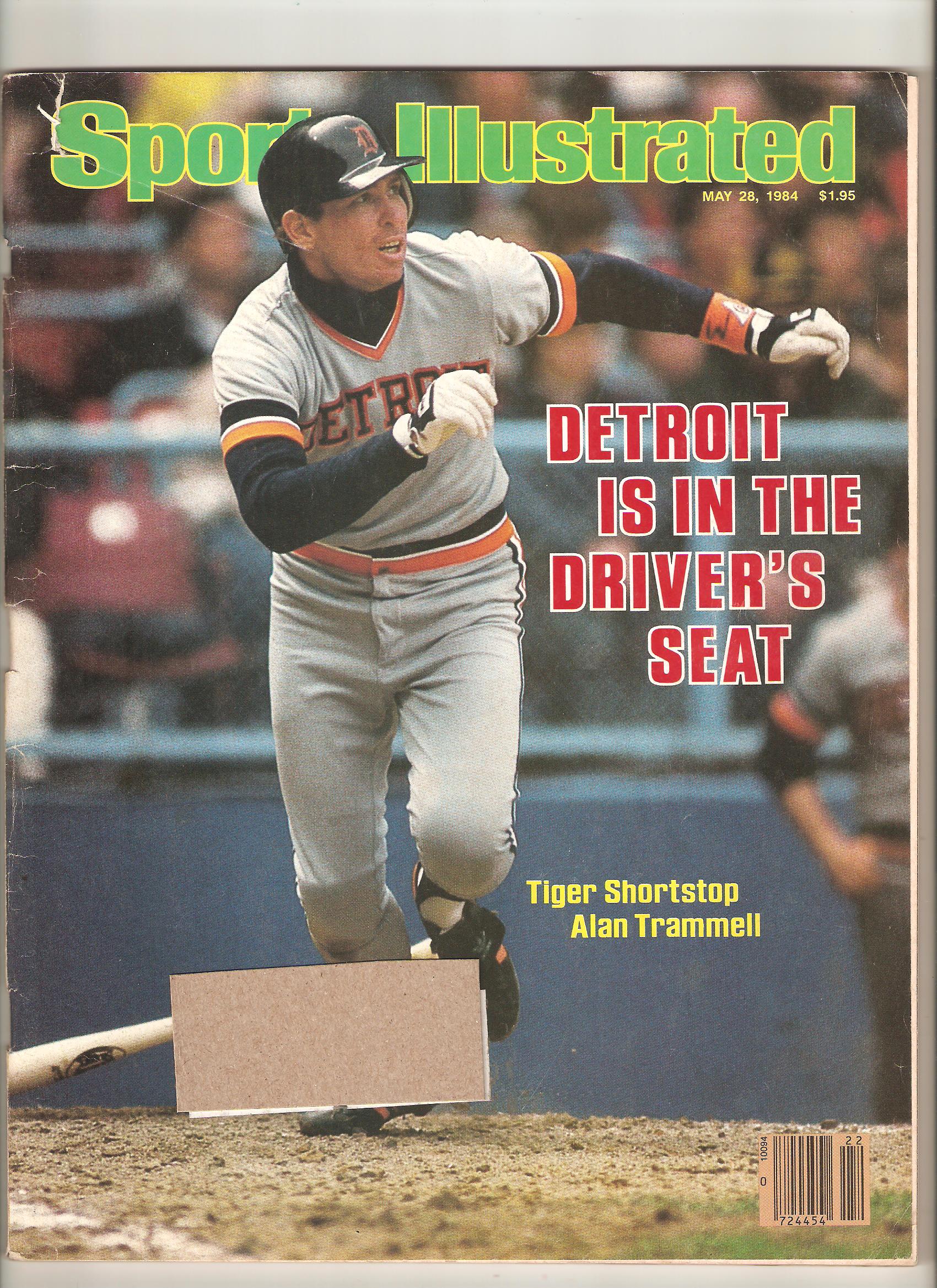
Returned to his customary #2 spot in the batting order in 1983, Trammell batted .342 after June 1. He finished the year at .319, good for fourth in the league. The Tigers won 92 games and gave a preview of things to come. Led by Trammell, the 1984 Tigers raced off to a historic 35-5 start en route to a wire-to-wire World Championship. Trammell made the cover of Sports Illustrated twice that year, the second after being named MVP in the World Series for batting .450 including two home runs in Game Four. He and Lou Whitaker even made an appearance on the hit TV show Magnum PI.

Injuries began to hamper Trammell in the following years, but in 1986 he became only the second player in Detroit history to hit 20 home runs and steal 20 bases. His best statistical year came the following season. Moved to the cleanup position after the departure of Lance Parrish, he became the first Tiger since Al Kaline to have 200 hits and 100 RBI in the same season. He led the Tigers in a dogfight with the Toronto Blue Jays for the AL East title, won by Detroit on the season's final day.

As the seasons went on, Trammell became the face of the Tigers. He was fourth in the league in batting in 1990 and an All Star for the sixth and final time. From then on, injuries reduced him to a part-time player, which he accepted with grace. He retired in 1996. He returned to the Tigers in 2003 as their manager and presided over one of the worst teams in major league history as the Tigers lost 119 games. He was let go by the team following the 2005 season and is currently the bench coach for Lou Piniella on the Chicago Cubs.

Why I love this card
Trammell was a significant part of my childhood. I was nine the summer this card came out and grew into a major Trammell fan. I was in eighth grade when he was named MVP of the World Series and in 11th when he led the Tigers past the Jays. I was 25 when he retired and was at Tiger Stadium for his final game. In his last appearance he got a base hit and moved the tying runner over to third. Typical Trammell, doing all of the little things to put his team in a position to win.

Something else....
Everyone knows about Trammell and Whitaker playing the most games as teammates (1918) and have turned the most double plays than any other combination in history. But allow another personal reflection. November 11, 1996. I am at Michigan Stadium for a Penn State-Michigan football game. Halftime I go to use the bathroom and the lines are enormous. I'm looking around and standing directly behind me is Trammell, not two months after he retired. After debating whether or not to acknowledge him, I turn around and say, "Normally I would shake your hand and thank you, but this is really not the place." Trammell laughed and then thanked me for being a fan. Class act.

On this date in 1980:
Paul McCartney is jailed in Tokyo for 10 days on marijuana possession.

By the way, time for another poll. The Burger King Winfield was only the second non-1980s base card to win the election (Ray Knight was the other)

Sunday, January 10, 2010

#231 Steve McCatty


Who is this player?
Steve McCatty, starting pitcher, Oakland Athletics
In his second full season in the major leagues, Steve McCatty was one of the fabled "Five Aces" that led the Oakland A's into contention in 1980. With the notorious Billy Martin as their manager, McCatty teamed with Mike Norris, Rick Langford, Matt Keough and Brian Kingman to form a starting rotation that was the envy of every team in the game. The A's finished in second place and the righthanded McCatty contributed 14 victories, eight in the second half to keep the A's in contention.

A native of Troy, Michigan, McCatty signed with the A's as an amatuer free agent in 1973. He spent several years in the minor leagues pitching as both a starter and a reliever with brief looks at the major league level in both 1977 and 1978. As the A's decended into the cellar of the AL West, McCatty was given an opportunity that he took full advantage of in 1979. He earned a spot on the pitching staff in in May and began his season 4-0. The hard-throwing McCatty won 11 games for a team that won only 54, pitching eight complete games and leading the team in ERA.

McCatty notched his best season in 1981. As the A's cruised to a playoff spot, Steve led the American League in victories and shutouts. His 2.33 ERA was third in the league and he finished second in the Cy Young Award voting. He pitched a complete game victory in Game 2 of the AL West playoffs against the Royals, but McCatty and the Yankees did not fare as well in the ALCS, losing to the Yankees in three games.

Known as a practical joker, McCatty once set Martin's shoelaces on fire at the moment the manager was giving the sign for one of his celebrated Billy Ball suicide squeezes. But the fun was over for McCatty in 1982 as he began to suffer arm problems. Not wanting to lose his spot in the rotation, McCatty pitched through the pain, which turned out to be a knot in his rotator cuff. He did not have surgery and slowly worked his way back into the A's starting rotation by 1984. Injuries persisted and his ninth and final season in the majors was 1985. He signed a minor league contract with the Chicago White Sox and pitched in the minors for two years (1986-87) before finally retiring.

Today, McCatty is the pitching coach for the Washington Nationals, a position that he assumed in June of 2009. He had previously spent several years coaching in the minor leagues and most recently at the major league level with the Detroit Tigers in 2002. Still residing in his native Michigan, McCatty also spends the offseason as a private pitching instructor with Jason Thompson Baseball.

Why I love this card
I had mentioned previously that there are several cards in the 1980 set that remind me of the day that my Grandpa died. Sorry for the downer, but McCatty one that I distinctively remember pulling from a pack that day. Even now, whenever I see or hear about McCatty I think of Grandpa.

Something else....
From Wikipedia: During in a 1982 exhibition game against the San Diego Padres, McCatty steped to the plate wielding a toy 15-inch bat but was refused by umpire Jim Quick to hit. McCatty was instructed by A's manager Billy Martin to use the toy bat as a protest, who was furious that the DH rule was not allowed in National League ballparks.

On this date in 1980:
After six seasons on NBC, the final episode of "The Rockford Files" aired. While still a ratings success, the show was cancelled due to the health concerns of star James Garner, who was suffering from bad knees and back as well as an ulcer.

Saturday, January 9, 2010

#230 Dave Winfield


Who is this player?
Dave Winfield, right fielder, San Diego Padres
Hall of Fame, Class of 2001
Coming off a season in which he led the National League in RBI, Dave Winfield entered 1980 in the final year of his contract with the San Diego Padres. As the year began, he shocked the Padres and baseball by asking for a $20 million dollar, 10-year deal. The contract discussions dominated Winfield's 1980 season and while he was again an All-Star, there was a drop in his offensive numbers from the previous year. The Winfield Sweepstakes began in earnest when the season ended. The New York Yankees won Winfield's services, signing him to the richest contract in baseball history at the time.

Born the day of "The Shot Heard 'Round The World," indeed it was as if Dave Winfield was destined for baseball stardom. The 6'6" Winfield excelled at several sports as a youth and he earned a full scholarship to the University of Minnesota for baseball and basketball. He led the Golden Gophers to a Big Ten Championship in basketball and was drafted by four professional teams, the Padres, two basketball teams, the Atlanta Hawks and Utah Stars of the ABA and the Minnesota Vikings (even though Winfield never played college football).

Winfield chose baseball and he was promoted directly to the majors, never spending a day in the minor leagues. He quickly became the Padres first true superstar earning Gold Glove accolades and was a legitimate MVP candidate. Dave was the first active athlete ever to establish a charitable foundation. Founded in 1975, the Winfield Foundation provided scholarships and education for underprivileged kids. It also inadvertently opened batting practice at the All-Star Game when Winfield brought nearly 10,000 kids to the hometown event in 1978.

When he moved on to New York, Dave enjoyed a successful, yet sometimes tumultuous nine years. The Yankees adavnced to the World Series in Winfield's first year, but he struggled, batting .045. He was selected to the All-Star Game every season and won five of his seven career Gold Gloves. He engaged in a memorable batting race with teammate Don Mattingly in 1984, batting a career high .340. As his time in New York wore on, he fell out of favor with owner George Steinbrenner. His attempts to discredit Winfield and his foundation temporarily led to Steinbrenner's banishment from Major League Baseball.

After a brief stop with the California Angels, Winfield signed on with the Toronto Blue Jays as a free agent in 1992. It was there that Winfield earned redemption by leading the Jays to a World Series title. In the 10th inning of Game 6, Winfield had the deciding a hit, a double that scored the game-winning run. Dave spent the last three seasons of his 22-year career with the Twins (where he achieved his 3000th hit)and Indians. In retirement, he gained several accolades, with the ultimate being his induction to the Hall of Fame in 2001. Today, Winfield can be seen as an analyst on ESPN's Baseball Tonight.

Why I love this card
Winfield had a lot of cards in 1980. Below is also his Topps Super Card and his Burger King Card. The BK one is different than the regular issue, so that means it's time for another vote - the ballot box is now open.

Something else....
At first I thought I would mention the Seagull incident in Toronto but that one has been told and retold. One I didn't know came in 1994. Winfield was traded to the Cleveland Indians at the trading deadline for a "player to be named later." The 1994 season had been halted two weeks earlier and eventually cancelled by the strike. Winfield did not get to play for the Indians that year and no player was ever named in exchange. To settle the trade, Cleveland and Minnesota executives went to dinner, with the Indians picking up the tab. This makes Winfield the only player in major league history to be traded for a dinner.

On this date in 1980:
Detroit Tigers outfielder Al Kaline became only the tenth player in history to become elected to the Baseball Hall of Fame in his first year of eligibility. Brooklyn Dodger outfielder Duke Snider, who waited 11 years, is also elected.


Friday, January 8, 2010

#229 Jim Bibby


Who is this player?
Jim Bibby, starting pitcher, Pittsburgh Pirates
As the Pirates began the defense of their World Championship in 1980, Jim Bibby emerged as the staff ace. The 6'5" righthander raced to a 11-1 start and was selected to his first All-Star Game, where he pitched a scoreless sixth inning. One of his more impressive performances of the year came on May 27, when he pitched 11 innings against the Phillies in a 3-2 Pirates victory. While Pittsburgh failed to repeat, Bibby tied a career-high with 19 wins, led the league in winning percentage and was third in the Cy Young Award voting.

Born in Franklinton, North Carolina, Bibby had to endure more detours than a normal prospect on his path to the major leagues. After being drafted by the New York Mets out of Fayetteville State University in 1965, he missed two years because of military service that included a tour of Vietnam. Another year was lost because of a back injury that required spinal fusion surgery. Despite that, Bibby perservered and made his major league debut as a member of the St. Louis Cardinals in 1972.

He was traded to the Rangers in 1973 and was immediately inserted into their starting rotation. He threw a one-hitter in his first month in Texas and later that season, fired the first no-hitter in team history on July 30, 1973 against the World Champion Oakland Athletics. The following year, he won 19 games on a surprising Rangers squad that finished second in the AL West. The dependable Bibby finished second in his league that year with 41 starts.

Bibby started out slowly in 1975, with an ERA over 5.00 when he was traded again, this time to the Cleveland Indians. Bibby spent a little over two years in Cleveland, again serving as a durable and dependable part of the Tribe's starting rotation. He won 30 games with Cleveland before entering the free agent market and being signed by Pittsburgh in 1978. He spent six productive seasons with the Pirates, going 12-4 with a 2.81 ERA in 1979 and starting Game 7 of the World Series. Although he did not earn a decision in the postseason, Bibby had a 2.08 ERA in three starts as Pittsburgh went on to a title.

An arm injury caused him to miss the entire 1982 season and he spent 1983 as a swingman. It was a rough year for Jim as he finished with a 6.69 ERA. He returned to Texas in 1984 for his 12th and final season. Bibby spent many years as a coach, reaching the Triple-A level in 2000. The bulk of his coaching career came with the Lynchburg Hillcats, who honored him by retiring his number in 2002. After two knee replacement operations in 2001, Jim Bibby's coaching career came to an end and he is enjoying retirement in Madison Heights, Virginia.

Why I love this card
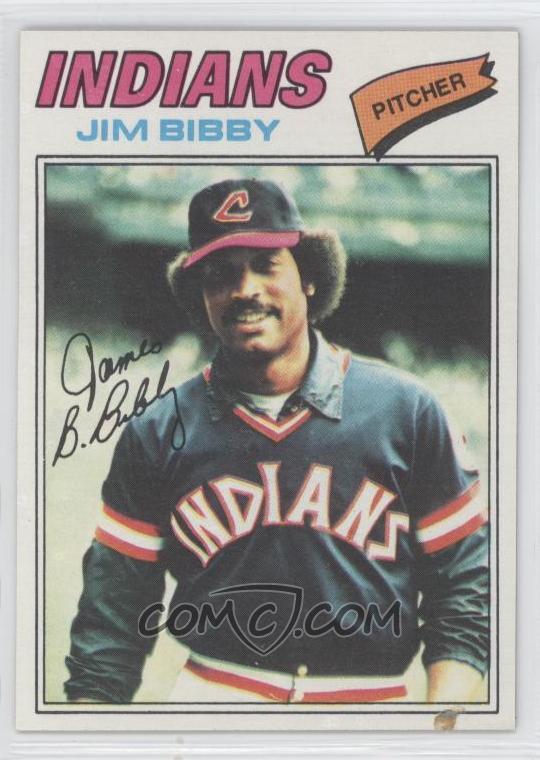
I love this card, primarily because it reminds me of this card. As much as I could, I traded my 1980 doubles to the older kids for cards from other years. It didn't matter who they were actually, I just wanted the cards. I'm sure that I got rooked often, but I didn't care then and don't care know. There was something about that 1977 Bibby card with the awesome afro and Indians jersey that appealed to me. When I was told that the photo was taken at Tiger Stadium when they had green seats - I was hooked.

Something else....
Bibby's brother is Henry Bibby, a former NBA star, primarily with the Philadelphia 76ers. His nephew (and Henry's son) is Mike Bibby who is currently playing with the Atlanta Hawks.

On this date in 1980:
The NCAA decides to sponsor women's championships in 5 sports; women's basketball, field hockey, tennis, swimming and volleyball.

Wednesday, January 6, 2010

#228 Johnny Oates


Who is this player?
Johnny Oates, reserve catcher, Los Angeles Dodgers
Shortly before the 1980 season began, Johnny Oates was released by the Los Angeles Dodgers. Less than a week later, he signed on with the New York Yankees, with whom he spent the entire campaign. Oates was used sporadically but his primary contribution to the club came in working with the pitching staff and mentoring starter Rick Cerone, who was replacing the late Thurman Munson. By all accounts, Johnny was a good and popular teammate and the Yankees went on to win the AL East in 1980.

Known throughout his career as a defensive specialist and a good caller of games, the lefthanded batting Oates was drafted by the Baltimore Orioles in 1967 off of the campus of Virigina Tech. Johnny was given a brief look in 1970 and enjoyed an outstanding season at Triple-A Rochester in 1971, where he led the International League in fielding percentage. The following year, he earned a position as part of a platoon with Andy Etchebarren and batted .261. At season's end, he was included in a package that found him traded to the Atlanta Braves.

It was in Atlanta that Oates received his only opportunity to be a regular and was the Braves starting catcher for two seasons. It was during that time that Oates cemented his reputation as a good defensive player and a valuable asset to a major league club. Indeed, he was trade twice more before the end of the 1970s, both times to contending clubs, first to the Philadelphia Phillies and then to the Los Angeles Dodgers.

With the Phillies, he worked his way into a spot starting role and helped tutor All-Star Bob Boone. He appeared in the NLCS in 1976 as Philadelphia made the postseason for the first time in 26 years but was traded to the Dodgers after the season. With Los Angeles, he appeared in two World Series, unfortunately the Dodgers lost both contests. In New York, he again joined a contender, as the Yankees tmade the playoffs both years Oates was there. He retired when the 1981 strike hit, ending his 11-year major league career.

Oates moved on to the second phase of his baseball life, as a coach and manager. He was named manager of the Baltimore Orioles in 1991 and moved on to the Texas Rangers in 1995. The Rangers won their first ever AL West title under Oates and qualified for the playoffs on three separate occasions. Oates was rewarded for his managerial efforts in 1996 when he was named AL Manager of the Year. In 2001, he was diagnosed with brain cancer during which he renewed and promoted his relationship with God. He made an emotional return to Camden Yards the following spring when he threw out the first pitch on Opening Day. Johnny passed away in his native Virginia surrounded by his family in 2004.

Why I love this card
OK, I know that this Johnny Oates is not this Johnny Oates. However, if there was a group around you and you got this card, invariably the group would start singing "Rich Girl." Personally, I think it was a cheap excuse to say "bitch."

Something else....
Johnny Oates is one of only two Texas Rangers to have his number retired. It was retired in a ceremony posthumously during the 2005 season. The club honored Oates by wearing a patch on their uniform that year and hanging a sign in the outfield with Oates' name and number.

On this date:
The Pittsburgh Steelers defeated the Houston Oilers 27-13 in the AFC Championship game and advance to their fourth Super Bowl of the decade. The game was memorable for a controversial play that eventually led to instant reply being used by officials. In the NFC, the Los Angeles Rams ended the Cinderella dreams of the Tampa Bay Buccaneers, defeating the Bucs 9-0.

Baseball Digest Giveaway


Several years ago, our friends over at Grand Slam 1978 was gracious enough to give us his collection of Baseball Digest magazines. If you are like me, Baseball Digest was an integral part of my reading growing up. Our school library used to carry them throughout the year and I nearly always had one for "silent reading" after recess. Anyway, this particular group is a wonderful lot stretching from 1982 to about 1987. Two of the years are bound that make them all the better. I have finally made the room to display my run from 1979-1990 on a shelf in our library downstairs.

What I didn't realize is that I had duplicates of many of them purchased over the years at garage sales, flea markets and thrift shops. I don't have the room to keep the duplicates and I don't particularly want to be bothered selling them on ebay.

I would like to return the gesture that Grand Slam 1978 showed me by giving my extra copies to the friends and followers of 1980 Topps Baseball. To be honest, I don't even know if anyone would even want these. However, if you are interested, email me at maxcarey@yahoo.com with your wants. There are about 50 in all so if you want them all, we would have to work out something with postage.

Any questions, you can leave a reply here too.

Tuesday, January 5, 2010

#227 Len Barker


Who is this player?
Len Barker, starting pitcher, Cleveland Indians
After several seasons of inconsistent performance, Len Barker put it all together in 1980 to have his finest season. The righthander always had an intimidating fastball and he used it that year en route to a 19-win season and led the American League in strikeouts (187). The Indians' ace was particularly impressive in the second half of the season, when he went 12-5 with a 3.45 ERA and five complete games. Len finished sixth in his league in victories but also ranked in the Top Ten in walks and led the circuit in wild pitches.

Originally selected out of high school by the Texas Rangers in 1973, Barker was considered an exceptional pitching prospect. There were concerns about his control, something that would plague Barker on and off throughout his professional career. He was given a brief look in 1976 and in the two following seasons, he was alternated between starter and reliever. The Rangers apparently became disenchanted with Barker in 1978 when he struggled and was even sent to the minor leagues. He was included with Bobby Bonds in a trade with the Cleveland Indians.

He was inserted into the Tribe's starting rotation in 1979, the first real opportunity for him to start on a consistent basis. The high point of Barker's career undoubtedly came during the 1981 season, where he became only the tenth man in major league history to pitch a perfect game. You can view clips of that game here. He was selected as an All-Star that year and received the loudest ovation when he was introduced in front of his hometown fans in Cleveland. When he appeared in the game, he received a kiss from Morganna. Barker again led the American League in strikeouts in 1981, 127 in a shortened season.

A durable starter, Barker won 15 games in 1982, logging 244 innings and pitching a career-high 10 complete games. The Indians made the decision to trade Barker to the Atlanta Braves in 1983 as the Braves were looking to defend their NL West crown. At the time, Atlanta held a slim first place lead, but Barker and the Braves flopped down the stretch, failing to win the division. Barker signed a large contract with the Braves shortly after the trade who were hoping to count on him for several years to come.

Injuries and inconsistency undermined Barker's tenure in Atlanta as two of the players traded for him (Brett Butler, Brook Jacoby) became All-Stars. As the Braves sunk into the second division, Barker was unfairly singled out as an example of the team's plight. He was released in 1985 with three years remaining on his contract and spent all of 1986 at Triple-A in the Montreal Expos chain. He returned to the majors with the Brewers for his 11th and final season in 1987. Barker now lives in Cleveland area and has operated a construction and remodeling business for the past decade. He remains a fixture at Indian events and makes several personal appearances every year.

Why I love this card
Two Indians only four cards apart (the other being Ron Hassey). Not counting League Leader or Highlight cards, this is the shortest distance between two guys sharing the same team. Interestingly, the two would team up in Barker's perfect game in 1981.

Something else.....
For years, a clip of Barker had made every blooper tape ever produced. In 1978 as a member of the Texas Rangers, Barker uncorked a wild pitch that went halfway up the screen behind home plate and rolled to the edge of the roof before finally descending back to the ground. I must have seen this play hundreds of times, yet cannot find any video of it on the net. I apologize to those of you who have never seen this play, those of you who have know what I'm talking about. A boxscore of the game is here.

On this date:
Six Republican candidates for President met in Des Moines, Iowa in the first debate of the 1980 Presidential race. The candidates were: Sen. Bob Dole of Kansas, Rep. Phillip Crane of Illinois, Sen. Howard Baker of Tennessee, former Texas governor John Connolly, John Anderson, and George Bush. A seventh candidate, Ronald Reagan, did not appear at the debate, saying that it was "divisive" to the party. Reagan of course, would go on to win the presidency in November.