Showing posts with label New York Yankees. Show all posts

Monday, August 1, 2016

#387 Fred Stanley


Who is this player?
Fred Stanley, infielder, New York Yankees

Widely known as a defensive specialist, by 1980 Fred Stanley had seen his playing time decrease for the third consecutive year in the Bronx. It was unfortunate timing for Stanley, seeing that incumbent Bucky Dent was out of the lineup due to injuries. Mainly hampered by injuries himself, Stanley saw much of his playing time usurped by both Brian Doyle and Joe Lefebvre. This made Fred expendable and Stanley was not included on the postseason roster of the AL East Champion Yankees. New York was swept by the Kansas City Royals in the ALCS. Before the calendar would turn to 1981, Stanley's time in Gotham was over, as he was traded to the Oakland A's on November 4, 1980.

Today, Fred Stanley is commonly referred to as a "baseball lifer." A respected judge of talent Stanley most recently helped architect the rise of the San Francisco Giants, serving as the director of player development from 2008-2013 and prior to that was the Giants coordinator of minor league instruction. Players such as Buster Posey, Madison Bumgarner, Pablo Sandoval and Tim Lincecum were all under Stanley's watch as the Giants won three World Championships in the past decade. Presently he serves as a special assistant to the Giants.

But prior to his long and successful career developing major league talent, Fred Stanley was a boy from Farhamville, Iowa with major league aspirations. Like most players of this era, Stanley was a high school star, which resulting in a selection by the Houston Astros in the early days of the amateur draft. Houston sold him to the Seattle Pilots in their first and only season, where he made his major league debut in 1969. In time, Stanley would be the last active Seattle Pilot in the major leagues. During this era, the position of shortstop was seen as a defensive one, and anything a player could contribute with the bat was additional, but not primary.

Nicknamed forevermore "Chicken" in the minors due to youthful exuberance of young men, Stanley provided that "good glove," but he was often moved from team to team early in his career, from Seattle to Milwaukee to Cleveland and then to San Diego. To help himself with the bat, Stanley batted from both sides of the plate during the first few years of his career before giving it up and staying a right-handed hitter. When Fred was traded to the New York Yankees prior to the 1973 season, it would begin the longest association in which he is most remembered.

Fred Stanley was present as the Yankees were purchased by George Steinbrenner and began their ascent in the standings. He was present when Billy Martin was named manager and for two seasons, was the everyday shortstop. He was the starter as the Yankees won their first pennant and played in their first World Series in 12 years. Stanley would play a major role that season, batting .238 and finishing as the runner up in his league in fielding at his position. And perhaps unfairly, was singled out by his owner as a primary reason that the Bombers did not win that year. This was the error that ended up costing the Yanks Game Two, but lost to history was Stanley's role in starting the late rally that tied up the game in the first place.


Stanley would spend three more years in the Bronx Zoo, winning two championship rings before following manager Martin to Oakland where he would finish his 14-year major league career. A memorable part of Stanley's A's stint came in 1982, when he was fined over getting picked off second base. It was contended at the time that Stanley did so intentionally to give Rickey Henderson an opportunity to set the single-season stolen base mark in front of the home fans. A picture is below:


Why I love this card
I knew absolutely nothing about the Seattle Pilots when I first saw the back of this card. Even though it was only 11 years after their only season, it was like discovering life on Mars. Totally mind-blowing. My dad filled in the gaps, although he didn't recall many of the players, except for a certain knuckleball pitcher that once pitched for the Yankees.  It would begin a life-long fascination that I would have with the Pilots, accentuated by Ball Four that I read in high school and a Pilots hat I purchased in Cooperstown in 1989. I still have the book, but wish I still had the hat.

Something else...
An alternate printing of the Stanley card with a yellow hue in his name is one of the few "error" cards from this set. I knew nothing about that at this time either as those cards never filtered down to the plebeians getting their cards from Collie Drugs and Jerry & Goldie's Party Shoppe. If you can find one, it can fetch you a little scratch, but that's about it. A PSA 9 grade of this card (I assume that's good) is currently listed for $1,100 on ebay.  Here's a shot of it:


Sunday, June 12, 2016

#365 Bobby Murcer


Who is this player?
Bobby Murcer, reserve outfielder, New York Yankees

A popular fan favorite in the Bronx, the 1980 season was one of mixed emotions for Bobby Murcer. Part of a crowded Yankee outfield picture, a lack of consistent playing time initially frustrated Murcer. Coupled with the illness and passing of his father, Bobby was struggling, batting less than .200 as June began. He heated up with five home runs during the month including a dramatic home run against Oakland and a two-homer day against Cleveland. Bobby played an integral role in the number retirement ceremony of his friend, the late Thurman Munson in September and days later he celebrated the Yankees AL East championship. It was Murcer's first taste of the postseason, but he went 0-4 in a three game sweep of the Kansas City Royals.  The year ended with Murcer touring Japan with a major league All-Star team and opening a short-lived baseball academy in Florida.

Bobby Murcer's life and career in pretty well documented on the web, both on his Wikipedia page as well as a comprehensive biography on the SABR website. Depending on when you were born, you likely think of one of three distinct phases of Bobby Murcer's life and career:

The first is the Oklahoma kid, the heir apparent to Mickey Mantle in the Yankee legacy. Murcer idolized Mantle and achieved a thrill playing alongside him during the mid 1960s. After a stint in the army, he certainly delivered on much of this promise, hitting for power and average as the Yankees slowly started becoming a contender. A five-time All-Star, he was a legitimate MVP candidate, among the league leaders in several categories, leading the the league in on-base percentage in 1971 and runs in 1972. When Bobby clubbed four consecutive home runs in a double header against the Cleveland Indians in 1970, he was on his way to becoming a superstar in the media capital. Bobby appeared on Beat the Clock, Hee Haw and What's My Line (below). His trade to the San Francisco Giants for Bobby Bonds in 1975 was a shocker, but this was the Murcer National League fans were expecting. While he never did match his production with the Giants and later the Cubs, he was still a respected and dangerous bat.


The second phase came upon his return to the Yankees where he performed as a reserve outfielder and designated hitter. However, the most indelible image of Murcer, during this time, if not during his entire career where the events of Monday, August 6, 1979. Yankee captain and Murcer's friend Thurman Munson was being buried after a tragic plan crash. Murcer delivered the eulogy that afternoon and later that night hit a home runs a delivered the game winning hit on a nationally televised game against the Baltimore Orioles. This moment established Murcer as a Yankee legend, a elder statesman and leader in the clubhouse and on the field.


The final phase was as Yankee broadcaster, where he endeared himself to a new generation of Yankee fans. He was also instrumental in several causes, such as the Baseball Assistance Team and becoming an anti-tobacco advocate.

Murcer fought a courageous battle against cancer the final two years of his life, passing away on July 12, 2008. Earlier that year, his biography "Yankee For Life" was released. A moving and inspirational memoir, Murcer wrote with incredible determination, positivity and courage in the face of a deadly disease. It stands as a testament to what kind of human being Bobby Murcer was.

Why I love this card
I am not then, nor am I know a Yankee fan. I don't know why, but getting a Murcer card was different. He was from a different era, played in the old Yankee Stadium with Mantle, Maris and Ford. I respected his longevity at that point but what really stood out was his shin guard. You really didn't see that often in 1980 and it jumped out at me. I played soccer and had shin guards like this and had no clue why Murcer would wear one. Just another source of endless childhood debate.

Something else....
In his autobiography, Murcer writes about his ill-fated baseball school. With big names such as Lou Piniella, Rick Cerone and Charlie Lau, the camp nonetheless underestimated expenses and failed to make money. There was one success story, future major league All Star Mike Stanley was a the most famous graduate, enjoying a 15-year major league career.

Sunday, July 10, 2011

#334 Jim Beattie


Who is this player?
Jim Beattie, starting pitcher, New York Yankees
After spending two frustrating seasons in New York, by the time 1980 began, Jim Beattie was wearing the uniform of the Seattle Mariners. The 25-year old right hander was the key man in a six player deal that sent Ruppert Jones to New York. Given an opportunity to start regularly, Beattie was immediately installed as the Mariners #2 starting pitcher. However, Jim struggled in his first season as a Mariner, with an ERA well over 5.00 for most of the season. He finished the campaign with a 5-15 record and a 4.85 ERA as the Mariners finished last in the AL West. However, it was still generally felt that there was a strong upside to Beattie and that his 1980 performance was not indicative of his true talent.

Born on the Fourth of July, Jim Beattie starred both on the baseball diamond and basketball court at Dartmouth University before he was selected by the New York Yankees in 1974. With a deep wealth of pitchers on the Yankees, it took some time before Beattie could break into the major leagues. He did so in style in 1978 defeating future Hall of Famer Jim Palmer in his debut. He begane the year slowly, but was instrumental in the great Yankee comeback that season, winning won four of his six decisions in September and finishing his rookie season with a 6-9 record. He followed that performance with a win in the ALCS against the Royals and a complete-game victory against the Dodgers in Game 5 of the World Series.

However, the chaos of the "Bronx Zoo" management did more to impair Beattie's improvement and he was shuttled between the majors and minors in 1979. He was on the mound when Carl Yastzemski collected his 3000th hit, but the year was otherwise forgettable. The trade to Seattle was welcomed by Beattie, and although he did not pitch well in 1980, his health improved the following year. As Beattie told Baltimore Sports and Life:
My improvement came as a result of two things, getting healthier and pitching more. In 1980 my shoulder did not allow me to throw easily and hard although I kept going out to pitch and tried to battle through it. When I got healthy during the 1981 season (pitching in the minor leagues during the strike) I came back a different pitcher

In 1982, Beattie set a club record for a starter by pitching 19 consecutive scoreless innings and finished in the top ten in strikeouts. On September 27, 1983, Beattie threw the first one-hitter in Mariners history and the following year was fourth in the American League in complete games. However, it was difficuly for Jim to post a winning record because he pitched for poor Mariner teams. The final two seasons of his nine-year career were marred by injuries and when he retired after he was released by the Mariners at the end of the 1986 season.

Beattie returned to school where he earned his Master's Degree and began a long career in baseball administration. He returned to the Mariners in 1989 as Director of Minor League Operations and help oversee the M's rise in the 1990s. He moved on to the Montreal Expos as their General Manager and later assume the same role with the Baltimore Orioles. Today, he is a employed as a scout with the Toronto Blue Jays.

Why I love this card
Beattie signs his full name on the facimile autograph on this card. This was the way that we had to sign things in school. Complete first name "no nicknames," as Sister Julie would say, with middle inital. I wonder if Jim Beattie hated signing his full name as much as I used to back in 1980.

Something else....
Beattie was Director of Minor League Operations when they drafted Alex Rodriguez. He was also the GM when the Montreal Expos traded Pedro Martinez to the Boston Red Sox (granted, he had little choice in the matter). He also drafted future All-Stars Grady Sizemore, Milton Bradley, Jason Bay, Brandon Phillips and Cliff Lee.

Tuesday, June 15, 2010

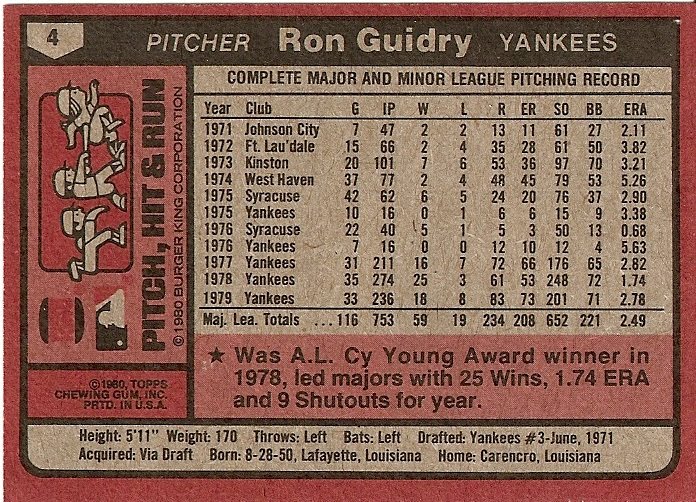
#300 Ron Guidry


Who is this player?
Ron Guidry, starting pitcher, New York Yankees
Two years removed from the best season of his career, Ron Guidry began 1980 as the unquestioned ace of the Yankees staff. In "Bronx Zoo" fashion, he started the year by being fined by the club for participating in ABC's Superstars competition. On Opening Day, the southpaw allowed only two singles and retired 20 of the final 21 batters he faced, but earned a no-decision against the Texas Rangers. His performance was streaky for much of the year, but his 17 wins helped lead the Yanks to the AL West flag. Ron started and lost Game 1 of the ALCS, a series that saw New York lose to the Kansas City Royals. When the season ended, his name was involved in trade rumors to the Boston Red Sox for outfielder Fred Lynn. Instead, the Yankees renegotiated Guidry's contract and he stayed in New York.

1978, 25-3. Those numbers will forever be linked with Ronald Ames Guidry. His dominating performance that year not only led to a Cy Young Award and an another world championship, but was one of the finest pitching seasons of the modern era. Guidry's defining moment of the 1978 season was his 18-strikeout performance against the California Angels and his .893 winning percentage that year is the highest ever for a starting pitcher. Additionally, Guidry's 1.74 ERA remains the lowest in the American League since 1968. Throw in two post-season victories, including a World Series complete game, and you begin to see just how good Guidry was at his very best.

No one could have predicted such success when the man known as "Gator" was selected by the Yankees in 1971. The Louisiana-born Guidry pitched well in the minors, but found it difficult to crack the starting rotation. There was also a knock against him that he was too small to pitch effectively in the majors. However, he was moved into the starting rotation for good in 1977 and won 16 games en route to a world championship. His blazing fastball found him atop the game's strikeout leaders and he was soon alternately known as "Louisiana Lightning." His size would never again be an issue.

A four-time All-Star, Guidry quietly distinguished himself with class, hardly ever finding himself tabloid fodder like most of his teammates. He won the Gold Glove Award five consecutive seasons (1982-86) and three times won 20 games, leading the league again in 1985. Guidry began to experience some arm trouble in 1981 and despite his high levels of achievement, it effected his pitching. He struggled during the last three years of his 14-year career and retired in 1989 when shoulder surgery did not improve his arm.

His number 49 was retired on "Ron Guidry Day," August 23, 2003. The Yankees also dedicated a plaque to hang in Monument Park at Yankee Stadium. He joined Joe Torre's staff as pitching coach in 2006 and was criticized when the pitchers did not perform well in '07 and '08. Though he was interested in returning to the Yankees for the 2008 season, he was not offered a position on new manager Joe Girardi's coaching staff. He has returned to the Yankees as a spring training instructor and remains a popular figure at Yankee events and Old-Timers gatherings.

Why I love this card
When I got this card, I was convinced that Guidry was going to go to the Hall of Fame. This was one of those "hands off" cards that everybody respected. You didn't even bother to ask to trade for it because the unspoken law was that you didn't trade it. After all it was a "hundreds" card. Any card that ended with two zeros (300) was special. You either had it or you didn't. It would be a couple years later when we stopped caring about that and just traded liberally.

Something else....
Guidry was featured earlier on the ERA Leaders card, and he also had two other issues in 1980, first in the Burger King set and again in the Topps Super. Here are both.


Saturday, May 15, 2010

#278 Jim Spencer


Who is this player?
Jim Spencer, reserve infielder, New York Yankees
Generally regarded as one of the top defensive first basemen of his era, Jim Spencer of the New York Yankees was a part-time player in 1980. Splitting time between first base and designated hitter, the lefthanded batting Spencer provided some offensive pop (13 HR) and a reliable late-inning glove. He belted a grand slam early in the season against the Texas Rangers and had a five-RBI performance against the Oakland A's in June. Spencer appeared in the ALCS that fall after he helped the Yankees win the AL East but the Yanks were swept by the Kansas City Royals three straight.

The grandson of a former major leaguer, Jim Spencer was 3-sport athlete in high school and hit a home run at Yankee Stadium as a American Legion All-Star in 1963. Two years later, he was a first round selection (11th overall) by the California Angels. He was the MVP of the Texas League in 1967 and earned a trial look by the Angels after leading El Paso to the championship in 1968. He wrested away the starting position at first base the following season and would remain there for the next four and a half seasons.

In 1973, he was traded to the Texas Rangers and was selected to the American League All-Star team. It was also in Texas where he established his reputation as a fine fielder. Although he already won a Gold Glove in 1970, Jim committed only 2 errors at first base over the next two seasons, in excess of 180 games. Now with the White Sox, he had another fine performance in 1976, only committing two errors in 143 games played. Another Gold Glove followed in 1977. Spencer was traded again in 1978, this time to the New York Yankees, where he saw his first World Series experience as he helped the Yankees overtake the Boston Red Sox and charge to a Series championship.

When he reported to spring training in 1981, Spencer complained to press about excessive platooning the previous summer by former manager Dick Howser and pressure from George Steinbrenner who was unhappy with Spencer's lack of production at the plate. Less than two months later, the Yankees tried to trade Spencer to Pittsburgh, but Commissioner Bowie Kuhn vetoed the deal because the Yankees would have given the Pirates $850,000. exceeding Kuhn's limits for cash transactions. In May, the Yankees sent Spencer to the Oakland Athletics, where he would spend the remaining years of his 15 year career.

After his playing career ended, Spencer was an assistant baseball coach at Navy, and he worked briefly as a scout for the Yankees. He often appeared at charity events and Yankee fantasy camps. Spencer suffered a heart attack at his winter home in Sarasota, Florida in February 2002 and passed away at the age of 54. Only five days before he died, Spencer had played first base in a benefit game for the Joe DiMaggio Children's Hospital in Hollywood, Florida.

Why I love this card
What stood out most with this card is that Spencer was so bad-a**, he is glaring straight into the sun without sunglasses or eyeblack. And isn't the least bit afraid. That may not sound like much, but think back to Little League. What did every kid do the moment any trace of sun was in their eyes? That's right turtle-up at even the sound of a ball coming at you. Seeing Spencer on this card not at unintimidated by sunlight oozed "major leaguer" for me.

Something else....
Like the Rick Bosetti card, Topps again shows some laziness with Spencer's 1980 issue. Check out the back again of Spencer's 1980 card and his 1979 card. They both use the same exact like about a pinch-hit grand slam in 1978!


On this date in 1980:
Shawn Weatherly of South Carolina is crowed Miss USA. Bob Barker hosts the pageant from Biloxi, Mississippi. You can watch the crowing moment here.

Wednesday, February 24, 2010

#250 Jim Kaat


Who is this player?
Jim Kaat, relief pitcher, New York Yankees
Like many Yankees before him, Jim Kaat began the 1980 season irritated with Yankee owner George Steinbrenner. As Kaat wrote in his 2003 book, first Steinbrenner reneged on his 1980 salary and then made him report to Spring Training as a non-roster player. His pride challenged, he pitched 19 consecutive scoreless innings and made the squad. He only appeared in four games and was sold to the St. Louis Cardinals at the end of April. He was very effective in middle relief for the Cards, winning six games, losing four and lodging a 3.40 ERA.

When Jim Kaat retired in after 25 seasons in the major leagues, he had spent more time in a major-league baseball uniform than any other player. in a career that spanned four decades, he originally broke in with the Washington Senators in 1959. In the next quarter century, he won 283 games with five different teams, but made his mark as a member of the Minnesota Twins. He led the league with 25 wins in 1966 and won 10 or more games for fifteen consecutive seasons. He was consistently among the league leaders in innings pitched and after he transitioned to the bullpen, he became a World Champion with St. Louis in 1982.

History will remember Kaat for two things: his 16 consecutive Gold Gloves and his reputation as a fast worker on the mound. Legendary pitching coach once said he never saw a pitcher work as quickly as Kaat and his games consistently were little more than two hours. For example, in 1974, the year Kaat won 21 games for the Chicago White Sox, his games averaged 2 hours 12 minutes per start. Nine starts finished in under two hours and the only two games that went longer than three hours were 12 inning affairs.

For many years, Kaat held the record for Gold Gloves by a pitcher until it was eclipsed by Greg Maddux. However, recent studies have attempted to question his real prowess as a fielder. Cited as evidence is his 1969 season, when he won a Gold Glove in spite of eight errors and a fielding percentage of .826. Kaat's smooth delivery and excellent pickoff move did enhance his reputation, but one does not win 16 consecutive Gold Glove by reputation or accident.

When his playing career ended, Pete Rose hired him as a coach with the Cincinnati Reds for a two years (1984-1985). He then transitioned to a lengthy broadcasting career for Twins and Yankees, but also for CBS, NBC, ABC, Fox Sports, ESPN, TBS and the MLB Network. He also broadcast the College World Series and the World Baseball Classic, winning seven Emmy Awards for excellence in sports broadcasting. In 2009, Kaat retired from his broadcasting career and also ended his longtime blog, Kaat's Korner.

Why I love this card
You had to love a guy that played for the original Washington Senators. Any connection to the pre-expansion era was a plus for me. However, Topps did an interesting thing with Kaat's card the following year. The cards were nearly identical Compare:


Something else....
Kaat was the last of the original Washington Senators to play in the major leagues. A ballpark complex in his hometown in Zeeland, Michigan bears his name.

On this date in 1980:
If you were settling in to sit down and watch Flo's farewell on "Alice" on CBS 30 years ago, this is what you would have seen.

Sunday, January 3, 2010

#225 Lou Piniella


Who is this player?
Lou Piniella, left fielder, New York Yankees
Known today as the bombastic manager of the Chicago Cubs, Lou Piniella's playing days have largely faded quietly into memory. In 1980, he was a integral part of the New York Yankees. A fan favorite that was greeted by a chant of "Looooooooou" when he stepped to the plate, the righthand hitting Piniella batted .287 in 116 games. He helped lead New York to the playoffs for the fourth time in five years. When the Yankees lost in the ALCS, whispers of concern began regarding Lou's age (36) and his lack of run production (27 RBI).

Lou Piniella's 18-year playing career stretches as far back as 1964, when he appeared in four games for the Baltimore Orioles. The Florida native was an excellent amateur athlete, being named an All American in high school (basketball). Lou played PONY league baseball with fellow standout Tony LaRussa and starred at the University of Tampa. After his brief stint with the Orioles, Piniella spent time in three different organizations before returning to the majors in 1968 as a member of the Cleveland Indians.

He was selected by the expansion Seattle Pilots for the 1969 season, but he was traded to the Kansas City Royals shortly before Opening Day. The Royals were also in their maiden voyage and Piniella was their first ever leadoff hitter. He is in the Royals record book for earning the first hit a scoring the first run in team history. Lou's performance (.282 11HR 68RBI) earned him the Rookie of the Year award. In five years in Kansas City, Piniella batted .286, and had an excellent 1972 season. That year, he earned his only All-Star nod, led the league in doubles and finished second in batting.

Prior to the 1974 season, he was traded to the Yankees and it was in New York that he achieved his most fame as a player. He played in four World Series with the Yankees was part of the fabled "Bronx Zoo" that won the World Championship in 1977 & 1978. His fielding play in ninth inning of the 1978 AL East playoff is credited with helping the Yankees advance to the playoff. Lou spent 11 seasons in New York, often times in the center of controversy, one of more aggressive and emotional players on the team. He retired in a tearful ceremony in June of 1984.

In nearly every season since his retirement as a player, Piniella has managed at the major league level. After a tumultuous tenure as Yankee GM and manager, he led the Cincinnati Reds to a World Series title in 1990. From there he went to Seattle where the Mariners became contenders for the first time and achieved a record 116 wins in 2001. Unable to win a World Series after ten years in Seattle, Piniella returned to his home town to manage the Tampa Bay Devil Rays for three seasons before becoming the Cubs skipper in 2007.

Why I love this card
One of the neighborhood kids, Louie down the block, moved onto our street in 1978. They lived in Flushing, New York and he was a huge Yankees fan. Since they shared the same first name, he was naturally a huge Piniella fan as well. It was an automatic that if anyone got a Piniella card we would just give it to him, more to shut him up than anything else. He tried to get me to like Chris Chambliss for the same reasons, but it just didn't take.

Something else....
Piniella holds the distinction of being the only major league player to be thrown out at every base in a single game. He accomplished this "feat" on April 16, 1970 in Milwaukee. It was a good game otherwise for Lou, he went 3-5 with a homer and three RBI and the Royals defeated the Brewers 8-6.

On this date:
Alfred Hitchcock is knighted during ceremony at Universal Studios in Los Angeles, the first ever director to be so honored. Hitchcock was named by Queen Elizabeth II the knight commander of the Order of the British Empire. The 80-year old Hitchcock would pass away on April 29, 1980.

Saturday, December 5, 2009

#207 1979 Earned Run Average Leaders


What is this card?
1979 Earned Run Average Leaders Card
Ron Guidry was the defending AL ERA Champion in 1979 and successfully defended his crown, even though his ERA was nearly a run higher than the previous year. J.R. Richard of the Astros led all of baseball with a 2.71 ERA. Richard is the only player to appear on two leader cards in 1980.

How was the race? Guidry's teammate, Tommy John was the American League leader for much of the first half, until two disasterous starts swelled his ERA and allowed Guidry to take the title. In the National League, Tom Hume was a late season challenger into the race, primarily since he was a releiver. Richard was able to nip him with 16 consecutive scoreless innings to close the 1979 season.

Where are the 1980 League Leaders? Neither Rudy May, the 1980 AL Champion nor Don Sutton, the NL Leader posted in the Top Ten in their respective leagues in 1979.

Did these players ever repeat? No. As mentioned in other posts, Richard's career was over by 1980 and the closest Guidry would ever come again was seventh in 1985.

Why I love this card
I was always intrigued by the contrast between the 5'11", 162lb Guidry and the 6'8" 225lb Richard, both of whom led their league in the same category. It truly amazed me how both could be such dominating starting pitchers. I was convinced that both would wind up in Cooperstown.

Something else....
For a New York Yankee, it seems that Ron Guidry's accomplishments have largely been overlooked. Even his 25-3 1978 season seems to be glossed over. While I'm not a Yankee fan and find that many of their players have been overrated, Guidry is one guy that I thought never received his fair share.

Thursday, October 29, 2009

#179 Ron Davis


Who is this player?
Ron Davis, relief pitcher, New York Yankees
A hard throwing righthander, Davis was entering his second full season in 1980. He was slated to serve as setup man to Rich Gossage after an effective performance as closer when Goose was injured in 1979. In a largely unheralded role, Davis won nine games, saved seven and finished the year with a 2.95 ERA. His success was instrumental in leading the Yankees to the AL East title, despite their loss in the ALCS to the Kansas City Royals. Soon, many successful teams would begin to use this formula of a solid setup man to their closer.

Originally drafted by the Chicago Cubs, he was traded while still in the minor leagues to the New York Yankees in 1978. He made the most of his first major league opportunity the following season winning 14 in relief and saving nine in 44 appearances. His performance earned him Rookie of the Year consideration as Davis finished fourth in the balloting.

1981 was arguably the best of Davis' career. He was recognized for his effective work by being named an All-Star, appeared in the World Series (a six-game loss to the Dodgers) and set a record for striking out eight consecutive batters as a reliever in a May game against the Angels. Davis would prove that this was no fluke as he struck out three or more in 11 of his 43 appearances. With his stock high, he was traded to the Minnesota Twins for shortstop Roy Smalley.

In Minnesota, Ron never attained the same level of success that he had in New York. Playing for the worst team in the American League in 1982, Davis lost nine games and his ERA ballooned. He placed in the top 10 the next four years in saves (1982-1985), totalling 106 over that span. However, Davis was the scapegoat for a Twins organization that was going through growing pains. He set a record in 1984 for blowing 14 saves a mark that still stands. In 1986, he lost his closer's role with two spectacularly blown saves early in the year. You can read about those in Davis' Wikipedia entry here.

Davis was traded to the Chicago Cubs midway through the 1986 season and spent the last two seasons of his career in middle relief with the Cubs, Dodgers and Giants. His major league career ended in 1988 after 11 seasons. Davis played in Japan in 1989 and married Kendall Davis, lead singer for the Groove Merchants. Today, he runs the Major League School of Baseball Camps for Children in Arizona and his son was drafted by the New York Mets in 2008.

Why I love this card
I can recall the date that I received this card. Sunday, August 16, 1981. The strike had just ended and the Yankees were visiting Tiger Stadium. The game was broadcast locally in Detroit. Louie down the block was a major Yankees fan and we were watching the game at his house. He was really rubbing it in when the Yankees entered the ninth with a 4-1 lead. The Tigers rallied to score four in the ninth, capped by a dramatic Kirk Gibson home run to win the game, one that will remain with me probably as long as I live. Louie was so disgusted with Davis (who allowed the home run) he traded it this card to me on the spot. That is the one you see above.

Something else....
Fitting that a Yankee card would follow a Phillie card during the World Series. During the 1981 Strike, Davis worked as a waiter in a Kansas City restaurant. He was part of the rescue efforts when a walkway collapsed on July 17, 1981 that killed over 200 people. I remember this happening at the time, but it had been pushed from my memory until I was researching Davis for this post.

Sunday, October 4, 2009

#159 Ken Clay


Who is this player?
Ken Clay, relief pitcher, New York Yankees
After spending most the 1980 season in Triple-A Columbus, the New York Yankees traded Ken Clay to the Texas Rangers in August for pitcher Gaylord Perry. As a starter in Columbus, the righthanded Clay won nine games with a 1.96 before his trade. He started eight games with the Rangers, and was victorious in his 1980 debut. Ken finished the year with a 2-3 record and 4.60 ERA. At season's end, Clay was part of a multi-player trade that found him a member of the Seattle Mariners.

A graduate of E.C. Glass High School in Lynchburg, Virginia, the New York Yankees made Clay their second selection in 1972 draft. He toiled for five years in the Yankees minor league chain where he suffered bouts of wildness and inconsistency. In two years at the Triple-A level (Syracuse), Clay walked 94 hitters in 217 innings and posted a 4.50 ERA.

Clay started the 1977 season exceptionally well, winning five with a 1.68 ERA and he finally earned his big league promotion. He spent the rest of the season on the Yankees pitching staff, appearing in 21 games. New York, meanwhile, advanced to the World Series in 1977 and Clay appeared in two games as the Yankees won their first title since 1964. Ken was again on the Yankees roster for the 1978 season appearing both in relief and occassionally starting. The Yankees repeated as World Series champions with Clay earning another championship ring and appearing in both the ALCS and Series.

He split time between starting and relieving in 1979, and at seperate times was used as replacements for Catfish Hunter and Rich Gossage when both were injured. In both instances, he did not pitch well, going 1-7 with a 5.40 ERA. These performances, along with his outings in Spring Training 1980 led to his return to the minors and ulitmately, his last appearance with the Yankees. His New York teammates did not speak kindly of Clay with Hunter saying he had "great arm, great slider, bad brains." Sparky Lyle also wrote dirisively of Clay in "The Bronx Zoo."

1981 would be Clay's fifth and final season in the majors, going 2-7 with a 4.63 ERA. In his final appearance, he started and defeated the Toronto Blue Jays on the final weekend of the season. He was released at the end of Spring Training in 1982. Clay's post-baseball career has been troublesome. He has been arrested and jailed numerous times, ranging from drunken driving to theft.

Why I love this card
Clay's signature on this card is "Kenny Clay." Don't ask me why, but I always thought that it was neat when the signature on the card didn't match the name that was "officially" listed. Also, it seemed as if all of the Yankee cards in the 1980 set showed them in their classic home pinstripes. While I'm not a Yankee fan, if you are going to show them, show them at home.

Something else....
I probably should have added a label in this blog that somehow indicates players who have been arrested or jailed, as their seems to be an inordinate amount so far. In addition to Clay, there has been Lary Sorenson, Ron LeFlore, Matt Keough, Sammy Stewart, Willie Wilson, Fran Barrios and Derrel Thomas. I have to check back and see if there are more but it seems like there have been a lot.

Thursday, September 10, 2009

#140 Rich Gossage


Who is this player?
Rich Gossage, closer, New York Yankees
Hall of Fame, Class of 2008
One of the most dominant short relievers in the history of the game, in 1980 "The Goose" had perhaps his finest season. The intimidating righthander led all of baseball with 33 saves as the Yankees won the AL East for the fourth time in five years. He slammed the door most definitively in the second half when he earned a save in 17 of his last 22 appearances, including nine in a row. Goose finished third in the MVP and Cy Young voting at the end of the year. This season would be one example Gossage's supporters pointed to when making his case for the Hall of Fame.

Born and raised in Colorado, Gossage was selected by the Chicago White Sox in the 1970 amateur draft and was in the major leagues in a little over a year. He earned his famous moniker from former White Sox roommate Tom Bradley, who said he looked like a goose when peering in to get the sign from his catcher. His first season, 1972, he went 7-1 with 2 saves, and an ERA of 4.28. By 1975, he became the White Sox top fireman, getting a league-leading 26 saves and being named to his first All-Star team. The next year, though, he was used as a starter by manager Paul Richards and lost 17 games. When the season ended, he was traded to the Pittsburgh Pirates.

Goose only spent the 1977 season in Pittsburgh where he was third in saves and again an All Star. He signed with the defending World Champion Yankees as a free agent prior to the 1978 season and his presence immediately threatened reigning closer and Cy Young winner Sparky Lyle. Goose quickly established himself as the new stopper as he closed out the AL East playoff, the ALCS and World Series as the Yankees repeated as champions. Gossage, meanwhile, was honored as the Rolaids Relief Man of the Year. His 1979 season was cut short when a locker room fight with Cliff Johnson resulted in a broken thumb.

Gossage continued his dominance in the truncated 1981 season, posting a microscopic ERA of 0.77. The Yankees again made it to the postseason, but lost the World Series to the Dodgers. As with most Yankee stars of this era, he had his run-ins with the press and owner George Steinbrenner and when his contract expired at the end of the 1983 season, he signed with the San Diego Padres. He helped lead the Padres to their first ever league pennant and the 1984 World Series. Unfortunately, San Diego fell to the Tigers 4 games to 1. After another spectacular All-Star season in 1985, Goose's effectiveness as a closer began to wane. He was traded to the Chicago Cubs at the start of the 1988 season.

He bounced around in the final years of his career, with five major league clubs and even one in Japan. He found new life as a setup man with the A's, Rangers and Mariners in the early 1990s. During this period, the still formidable Goose could still be called upon to close out a game or two. His final season was 1994 and he retired after 1002 games, 310 saves and 22 seasons in the majors. After eight years on the ballot, Gossage was finally elected to the Hall of Fame in 2008. Parts of his speech can be found here. It also earned him an appearance on David Letterman, here.

Why I love this card
While I'm not a fan of the simple head shot, here is Gossage without his classic Fu Manchu. In his Yankee years, this is the only shot of Gossage's face as all the others show him pitching. That makes it somewhat historic, I guess. Gossage discusses the origin of the Fu Manchu here. Goose also discusses the "Pine Tar" home run at that link. Finally, Topps did not make a single card of Gossage during his playing days where he was referred to as "Goose" on the front.

Something else....
I must say dear readers, at this point in the blog I am somewhat disappointed. Over the weekend, this card cameo my possession:


Needless to say, imagine my shock/dismay/joy upon seeing this and a couple other similar looking 1980 vintage cards. I was never even aware of this! Now, my absence from the card collecting scene and ignorance of the current product is pretty established. I was told by the vendor about the "Fan Favorite" cards earlier this decade, but I cannot find any information (how many were made in 1980 style) or a checklist(s). I'll give Topps this much - they did improve on the 1980 Gossage as this is certainly a better photo. I can't say the same about Cecil Cooper, featured earlier. His 1980 chops are way better.


Can anyone else provide information about these "Fan Favorite" cards? I'll feature them as I go along if I know who/what is out there.

Tuesday, August 11, 2009

#114 Juan Beniquez


Who is this player?
Juan Beniquez, reserve outfielder, New York Yankees
By the time the 1980 season began, Beniquez was already gone from the Yankees, as part of a six player deal that ultimately brought Ruppert Jones to New York. Beniquez only appeared in 62 games in 1979 as injuries limited his playing time. He was slated to be the full-time centerfielder in Seattle, but a shoulder injury in Spring Training put him on the sidelines until June. He slumped at the plate and his frustration boiled over when he was suspended by the team in September for insubordination.

One of the most well-traveled players of his generation, the righthand hitting Beniquez broke into the majors as a shortstop with the Boston Red Sox in 1971. The following season, he established a modern major league record when he committed six errors in two consecutive games, prompting the Red Sox to convert him to an outfielder. After a year in the minors, Beniquez won the centerfield position in 1974, and promptly lost it the following year to Fred Lynn. As the fourth outfielder in 1975, Juan hit .291 and appeared in the 1975 postseason for the American League champions.

Short of starting pitching, the Red Sox traded Beniquez to the Texas Rangers for future Hall of Famer Ferguson Jenkins. He was immediately inserted into the Rangers lineup as their everyday centerfielder. In 1977, he was recognized for his defensive abilities when he was awarded the Gold Glove. He also finished in the top ten in stolen bases that season. He achived career highs in home runs and RBI in 1978 but the Rangers never advanced to the post-season. He was traded to the Yankees prior to the 1979 campaign.

It was in Anaheim that Beniquez enjoyed his longest term with one team. Playing with the Angels for five seasons, he was a member of the Angels 1982 division champions. He also began a transition from a defensive specialist to a consistent .300 hitter. After never hitting higher than .291, starting in 1983 he went for .305, .336, and .304. In 1984, he set career highs for OBP (.370) and slugging (.452), and even finished 25th in the MVP voting. He was granted free agency and signed with the Baltimore for the 1986 season. On June 12th he had his greatest singular game when he hit three homers in one game. Despite hitting .300 he was on the move again, traded this time to Kansas City for the 1987 season.

He lasted only half a season in Kansas City before he was acquired by the Toronto Blue Jays for the 1987 stretch drive. His bases loaded triple in a late season game against Detroit gave Toronto a 3.5 game lead over the Tigers in the AL East with eight to play. However the Blue Jays would soon blow that lead, losing their final 7 games of the season while Detroit won 6 of its last 8 to take the division by 2 games. Beniquez played his final season in 1988 wrapping up a 17 year career with eight different teams.

Why I love this card
Hard to believe but this card is the first appearance of the bat-at-the-camera shot. Beniquez looks as if he's going to swat the "Yankees" pennant. In a different era, this shot was fairly common on a baseball card, but by 1980 it wasn't as employed as often. And what's up with his name printed so prominantly on both his batting gloves? Was Ruben Rivera hanging around the Yankee clubhouse even then?

Something else....
In 2008, an ebay listing offered the actual bat used by Bernie Carbo in the 1975 Series. The listing proported that it was the bat Carbo used to hit his famous game-tying home run in Game 6, the precursor to Carlton Fisk's home run. What does this have to do with Beniquez? The bat in the listing was a Juan Beniquez model. Carbo has since questioned the authenticity of the bat.

Monday, July 20, 2009

#89 Don Hood


Who is this player?
Don Hood, relief pitcher, New York Yankees
A veteran lefthander, Hood began the 1979 season as a member of the Cleveland Indians. He was obtained by the Yankees in early June, who were in need of relief pitching. Closer Rich Gossage had broken his hand in a clubhouse brawl, and Hood was acquired to help patch the hole. He pitched well for the Yankees, occasionally starting, but was not offered a contract and left New York as a free agent. He was signed by the St. Louis Cardinals and pitched in a similar role. He was very effective throughout most of the season, but allowed 10 earned runs in his last two appearances.

Drafted in the first round in 1969 by the Baltimore Orioles, Hood quickly moved his way up the minor league ladder. Every season he was promoted to the next level, and by mid-1973, he was ready for the major leagues. In his debut, he pitched four innings of shutout relief against the World Champion A's, allowing only two hits. He pitched well down the stretch for the Birds, helping them win the AL East. He even appeared in the ALCS, albeit as a pinch runner. Hood and the Orioles again won the AL East in 1974, but in both seasons, the Orioles lost in the playoffs.

Prior to the 1975 season, Hood was traded to the Cleveland Indians, where he would spend the majority of his career. His manager there was Frank Robinson, who at the time was receiving national attention as the first black manager in baseball. Robinson made Hood a starting pitcher. Don would alternate between starting and relieving throughout most of his tenure in Cleveland.

Hood was not on a major league roster for the 1981 season, as he spent the entire season at the Royals Triple-A affiliate in Omaha. His work there eared a return to the majors in 1982 where he pitched effectively out of the Royals bullpen for two seasons. His career came to an end after the 1983 season and 10 years in the majors. He finished with 34 wins and a career ERA of 3.79.

Why I love this card
The "So. Car" designation on the back of his card under 'Born' and 'Home.' I don't think that I have ever seen South Carolina referred to that way and still can't understand why they just didn't use "S.C."

Something else....
I couldn't find anything on Don Hood's post-baseball career. I would be most appreciative if someone had an update on what he is up to now.

Wednesday, June 17, 2009

#60 Bucky Dent


Who was this player?
Bucky Dent, shortstop, New York Yankees
Entering the 1980 season, Dent was coming off a tumultuous 1979 season that saw him experience marital problems, a season-long slump and become a media sensation and poster boy. His agent, future NFL Hall of Famer Nick Buoniconti, negotiated a new contract in the off-season and Dent responded strongly and was elected to the All Star Game. He raised his average 30 points from the previous season and helped the Yankees win the AL East for the fourth time in five years.

Born Russell Earl O'Dey, he was raised by an uncle and aunt who adopted him and he took the name Dent. He was drafted by the Chicago White Sox in 1970, and called up during the 1973 season. He became the team's regular shortstop the next year and over the next three seasons established himself as a scrappy, sure-handed infielder, even making the All Star Game in 1975.

He came to the Yankees prior to the 1977 season and landed in the fabled “Bronx Zoo.” The Yankees won the World Series and the following year, they came back from 14 games back in July to win the division again. Dent’s career defining moment came in that AL East playoff game against the Boston Red Sox. He became Bucky “F-ing” Dent for his famous home run and followed it up with an MVP performance in the 1978 World Series. He capitalized on the media attention of his memorable October with commercials and personal appearances.

Dent was again elected to the start the All Star Game in 1981, but soon found himself on the outs in New York, who traded him to Texas for Lee Mazzilli in mid-season 1982. He was the Rangers’ regular shortstop in 1983, but they released him prior to the 1984 season. He played the end of the ’84 season with the Royals before retiring as an active player. It was during the summer of 1984 that Dent also filmed and later appeared as an extra in the movie “The Slugger’s Wife.”

After his playing days, Dent became manager of the Yankees for the end of 1989 and start of 1990. He was a coach for the Cardinals, Rangers and bench coach for former teammate Jerry Narron in Cincinnati. Today, he runs a baseball academy with minor league teammate Larry Hoskin.

Why I love this card
When I noticed the crease in this particular card, it triggered a long-forgotten memory of how I got it. Louie down the block was from New York and moved on our street in 1978. His aunt was visiting when I made a trade for this Dent card. When she saw that I now had the card in my possession (I think for a Mitchell Page) she smacked him in the back of the head and screamed “YOU CAN’T TRADE BUCKY DENT!” It scared me initially, as this crazy lady was really angry over a Dent card. However, whenever any of got a Dent card, sticker, slurpee cup from that point forward, it invariably invoked a chorus of “YOU CAN’T TRADE BUCKY DENT.” Completely forgot about that.

Something else.....
The Bucky Dent baseball school has been operating for 30 years. To give you an idea of how long that is, one of its former students is Jamie Moyer, currently in his 23rd Major League season.

Wednesday, May 13, 2009

#35 Luis Tiant


Who was this player?
Luis Tiant, starting pitcher, New York Yankees
“El Tiante” had just completed his first season in pinstripes in 1979, winning 13 games. While his best days were behind him, he was slated to again be the #4 starting pitcher on the Yankees in 1980. He finished the year 8-9 with the highest ERA in his career.

Born the son of a Negro League legend, pitching success seemed all but destined for Luis Jr. Under the recommendations of former AL batting champion Bobby Avila, Tiant was signed by the Cleveland Indians in 1961. Tiant progressed through the Indians farm system and Tiant debuted in 1964 with a four-hit, 11 strikeout, 3–0 shutout victory against the defending AL Champion New York Yankees at Yankee Stadium. Making the debut sweeter was the fact that it was against future Hall of Famer Whitey Ford. Tiant finished his rookie season with a 10-4 record, 105 strikeouts, and a 2.83 ERA in 19 games.

In 1966, Tiant tied a major league record when he pitched four straight shutouts, and in the “Year of the Pitcher” 1968, started the All Star Game and posted the lowest ERA in the AL since the dead ball era. It was also in 1968 that Tiant perfected the delivery that would make him famous. An injury filled 1969 brought about a trade to Minnesota and another injury in 1970 threatened to end his career. Without a team, the Boston Red Sox took a chance on Tiant and signed him in 1971.

Tiant rebounded in 1972 to again lead the AL in ERA, shutouts in 1974 and won 20 games three times in four seasons. In 1975, with his father watching from the crowd, he won two games in the World Series, a famous encounter that saw the Sox lose in seven games to the Cincinnati Reds. After the 1978 season that saw Boston famously blow a huge lead in the AL East, Tiant was not offered a contract and he signed with the New York Yankees. He did not appear in the ALCS with the Yankees in 1980 and two years later, his 19 year career came to an end.

In his post-baseball career, he has produced line of a cigars, and has hosted a golf tournament to raise money for diabetes, a condition he was diagnosed with in 2004. He has also been elected to the Boston Red Sox Hall of Fame

Why I love this card
Tiant in a Yankee uniform. Today, I can’t imagine him in anything else but a Red Sox cap twirling and willing himself to victory during the 1975 World Series. It is almost forgotten today that a generation before Wade Boggs and Roger Clemens left Fenway for the Big Apple, El Tiante did it first. Still weird seeing him as a Yankee.

Something else....
Tiant is the subject of the documentary film "The Lost Son of Havana", produced by Kris Meyer and the Farrelly brothers, and directed by Jonathan Hock. It had its world premiere on April 23 at the 2009 Tribeca Film Festival, and was promptly acquired by ESPN Films.