Showing posts with label (Rookie Card). Show all posts

Sunday, July 24, 2016

#384 Joey McLaughlin


Who is this player?
Joey McLaughlin, relief pitcher, Atlanta Braves

Coming to a team that had the worst bullpen in the majors the previous season, anticipation was high when Joey McLaughlin arrived in Toronto for the 1980 season. Seen as the key piece to the Chris Chambliss trade, McLaughlin earned this acclaim by way of his solid rookie season with the Atlanta Braves in 1979. The Blue Jays, however, were a terrible team at this point,  losing 95 games and finishing last in the AL East. McLaughlin had a difficult year, primarily due to control issues, with his best stretch coming in during June that saw him lower his ERA by nearly a run and a half. He was moved to the starting rotation near the end of the season, which saw him split his four decisions.

A right-handed high school star pitcher and football player out of Tulsa, Oklahoma, McLaughlin was drafted by the Atlanta Braves in 1974. He was tabbed by former major league hurler Bob Veale as "the Braves future" as he worked his way up the Braves ladder. He would make his major league debut in 1979. Here is a video of him a month into his major league career, pitching against the Cubs on July 10, 1979:


After a rough 1980 season, McLaughlin settled in the Jays bullpen as the team slowly started to improve. He led the team in saves with 10 in 1981, and transitioned into more of a situational specialist when Bobby Cox took over the team. He in time established himself as a dependable, if not excitable relief pitcher that relied on his out-pitch, the knuckle curve.

Here is a clip of McLaughlin talking about the pitch on Opening Day, 1983:


However, 1983 would be a frustrating season for McLaughlin and the Jays and he was perhaps unfairly singled out by the boo-bird fans for the Jays late-summer fade. Nonetheless, the Jays made a move to obtain Dennis Lamp in their bullpen and McLaughlin's time in Toronto was coming to an end.

Toronto released Joey in May of 1984 but within a week he caught on with the Texas Rangers for the rest of the season. Although he would spend three more years in the minor leagues waiting for a call to return, 1984 would be the final major league season of McLaughlin's seven year major league career. He would earn 29 wins, 36 saves and appear in 250 major league games.

Since he left the majors, McLaughlin has enjoyed his retirement, assisting in the careers of his son's who followed a baseball path and as a coach in youth baseball. These days, he enjoys the company of his family and grandchildren in the Oklahoma area.

Why I love this card
Any player sporting sunglasses on a baseball card has to be cool. Nothing more.

Something else...
For no other reason than it is out there, here is a photo of the fun-loving McLaughlin during Spring Training 1984 getting his eyes tested for depth perception. Granted, not as cool as the sunglasses, but still...


Saturday, July 2, 2016

#376 Gary Allenson


Who is this player?
Gary Allenson, catcher, Boston Red Sox

Despite starting 82 games behind the plate in 1979 (primarily due to injury to Carlton Fisk), Red Sox management was not high on Gary Allenson as 1980 began. Even though he was solid defensively behind the plate, the Red Sox were looking for more offense from Fisk's understudy. This, even though Allenson spent the off-season playing winter ball in  Santurce, Puerto Rico under Frank Robinson.  Near the end of Spring Training, Boston landed Dave Rader in a trade with the Philadelphia Phillies. With a healthy Fisk returning and veteran Rader batting .328, Allenson saw limited action in 1980, appearing in only 36 games. A highlight, however, game on June 25th against the rival Yankees, which saw Gary collect two hits and score the game winning run in the 10th inning.

The man known affectionately as "Muggsy" came to Boston via the campus of Arizona State University and helped lead Team USA to a Silver Medal in the 1975 Pan American Games. After he was named the 1978 International League MVP he debuted as a Red Sox rookie in 1979 where he received a baptism by fire due to Fisk's injury.

Fisk's departure from Boston (as well as Don Zimmer's) opened the door for Allenson to be the Red Sox Opening Day catcher in 1981. Coincidentally, the Red Sox played the Chicago White Sox on that day - the heralded return of Carlton Fisk. Allenson, however, showed his mettle before the home town fans, homering to give the Sox a short-lived lead:


Allenson would be Boston's starting catcher for the next three seasons. His defensive abilities were always praised by his teammates and he had a strong and accurate throwing arm. Eventually, however, a harder hitting Rich Gedman would replace him in the starting lineup. He stayed with the Red Sox for one more year and finished his 7-year major league career with the Toronto Blue Jays in 1985.

Since his playing days, Allenson, like so many of his contemporaries, stayed around the game as a manager and coach, first in the early 1990s with Boston, then with the Brewers, finally with the Orioles, where he last coached in the majors in 2010. In between, he has had a long career managing in the minors where he managed future All-Stars such as Jake Arrieta, Bobby Abreu, Matt Weiters and Brian Roberts. Today he is the manager of the Buffalo Bisons, the Triple-A affiliate of the Toronto Blue Jays.

Why I love this card
It reminds me of one of my favorite trades that summer. Like most kids, George Brett was huge for me in 1980. And, even though I already had a card of his, I couldn't resist when one was offered to me in a trade. However, my buddy Peter didn't feel that Brett straight up for Steve Garvey was fair so I had to pad the deal. One of the "players to be named later" was Allenson. I think it ended up being a 10 for 1 deal. I only remember Allenson's inclusion because Peter said his helmet reminded him of Dairy Queen.

Something else...
Since everything is recorded these days, Youtube has posted an ejection of Allenson's when he was a manager, in this case with the Norfolk Tide where he spent five seasons. And since those are always fun to watch....enjoy, this one is unique!!

Monday, June 27, 2016

#373 Dan Petry


Who is this player?
Dan Petry, starting pitcher, Detroit Tigers

When Spring Training 1980 ended, Dan Petry was not on the Detroit Tigers roster as camp broke. It was not, however, due to Petry's performance, rather, the schedule. The first month of the season, off-days allowed manager Sparky Anderson to use a four-man rotation. Rather than have Petry sit out April in the Tiger bullpen, he was sent to Triple-A Evansville where he could get regular work. He was called up the first week in May and would go on to stay in the Tigers rotation for the next eight seasons.

There is a very comprehensive SABR biography of Petry that can be found here. Additionally, there is a 30-minute interview with Petry on Youtube that can be viewed here. Like many of his contemporaries, many modern-era ballplayers have had their histories extensively covered and/or blogged about and Petry is no exception. A couple of fast facts:

* Considered the #2 starter in the 1984 World Champion Detroit Tigers rotation. He was 18-8 that season, and finished 5th in the Cy Young voting. This comes a year after he won 19 games (a career high) and led the AL with 38 games started. His pitching coach Roger Craig claimed that Petry had the best slider in the American League and he came close to a no-hitter against the Cleveland Indians.

* Arm surgery in 1986 essentially ended his career as a top-tier starting pitcher. He was traded to the California Angels before the 1988 season. In the Detroit-area, there was some intrigue surrounding a May Tigers-Angels game as Jack Morris would be facing off against Petry. While it may have been an ordinary game on the schedule, it was exciting for Tiger fans who were treated to a pitching duel between the former teammates.

* He had an offer to extend his 13-year career in 1992 by playing in Italy, but he instead decided to retire. He worked for 16 years as a salesman and also with the Detroit Lions. Today, he appears often on Fox 2 Detroit for special events such as Opening Day and/or postseason appearances as an analyst. He also is an assistant baseball coach for his son Matt, who is the head baseball coach at Orchard Lake St. Mary in Orchard Lake Michigan. Another son, Jeff, is currently playing in the NHL with the Montreal Canadiens.

Why I love this card
Petry looks so young in this card. While he would later grow a mustache, and to me look much older, he was still very young during his best years and was 25 in 1984. While 25 may seem like an old man to a 10 year old collecting baseball cards, looking back it makes me shake my head.

Something else....
I met Dan Petry once at the Macomb Mall in Roseville, Michigan where he was making an appearance. I handed him this card (below) a 1986 over sized All Star card. It represented all the players named to the 1985 All Star Game. Being nervous and a dumb kid, I muttered something along the line of "sorry it wasn't the best of games for you." Petry walked the bases loaded in the game and gave up two runs. Rather brusquely, and rightfully so, Petry said "at least I was there." I didn't have any other response than "thank you" and moved on. I am still embarrassed about it to this day.


Oh, and one card separates Detroit Tiger teammates? Not sure what Topps was thinking in 1980 in terms of distribution but one card between Morris and Petry represents the shortest difference between teammates in the 1980 set.

Friday, June 17, 2016

#368 Willie Aikens


Who is this player?
Willie Aikens, first baseman, California Angels

During the summer of 1980, Willie Aikens was now a key member of the Kansas City Royals. As the Royals were on their way to another AL Western Division Championship and their first World Series appearance, Aikens was their left-handed slugging first baseman. In his second full season in the major leagues, the 25-year old crashed 20 home runs and plated 98 teammates while batting .278. It was in the postseason, however, where Aikens would make his greatest contribution. He batted .364 in the Royals' three game sweep of the New York Yankees in the ALCS, but made a bigger splash in the World Series, becoming the first player ever to hit two home runs in a World Series game twice, in Game 1 and Game 4. Behind the scenes, however, Aikens was at the beginning of a substance abuse problem that would evetually alter his life and career. He would admit to using cocaine after games, even World Series contests. But at that moment, the future looked bright for the World Series hero, unaware that what would unfold was still light years away as the 1980 season came to a close.

Today, Willie Mays Aikens is predominantly remembered for those World Series home runs and his long substance abuse issues and incarceration. His story is now about redemption, one that he tells in an autobiography, "Safe At Home."  However, there is much more to the man and the ballplayer.

Rather than write up the traditional player summary that has accompanied these posts, this can be best served by spending some time with this video currently on-line:


Why I love this card
Like most, it has to be the inclusion of his complete name. How can any kid not be infatuated with a player named Willie Mays Aikens. The questions were numerous. Are they related? Is he as good as his namesake? Regardless, it was a cool card to have.


Something else....
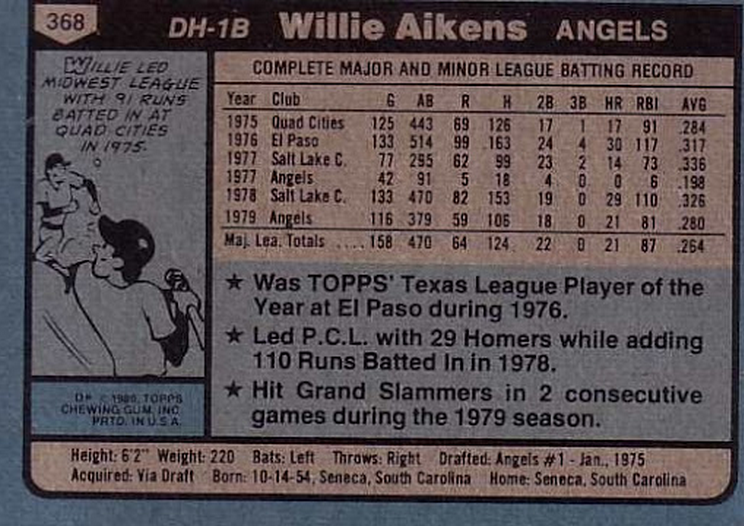
Aikens 1981 Topps card discussed the naming issue as well in the cartoon on the reverse:


Wednesday, May 2, 2012

#347 Harry Chappas


Who is this player?
Harry Chappas, reserve infielder, Chicago White Sox
Although he did not enter the season with as much fanfare as the previous season, Harry Chappas broke north with the Chicago White Sox at the end of Spring Training as an infield reserve. Despite all of the fuss made of his diminutive stature, Chappas was switch-hitting contact hitter whose batting eye and swift feet earned him a spot on the roster. The highlight of his season was a 4-hit performance against the defending AL Champion Baltimore Orioles. However, he managed only three hits in nineteen games after that and was shuttled back and forth to Triple-A. The last time came in June, and it was suggested that Chappas may return since he had an option left that would have prevented him from being placed on waivers. Unfortunately, Chappas did not return to the major leagues and his brief three-year career would come to an end.

Born in Maryland but raised in Florida, Harry Chappas was a prep baseball star as the back of this card indicates. He enrolled in Miami Dade North Junior College, where is performance attracted attention from the White Sox and was drafted in 1976. His early days as a player were described as "aggressive" and "combative"; indeed when a White Sox scout doubted Chappas' ability, he crushed a 425-foot drive.

Chappas had a solid season Single-A Appleton, batting .302 and being named an All-Star. He helped lead the team to 97 wins and in the process earned a ticket to the major leagues. Owner Bill Veeck used the opportunity to play-up Chappas' height. A stunt was created to have broadcaster Harry Caray "measure" Chappas and come in at 5' 3", making hims the shortest player in the majors (Chappas was actually closer to 5' 7'). In his September call-up, he batted .267 for Chicago and handled 92 chances without an error. Appropriately, his first big league hit was a perfect bunt which traveled 30 feet before rolling dead.

The following spring, Chappas made the cover of Sports Illustrated and won the starting shortstop position from Don Kessinger, who was the White Sox' player manager at the time. He struggled mightily the first month and was returned to the minors. When Kessinger was fired and Tony LaRussa took over as manager, Chappas was called back up. He batted .363 upon his return and hitting his only career home run.

Chappas played three more years in the minor league systems of the White Sox and Atlanta Braves before joining an Italian baseball league in 1984. While there, he was involved in a motorcycle accident and crushed his leg. Shortly thereafter, his professional baseball career came to an end.

In the subsequent years, Chappas returned to Florida and entered a vocational program. It was also reported that he had passed courses in precision-parts making and reading blueprints.


Why I love this card
I was oblivious to Chappas' appearance on the cover of Sports Illustrated. I was more transfixed by the cartoon of the base thief on the back of the card, who for some reason, looked suspiciously like the Hamburgler:


.


Something else....
Chappas also had some off-the-field idiosyncrasies. For instance, he raised and bred Australian and African finches, leaving most of them at his Florida home during the season, but keeping some with him. On the road, he also drove roommates to distraction by building model airplanes in his motel room half the night.

Saturday, July 2, 2011

#329 Bert Roberge


Who is this player?
Bert Roberge, relief pitcher, Houston Astros
One man's misfortune is another man's opportunity. Such was the case for Bert Roberge during the summer of 1980. He failed to make the Astros final cut in Spring Training and spent the first half of the season pitching out of the bullpen for the Tuscon Toros. When J.R. Richard had his unfortunate stroke that ultimately ended his career, Roberge got the call to replace him on the roster. Bert appeared in 14 games for the eventual NL West Champions, winning two games in relief.

A native of Lewiston, Maine, the righthanded throwing Roberge stayed in his home state and attended the University of Maine. He had dual dreams in those days, to be a major league and to be accepted into dental school. During his four years as a Black Bear, Bert set the school career ERA record (1.82) and is tied for the career shutouts mark (six). His collegiate performance drew the attention of the Houston Astros who drafted him on the fourteenth round in 1976. While he was accepted, dental school would have to wait.

Roberge made his major league debut in 1979 and spent most of the summer with the Astros as they challenged for their first NL West title. While the Astros fell a little short, Roberge pitched tremendously in 26 appearances. He fashioned a 1.69 ERA, winning three games and saving four more. A highlight of the season was back-to-back saves against the Giants in mid-season that helped Houston maintain it's lead in the NL West race.

It appeared the Roberge earned a spot in the Houston bullpen, but acquistion of Frank LaCorte and the signing of Nolan Ryan to the already pitching-rich Astros moved Roberge down the depth chart. Bert did not appear in the majors in 1981 but he returned to Houston in 1982, mostly in a long relief capacity. He again did not pitch in the major leagues in 1983 and he was granted free agency at the end of the season. Bert signed with the Chicago White Sox where he picthed well, if unspectacularly in middle relief.

He moved to Montreal in 1985 where he achieved career-highs in most picthing categories, including appearances and innings pitched. He struggled in 1986 and split time between the majors and minors for the third consecutive seasons. He retired from professional baseball at the end of the season after six major league seasons. Bert has since been recognized as one of Maine's greatest athletes and was part of the 1988 class of the Auburn-Lewiston (ME) Sports Hall of Fame.

Why I love this card
The cartoon on the reverse. Something about someone in their cap and gown with a diploma in one hand and a baseball bat in the other. Made everything seem so simple. For a nine-year old boy, the possibilities were limitless. By the way, is this card airbrushed? Roberge's hat looks strange to me.

Something else....
Today, Roberge is a sucessful businessman for Curran Company, where he and two of his brothers oversee the operations. The company specializes in fresh cut vegatables and has been in Roberge's family for over 40 years.

Monday, May 31, 2010

#291 Randy Scarbery


Who is this player?
Randy Scarbery, relief pitcher, Chicago White Sox
After leading the Chicago White Sox in appearances in 1979, things did not go as well for Randy Scarberry in 1980. When allowed three earned runs in his first appearance, and when April ended, his ERA was well over 5.00. He pitched in ten more games during May and began to get into a groove, allowing seven runs in 18.2 innings. To his surprise, he was sent to the minor leagues and then traded to the California Angels for infielder Todd Cruz. Randy never again made a appearance in a major league game, drawing the curtain on his brief two-year career.

A native of Fresno, California, Randy Scarbery was the first player selected twice in the first round of the amateur draft when Houston Astros selected him in 1970. He turned down an $86,000 bonus, choosing college instead, and was a standout at USC, a collegiate baseball powerhouse. The Trojans won the College World Series every year that Scarbery was on on the team, and he led the nation with 15 victories in 1973. He was drafted in the first round in 1973 by the current World Champion Oakland Athletics.

He immediately debuted at the Triple-A level, and although he sometimes struggled, he was often among the Pacific Coast League leaders in innings and starts. After three seasons in the Oakland organization, he was traded to the St. Louis Cardinals in April 1977 for fellow prospect Steve Dunning. He was granted free agency at the end of the season and signed on with the Chicago White Sox.

In Chicago he would finally break through and make the major league roster. He made his major league debut in April of 1979 and spent most of his rookie season coming out of the bullpen. He was used in virtually all roles, periodically used as a closer, long relief, and was even given five starting assignments. He finished his first season with a 2-8 record and a 4.62 ERA.

Scarbery didn't pitch anywhere after the 1980 season and I could not find any information on his whereabouts or activities post-baseball. Any information would be most appreciated.

Why I love this card
I loved the cartoons like the one depicted on the back of Scarbery's card. I always wanted to earn a trophy like that. The ones that I had always had a little baseball player on it and the bat always broke off.

Something else....
I found a little clip of Scarbery (along with several White Sox teammates) in Spring Training that you can find here.

On this date in 1980:
Ken Landreaux of the Minnesota Twins goes 0-for-4 in an 11 - 1 loss to the Baltimore Orioles, ending his hitting streak at 31 consecutive games, the longest streak in the American League since Dom DiMaggio hit safely in 34 games in a row in 1949.

Monday, May 24, 2010

#284 Larry Murray


Who is this player?
Larry Murray, outfielder, Oakland A's
While not known at the time, the six-year major league career of Larry Murray was already at an end. In Spring Training Larry was designated for assignment and spent the season with the Triple-A Ogden A's. Murray appeared in only 13 games that season batting only .233 with one home run and three RBI.

A phenominal three-sport athlete at Phillips High School in Chicago, Murray chose baseball after a high school career in which he broke and established numerous records as a standout running back/defensive back. He was taken in the 5th round of the 1971 draft by the New York Yankees, and spent the next six seasons in the minor leagues. Murray displayed impressive speed and a strong throwing arm, but his hitting was suspect. He failed to bat over .300 during that span in the bushes, but did earn three brief looks by the Yankees during 1974-76. He played in a handful of games each year and managed only four hits.

Nicknamed "Slick," Murray had his finest minor league season in 1976, leading the Eastern League in runs and being named an All-Star. He was assigned to Triple-A Syracuse in 1977 before he was involved in a multi-player deal with the Oakland A's. The trade would be the biggest break in Murray's career. As the A's fell from the perch of perennial contender in the wake of free agency, Murray earned regular playing time. He appeared in 90 games with the 1977 A's, but only batted .179.

Murray spent most of the 1978 season in the minors, but returned to the A's in 1979. He began the year as Oakland's right fielder, but eventually lost the job to Tony Armas. He also saw his playing time diminish thanks to a talented rookie named Rickey Henderson. Larry struggled at the plate all summer, finishing the year batting .186. Even his greatest asset, his speed faltered as he was cuaght 50% of the time. He attempted a comeback with the A's in Spring Training 1981 but was cut and his career was formally over.

Currently, Larry lives in California and was quoted in the Chicago Defender recently upon the passing of his high school coach, Carl Bonner. During his 42-year career as a coach/physical education teacher at Wendell Phillips High School, Bonner became one of the winningest coaches in Illinois history, winning more than 200 games. He also played a pivotal role in sending thousands of underprivileged student-athletes to college and beyond. Said Murray:
“He was one of the greatest men I knew. He helped shape us into who we turned out to be as men. It wasn't just football. He was like our father when our fathers weren’t there. We were a gang-infested school back then.”


Why I love this card
The minor league records occassionally listed on the back would always interest me. I would always ask my Dad where certain cities were when it wasn't obvious. I had an atlas and would look first. It may not have been Murray's card, but I do recall almost stumping him on Oneonta. I sat on the porch while he finished cutting the front lawn. When he was done he just looked at me and said "New York." Back to the drawing board....

Something else....
Murray finished his career with 20 stolen bases in 30 attempts. His 20 steals were the most by a post-Deadball Era player with a career average under .200. Murray is also featured in the recent book "Mendoza's Heroes" by Al Pepper.

On this date in 1980:
The New York Islanders defeated the Philadelphia Flyers in overtime of Game 6 of the Stanley Cup finals. It was the first Cup win for the Isles who would go on to create a dynasty and win four in a row. The game winner can be viewed here.

Tuesday, January 19, 2010

#233 LaRue Washington


Who is this player?
LaRue Washington, reserve outfielder, Texas Rangers
As Spring Training 1980 opened, LaRue Washington had a decent shot to make the Texas Rangers' roster as a fourth outfielder. Showing excellent speed and a decent glove, he was penciled in to be a reserve. However, the Rangers had an opportunity to obtain Rusty Staub and they traded Washington along with other players to Montreal on March 31, 1980. With the Expos rich in outfielders and contending for a division title, LaRue did not play in the major leagues in 1980.

A native of Long Beach, California, Washington was drafted in 1975 by the Texas Rangers off of the campus of Cal State Dominguez Hills. His skills almost immediately earned him a promotion to Triple-A Tuscon, where he batted .300 and stole 43 bases in his first season. He followed that with a .327 average with 50 swipes in 1978. He played a variety of infield positions with the Toros, primarily second base. The Rangers promoted him to the parent club in September 1978, and he was given a brief look.

He began the 1979 season at Triple-A and spent the majority of the season shuttling between Tuscon and Arlington. While in the minors, he again batted .300 but did not receive a full-time opportunity in his time with the Rangers. LaRue did have two hits in the first game he started against the A's, but was used primarily as a pinch runner. He did not return to the major leagues after the 1979 season, ending his brief two-year career.

He lasted two more years in the minor leagues and was traded to the Baltimore Orioles organization for the 1981 season. However, I was unable to find out his whereabouts after his playing days ended. Any help here would be most appreciated.

Why I love this card
When I was a kid, my little sister was in dance class. I think that everybody's sister was in dance class at one time or the other (ballet, tap, etc.). The school that the girls in my neighborhood went to was the "LoRu School of Dance." You can probably figure out the rest in regards to how this card fit in at some point.

Something else....
If you ever search for Washington at baseball-reference.com, make sure that you put a space between "La" and "Rue" otherwise it will not search for him. Just in case you were wondering.

On this date in 1980
Former Supreme Court Justice William O. Douglas passed away, he was 81 years old. With a term lasting 36 years and 209 days, he is the longest-serving justice in the history of the Supreme Court.

Thursday, December 24, 2009

#221 Joe Cannon


Who is this player?
Joe (J.J.) Cannon, outfielder, Toronto Blue Jays
A strong Spring Training earned the lefthand hitting Joe Cannon a spot on the Toronto Blue Jays roster in 1980. He was used sporadically, mainly as a pinch runner, thanks to his tremendous speed. J.J. did not notch his first base hit until June 17th. Cannon appeared in 70 games in 1980 and batted a meager .080. He scored more runs (16) than he had hits (4). J.J. did not return to the major leagues after the year, ending his four-year career.

The Camp Lejeune, North Carolina native, Cannon was the son of a retired marine who gave his son a passion for sports, specifically baseball. He was drafted in the first round of the 1974 amateur draft out of Pensacola (FL) Junior College. Cannon established himself as a prospect in the Astros organization, batting no less than .290 in four straight minor league seasons. He was given two brief looks at the end of the 1977 and 1978 seasons, appearing in only 17 games.

However, the Astros included him in a package following the 1978 season in a trade for catcher Alan Ashby. He split time between Toronto and Triple-A in 1979, batting .211 with the Blue Jays. In 148 big league games, he batted .176 and returned to the minor leagues for the final three seasons of his professional career (1981-1983).

Following his playing days, Cannon began a long career as coach and manager. He managed for 11 season at the Rookie and Single-A level for the Blue Jays, being named Manager of the Year for the New York-Penn League in 1993. He returned to the Astros organization in 2001 where he spent six seasons in several coaching capacities. He moved on to the Orioles organization in 2007 and has spent the last three years coaching with the Frederick Keys.

Why I love this card
At this stage in my life, I didn't understand the difference between minor league and major league baseball. When I saw a guy do well in the minors, it didn't make sense to me why they couldn't do the same at the major league level. It seemed unfair to see the .300 averages scattered in his batting record with a bottom line of .203.

Something else....
Not only is this Cannon's rookie card, but it is his only card. So far in the 1980 set, he is the fourth card to have that distinction (Eddy Putman, Fred Howard and Tony Brizzolara)

Thursday, October 29, 2009

#179 Ron Davis


Who is this player?
Ron Davis, relief pitcher, New York Yankees
A hard throwing righthander, Davis was entering his second full season in 1980. He was slated to serve as setup man to Rich Gossage after an effective performance as closer when Goose was injured in 1979. In a largely unheralded role, Davis won nine games, saved seven and finished the year with a 2.95 ERA. His success was instrumental in leading the Yankees to the AL East title, despite their loss in the ALCS to the Kansas City Royals. Soon, many successful teams would begin to use this formula of a solid setup man to their closer.

Originally drafted by the Chicago Cubs, he was traded while still in the minor leagues to the New York Yankees in 1978. He made the most of his first major league opportunity the following season winning 14 in relief and saving nine in 44 appearances. His performance earned him Rookie of the Year consideration as Davis finished fourth in the balloting.

1981 was arguably the best of Davis' career. He was recognized for his effective work by being named an All-Star, appeared in the World Series (a six-game loss to the Dodgers) and set a record for striking out eight consecutive batters as a reliever in a May game against the Angels. Davis would prove that this was no fluke as he struck out three or more in 11 of his 43 appearances. With his stock high, he was traded to the Minnesota Twins for shortstop Roy Smalley.

In Minnesota, Ron never attained the same level of success that he had in New York. Playing for the worst team in the American League in 1982, Davis lost nine games and his ERA ballooned. He placed in the top 10 the next four years in saves (1982-1985), totalling 106 over that span. However, Davis was the scapegoat for a Twins organization that was going through growing pains. He set a record in 1984 for blowing 14 saves a mark that still stands. In 1986, he lost his closer's role with two spectacularly blown saves early in the year. You can read about those in Davis' Wikipedia entry here.

Davis was traded to the Chicago Cubs midway through the 1986 season and spent the last two seasons of his career in middle relief with the Cubs, Dodgers and Giants. His major league career ended in 1988 after 11 seasons. Davis played in Japan in 1989 and married Kendall Davis, lead singer for the Groove Merchants. Today, he runs the Major League School of Baseball Camps for Children in Arizona and his son was drafted by the New York Mets in 2008.

Why I love this card
I can recall the date that I received this card. Sunday, August 16, 1981. The strike had just ended and the Yankees were visiting Tiger Stadium. The game was broadcast locally in Detroit. Louie down the block was a major Yankees fan and we were watching the game at his house. He was really rubbing it in when the Yankees entered the ninth with a 4-1 lead. The Tigers rallied to score four in the ninth, capped by a dramatic Kirk Gibson home run to win the game, one that will remain with me probably as long as I live. Louie was so disgusted with Davis (who allowed the home run) he traded it this card to me on the spot. That is the one you see above.

Something else....
Fitting that a Yankee card would follow a Phillie card during the World Series. During the 1981 Strike, Davis worked as a waiter in a Kansas City restaurant. He was part of the rescue efforts when a walkway collapsed on July 17, 1981 that killed over 200 people. I remember this happening at the time, but it had been pushed from my memory until I was researching Davis for this post.

Thursday, October 1, 2009

#156 Tony Brizzolara


Who is this player?
Tony Brizzolara, starting pitcher, Atlanta Braves
During the 1980 season, as we were getting Tony Brizzolara's rookie card, he was spending the year in Triple-A Richmond. Tony missed out on making the Braves near the end of Spring Training as there was not a spot for him in the rotation. Rather than have him sit in the bullpen, the Braves felt it was better for the 23 year old righthander to get regular work in the minors. He was 10-15 in Triple-A with a 3.71 ERA but did not earn a promotion back to the major league level in 1980.

Born in Santa Monica, California, Brizzolara's family moved to the Wisconsin area where Tony graduated from Beloit Memorial High School. He was a high school star and earned a spot on the team at the University of Texas. He spent only two years as a Longhorn as he was drafted by the Braves in 1977 and reported to Kingsport in the Appalachian League. The following season he rose quickly in the minor league ranks, starting the year in Single-A and finishing the year in Richmond.

In 1979, he pitched well in nine games in Richmond, posting a 1.91 ERA. When Larry McWilliams went down with an injury, Brizzolara took his spot in the starting rotation. He made 19 starts in 1979, winning six and posting a 5.28 ERA. He had two complete game victories that season, against the Cardinals in Padres. After his season in the majors, Tony would return to Richmond for the next four seasons, patiently awaiting his return to the majors. In the interim, he won 44 games but Richmond lost in the International League finals in both 1981 and 1983.

Brizzolara's determination was rewarded in late-1983 when he was added to the Braves roster, finally returning to the major leagues. He appeared in 14 games, all in relief and recorded a 3.54 ERA. He started 1984 in Richmond again and was called up to Atlanta again, this time for the last time. He started a few games and relieved in a few more, but did not have much success. It would be the third and final season of his major league career. However, Tony would pitch two more seasons in the minors before finally calling it quits in 1986.

In all, Brizzolara spent eight seasons (1978-85) with the Richmond Braves and still holds many of the their career pitching records. A fast worker on the mound, "Brizz" tops the list in wins (68), innings pitched (1,060), strikeouts (613), games started (158), and complete games (40). Today, Brizzolara is a minority owner, executive vice president and chief operating officer of an actuarial firm in Atlanta. Actuaries deal with statistical risks and life expectancies for insurance; Brizzolara specializes in pension plans. He has also made several appearances at Turner Field as part of the Atlanta Braves alumni association.

Why I love this card
As a kid, you can't help but love the name "Brizzolara." His signature reminds me of the scene in Billy Madison where Adam Sandler is trying to write the word "Rizzuto." Other than those two, how many other major leaguers have two Z's in their name?

Something else....
Earlier this year, blog follower Bo Rosny posted a great story about Brizzolara over at his website, Baseball Cards Come To Life! Its a great tale of what happened to Brizzolara's baseball card collection.

Thursday, September 24, 2009

#152 John Fulgham


Who is this player?
John Fulgham, starting pitcher, St. Louis Cardinals
Beginning the season as the #3 starter in the Cardinals rotation, the 24-year old Fulgham was regarded as one of the best young pitchers in the league. He pitched a complete game four-hitter against the World Champion Pirates in his second start and had pitched 23 consecutive scoreless innings over May and June. Fulgham began to experience shoulder trouble and got into a scrape with teammate Keith Hernandez. He went on the disabled list, returned in August and did not pitch well before being shut down for the season. When the season ended, he was diagnosed with a torn rotator cuff.

John Fulgham was born in St. Louis and was a prep star at Pattonville High School in Missouri before moving on to the University of Miami. He was drafted by the Cardinals in 1976 and began to work his way up the minor league ladder. Fulgham became a top prospect in 1977 when he won 18 games with a 2.05 ERA in A-ball at St. Petersburg.

He began the 1979 season with Springfield, winning six games before being promoted to the Cardinals. John made his big league debut on June 19 and pitched a complete game shutout. He was the Cardinals best starter from that point forward and each of his ten victories that season were the complete game variety. Overall, he went 10-6 with a 2.53 ERA and ranked seventh in the league in complete games. Despite finishing second among rookies in wins he did not receive a single vote for the Rookie of the Year.

Upon receiving the diagnosis of a torn rotator cuff, he first tried rest before opting for surgery in 1981. He sat out the entire season before attempting his comeback in 1982. Unfortunately, the comeback was not successful and he never returned to the major leagues, ending his two year major league career.

After his playing days, he was the head baseball coach for Rollins College in Florida from 1992 to 1994. He also returned to school and earned his B.S. and an M.B.A. from California Coast University. After spending many years as a financial consultant and advisor, today John is the senior vice president at Rochdale Investment Management.

Why I love his card
The connection to Fulgham's great-grandfather in-law in the cartoon on the reverse. Not only is the ancestry angle kind of neat but I distinctly remember looking at the depiction of the old 1800's player. The mustache was just like Rollie Fingers and the pillbox hat was just like the Pittsburgh Pirates. The more things change....

Something else....
A torn rotator cuff was a death knell for pitchers during this era. Unlike today where the surgery has become very common and pitchers make a return to the mound, back then it almost never happened. In addition to Fulgham, contemporaries Steve Busby, Don Gullett, Doug Rau, Wayne Garland, Mark Fidrych all lost their careers to the torn rotator. Between that injury and substance abuse, it is interesting to think how differently shaped this period in baseball could have been.

Saturday, September 12, 2009

#142 Phil Huffman


Who is this player?
Phil Huffman, starting pitcher, Toronto Blue Jays
As a rookie in 1979, Phil Huffman was a workhorse on a Blue Jays team that lost a league-leading 109 games. Over the winter, the Jays made numerous changes, including the hiring of Bobby Mattick as manager. The righthanded Huffman was on the bubble to crack the new-look Jays rotation. On the final day of Spring Training 1980, he was optioned to Triple-A Syracuse, where he went 3-9 in 15 starts for the last-place Chiefs.

Drafted out of Brazoswood High School in Texas, Huffman was original a prospect of the San Francisco Giants. He was drafted in the second round of the 1977 draft but spent less than a year in the organization when he was part of a package traded to the San Francisco Giants for Vida Blue. He spent only five months in the Oakland organization when he was traded once again, this time with Willie Horton to Toronto in exchange for Rico Carty.

It was with the pitching-starved Blue Jays that Huffman would receive his major league break. In only their third season, the Toronto franchise was in their infancy. Huffman made the squad out of Spring Training and was penciled in as the #4 starter. The season began well, for Huffman as he won in his major league debut. It was also Toronto's first win of 1979. After a rough outing his next time out, Huffman won again to raise his record to 2-0. Things went downhill from there, however, as Phil lost 11 of his next 13 decisions and had difficulty getting his ERA under 5.00.

Huffman's 1979 highlight undoubtedly was his August 27th one-hitter against Oakland. However, Phil finished the 1979 campaign 6-18 with a 5.77 ERA. While he was second on the team in starts and innings, his 18 losses led the league and remains today the franchise record. Huffman remained in the Blue Jays minor league system until he was traded to the Kansas City Royals for Rance Mullinks in 1982. He bounced around the minor leagues with the Royals, Mets and Orioles organizations with moderate success through most of the early & mid-1980s.

He made his return to the majors in 1985, appearing in two games with the Baltimore Orioles. He never appeared in the major leagues again. He was a fixture with the Rochester Red Wings in the mid to late 1980s, playing there for three years before finally retiring after the 1989 season. Huffman settled down in Rochester where he lives today. He got a job with the demolition crew responsible for razing Rochester's Silver Stadium, and while I am not certain, I am pretty sure this is him today, working with Jackson Welding Supply. I mean, how many Phil Huffmans can there be in Rochester???

Why I love this card
Interestingly, Huffman has a 1981 Topps card despite not appearing in a big league game in 1980. I love the fact that his full name "Phillip Huffman" is the signature pictured making it all the more formal. Through the magic of retrosheet.com, I am pretty sure Huffman is shown here during a June 9, 1979 game against Oakland, a 5-0 win. Good that Topps pictured him during a winning outing.

Something else....
The 1978 Vida Blue trade has been very popular so far in this blog. Outside of Blue himself, four of the seven players traded for him have been featured. Huffman, Gary Alexander (back-to-back!!), Mario Guerrero and Gary Thomasson. I won't spoil the surprise by revealing the other three, but there's nothing earth shattering to report. It is interesting to note that three of the four players would not be on the A's roster in 1980.

Tuesday, September 8, 2009

#139 Dane Iorg


Who is this player?
Dane Iorg, reserve outfielder, St. Louis Cardinals
Best known today for his game-winning hit in Game 6 of the 1985 World Series, Dane Iorg was the usual replacement for the oft-injured Bobby Bonds in 1980. He appeared in 105 games in 1980, a career high. An excellent contact hitter, he batted .303 that season also seeing action at first base. He had carved his niche on the Cardinals as a valuable bat off the bench and a dependable player that could play multiple positions.

A product of Bringham Young University, Iorg was one of a long line of Mormons to play Major League Baseball, including his brother Garth. He was a first round draft choice of the Philadelphia Phillies in the 1971 draft and proceeded to spend the next six seasons traveling the minor leagues. He finally made his major league debut on Opening Day in 1977 but only spent a month on the roster before being dispatched to the minors again. Unable to crack the Phillies lineup, he was traded to the St. Louis Cardinals in a package that brought Bake McBride to Philadelphia.

Dane spent parts of the '77 and '78 seasons on the major league roster before finally sticking full time with the Cardinals in 1979. He appeared in 79 games that season and batted .291, primarily as a pinch-hitter and defensive replacement. In 1981, Iorg led the team with a .327 and had 16 multi-hit games. The Cardinals finished with the best record in baseball, however, due to the Strike of 1981, the Cardinals were denied a postseason opportunity due to the split-season playoff arrangment.

Getting more playing time in 1982, Iorg was splitting time in left with Lonnie Smith. The Cardinals won the NL pennant that season, but Iorg did not appear in the Cardinals NLCS sweep over the Cardinals. He was slated to be the Cardinals designated hitter in the World Series against Milwaukee. In those days, the DH ruled alternated year to year rather than the current home team arrangment. Iorg appeared in five Series games and batted an incredible .529 (9-17) as the Cardinals won the Series in seven games. He appeared in only 58 games in 1983 as he chunks of playing time due to a series of injuries. He was sold to the Royals in May of 1984.

As a Royal, Iorg was primarily a role player appearing again as pinch hitter and spot starter. He again appeared in the posteason with the Royals, first in 1984 when Kansas City won the AL West and again the following season when they won their first and only championship. Iorg culminated a furious Game 6 rally with the Royals on the brink of elimination, a game famous for the Don Denkinger "safe" call on Jorge Orta's ground out. He was a free agent following the season, but owner's collusion at the time prevented him from getting serious offers. He signed with the San Diego Padres for his 10th and final season in 1986. Today, he is a salesman with Capital Lumber Company in Salt Lake City as well as working for a health supplement company.

Why I love this card
Post this card in the "I have no idea how to pronounce his name" category back when I got it. For weeks, I called Dane "EYE-ore-Guh." Bonus points for a shot of the Cardnals uniform numbers on the sleeves. Double bonus points for the extensive list of Iorg's minor league career on the back.

Something else....
I still vividly recall Iorg's hit in the World Series. For some reason, that hit is not as famous as some of the other Series moments from this generation. I also recall that when Iorg was interviewed immediately following the game he either had a bloody nose or mouth when he was smashed in the face during the postgame hoopla.

Monday, September 7, 2009

#137 John Castino


Who is this player?
John Castino, third baseman, Minnesota Twins
As the reigning American League Rookie of the Year (with Alfredo Griffin), John Castino entered his sophomore season in 1980 as one of the bright stars in the American League. A righthanded line-drive hitter, in 1980 he made big strides in hitting. His .302 average led the Twins regulars. He also topped the club in hits, runs and RBI. He had exceptional range at the hot corner and was being known for a strong, accurate arm. At 25, it appeared that Castino would be a baseball star for some years to come.

John Castino attended and played baseball for Rollins College, a private university located in Winter Park, Florida, where he was named Florida College Player of the Year in 1976. He was drafted by the Minnesota Twins in the 3rd round of the amateur draft a few months later. After three years working up the chain, he made his debut on Opening Day 1979. He worked his way into the starting lineup in May and he finished the year with a solid .285 average and leading all AL third basemen in double plays.

Coming off his 1980 season, he led the league in triples during the strike-shortened 1981 season and was second in sacrfice hits. Even though his batting average dipped to .268, it was still the best on his team and he led the Twins in hits. After the season, he had spinal fusion surgery to correct a sore back. Despite his solid play, the Twins had a prospect named Gary Gaetti ready to take over at third base and Castino was moved to second in 1982. He made only two errors at second base in 1982 but he struggled at the plate, primarily due to recurring back woes.

In 1983, Castino again had a solid season in the field at second base and he raised his batting average 30 points. He also achieved career highs in at-bats, doubles and runs scored. However, he began to experience back pain again and early in the 1984 season, and was placed in a body cast. He tried to recuperate with rest and then a second surgery. He remained on the Twins roster until 1985 when he was unable to come back, ending his six-year career.

Why I love this card
This card is Castino's rookie card. He is pictured here at Toronto's Exhibition Stadium. It was always fun to try and guess what stadium certain players were photographed. Exhibition Stadium was not a common venue but certainly a recognizable one. The weird configuration in right field was a common reminder that you were not in a baseball stadium. I once sat in the first row along the first base line in right field and my seat faced away from home plate. That tells you all you need to know about the CNE. By the way, would this card qualify as a Boyd Coffee rookie card?

Something else....
Castino went back to college after his playing days, earning an MBA from the University of St. Thomas. In 1987, he became an investment advisor and is currently Senior Vice President at Wealth Enhancement Group in Wayzata, Minnesota.

Tuesday, August 18, 2009

#123 Lynn Jones


Who is this player?
Lynn Jones, reserve outfielder, Detroit Tigers
As the 1980 season began, Jones had just been named the Tigers' Rookie of the Year when he batted .296. Typically batting in the lower third of the order, he was primarily a singles hitter with decent speed and a good glove. He was scheduled to split duties in right field in 1980 with Champ Summers starting against lefthanders. A knee injury suffered in Spring Training sidelined Jones for the majority of the season as he appeared in only 30 games and batted .255.

Originally drafted in 1974 by the Cincinnati Reds, Jones was a product of Thiel Collegein western Pennsylvania. It was difficult for Jones to advance in the Cincinnati organization as the team enjoyed a wealth of talent in the mid-1970s. After four seasons in the minor leagues, he hit .328 with Triple-A Evansville and the team finished with the best record in the regular season. However, it was not enough to get Jones promoted and he was selected by the Detroit Tigers that winter in the Rule 5 draft.

Jones made the Tigers out of Spring Training when Rusty Staub was injured. His hitting enabled him to find a spot on the club, typically as a fourth outfielder. Additionally, his older brother also made his major league debut in 1979 with the New York Yankees. Jones never found consistent playing time in Detroit and his games played decreased every year from 1981 to 1983. When the season ended, he signed on as a free agent with the Kansas City Royals.

Used primarily as a spot starter and pinch-hitter in 1984, Jones batted .301 as the Royals won the AL West championship. Ironically, the Royals lost the ALCS in three straight to Jones' old team, the Tigers. The following season, Jones appeared in a career-high 110 games, again mostly as a defensive replacement. That season the Royals won their first and only World Championship and Jones contributed a double and triple in the Royals' seven game victory over St. Louis. After hitting a meager .128 in 67 games in 1986, he did not receive any free agent offers and his eight-year career came to a close.

After this playing days, Jones served as first base coach for the Royals in the 1990s and managed for many years in the Florida Marlins chain. He was a coach with the Red Sox when they won the World Series in 2004 and today is the roving outfield and baserunning coach in the Atlanta Braves chain.

Why I love this card
This Lynn Jones card always reminds me of little Timmy, a neighborhood kid who was three years younger than me. We told him that he had to have a stance like a major leaguer to play with the older kids and somehow we all decided on Jones, using this card as a point of reference. After all, he was a Tiger. Could we have picked a worse card? It looks like Lynn is trying in vain to fit in the picture. Damn if little Timmy could still hit though, even at four years old.

Something else....
This is unofficial, but I think that the Jones' brothers (Lynn and Darryl) join the Alomars as the only set of brothers to make their major league debut in the same season.

Sunday, August 2, 2009

#106 Jeff Leonard


Who is this player?
Jeffrey Leonard, outfielder, Houston Astros
In 1979, Jeff Leonard was the starting right fielder in his first full season in the major leagues. He finished second in the Rookie of the Year balloting when he hit .290 in 134 games. When Houston signed free agent Joe Morgan, however, Art Howe was moved to first and Cesar Cedeno back to the outfield. The right-handed batting Leonard became the fourth outfielder. He suffered a season-long slump and batted only .213. Leonard did appear as a pinch-hitter in the NLCS against the Phillies three times, failing to get a hit.

Leonard signed with the Los Angeles Dodgers as a 17-year old amatuer free agent. He was called up to the Dodgers for a brief look in 1977 and in 1978, he led the Pacific Coast League in hits (183) and batting average (.365) while playing for the Albuquerque Dukes. The Dodgers traded him to the Astros to complete the Joe Ferguson trade and Jeffrey made his Houston debut shortly thereafter. When Leonard's slump continued into 1981, he was traded to the San Francisco Giants for Mike Ivie. Optioned to Triple-A Phoenix, Leonard batted over .400 when he was recalled.

It was by the Bay where he would earn his greatest fame. He batted over .300 in the last two months of the 1981 season, earning him a starting position in left field. Now known as "Hac Man," he would remain in the Giants lineup for the next six seasons. He was the team's leading hitter in 1983 and similarly led his team in home runs and RBI in 1984 & 1985, and hit for the cycle. Leonard and several other major leaguers received national attention in late-1985 when he testified in the Pittsburgh drug trials. Leonard, who also received immunity, avoided supension by Major League Baseball by donating 10% of his salary and 100 hours to drug-related community service.

In 1987, Leonard and the Giants had a memorable season. Leonard was selected to his first All-Star Game and the Giants won the National League West. They would face the St. Louis Cardinals in the NLCS. Leonard hit four home runs during the Series and drew the ire of Cardinal fans for his "one-flap down" home run trot. He was the fourth (and last) player to be named MVP of a postseason and play for the losing team.

The following season, he was surprisingly traded to Milwaukee in a largely unpopular move. After the season, he signed as a free agent with the Seattle Mariners, where he resurrected his career. A foot injury confined him to DHing, but he nonetheless reached career highs with 24 HR and 93 RBI and his second All-Star appearance. He was released after the 1990 season but he did not receive any interest and he retired after a 14-year career. In 2008, he was named manager of the Reno Silver Sox, but the team disbanded following the season.

Why I love this card
Leonard's other nickname during his playing days was "Penitentary Face." Looking at this card, I don't doubt it, but I can't imagine anyone calling him that to his face. There's also been a slight run on rookie cards as Leonard's is the second one since we turned over card #100. We had to get through 40 cards before we got to two in the first 100.

Something else....
I vividly recall the 1987 NLCS. I was rooting for the Giants slightly, but wouldn't have minded if the Cardinals won either. The dust-up with Leonard's home run trot added a nice backstory. He talked smack after the first two games and took 50 seconds to go around the bases in Game 3. In Game 4, he tried to score from first on a double, and Tony Pena crushed him in a collison at home plate. The Cardinal bench went ape. Two years later, when the Giants went to the Series, he traded barbs with Will Clark, calling him a racist.

Saturday, August 1, 2009

#103 Bill Caudill


Who is this player?
Bill Caudill, relief pitcher, Chicago Cubs
In his rookie season as a swingman on the Cubs' staff, Bill Caudill had a rough 1979 season, going 1-7 with a 4.80 ERA. He pitched erratically as a starter and was moved into the bullpen entirely for 1980. The move proved to be a good one for Bill as he served as Bruce Sutter's setup man. He appeared in 72 games (6th most in the NL), winning four and posting a sparkling 2.19 ERA. He thrived in the pressure situations of relief pitching and was seen as a potential star.

Originally drafted by the St. Louis Cardinals in 1974, Caudill was a strong prospect as a starting pitcher. He was traded twice before he made his major league debut, first to the Reds at the start of the 1977 for Joel Youngblood and after the season to the Cubs for Bill Bonham. When Sutter was traded to the Cardinals before the 1981 season, Caudill did not resume his role as a setup man, rather he was moved back to the starting rotation. The move did not agree with him as Caudill went 1-5 with a 6.28 ERA as a starting pitcher. He finished the year in the bullpen, but his confidence was shaken from the experiment. When the season ended, Caudill was traded, in what would be the biggest break of his career.

First traded to the Yankees and then quickly shuttled to the Seattle Mariners, Caudill became the closer and a huge fan favorite. In his first year in Seattle, he won 12, saved 26 and finished with a 2.35 ERA. He was 7th in the Cy Young Award voting and deserving of All-Star consideration. He repeated his save total the following season and earned not one, but two nicknames while a Mariner. A nice summary of how he earned both can be found here. In an inexplicable move, the Mariners traded Caudill after the 1983 season to the Oakland Athletics.

Caudill only spent one season in Oakland, but it was a successful one as Bill was named to the All Star team for the only time in his career. He saved a career-high 36 games, which was the second most in his league. The gregarious Caudill continued some of his antics in Oakland, but it was soon clear that the A's would not be able to meet his salary demands. Rather than lose him via free agency, Oakland traded Caudill to the Toronto Blue Jays in a move that was widely seen as the move that would ensure the postseason for Toronto.

Indeed, the Blue Jays would reach the playoffs for the first time in 1985. Caudill started slowly but pitched very well in the second half of the season. He finished with an ERA under 3.00 and in the top 10 in saves, but did not make an appearance in the Jays' loss in the ALCS to the Royals. He began to suffer arm injuries in 1986 and was released at the end of the season. He finshed his nine-year career in Oakland a year later. In retirement, Caudill has been been co-coach with former teammate Julio Cruz at the Eastside Catholic High School in Kirkland, WA since 1995. When not coaching, Bill also works for agent Scott Boras. The two were minor league teammates and Bill was Boras' first client.

Why I love this card
Finally! Another Chicago Cub. Its been almost 50 cards since the last one, that's quite a drought. Caudill's picture here is likely from 1979 his rookie year. That season the Cubs had in their bullpen; Caudill, Sutter, Dick Tidrow, Donnie Moore and Willie Hernandez. I didn't realize they had all that talent. In typical Cub fashion, they traded them all away. Consider that those five collected seven All-Star selections, six post-season appearances, one MVP, two world championships and 490 saves after they left the Cubs. Amazing.

Something else....
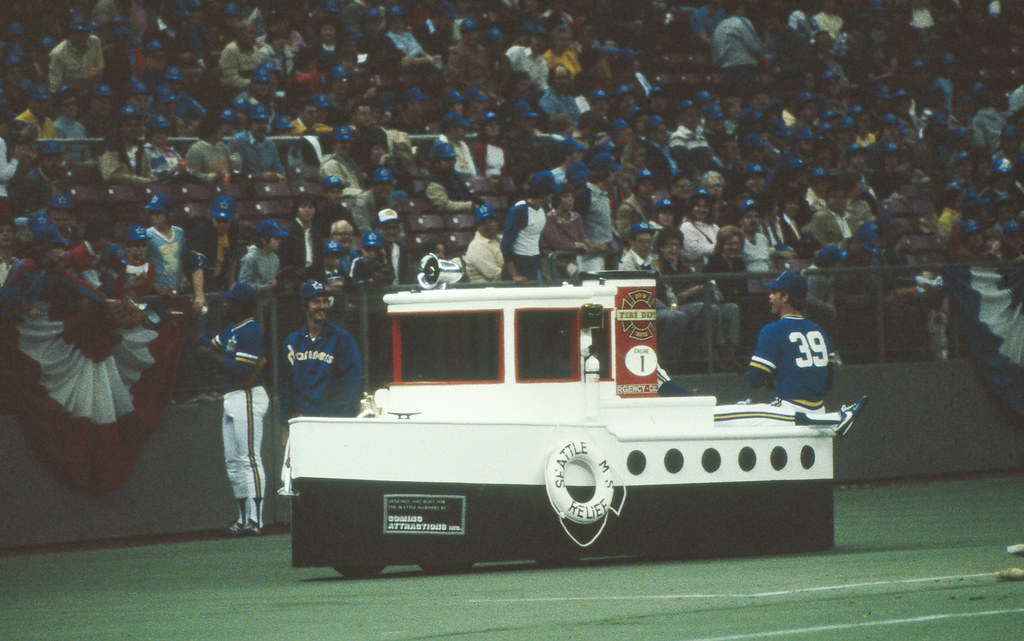
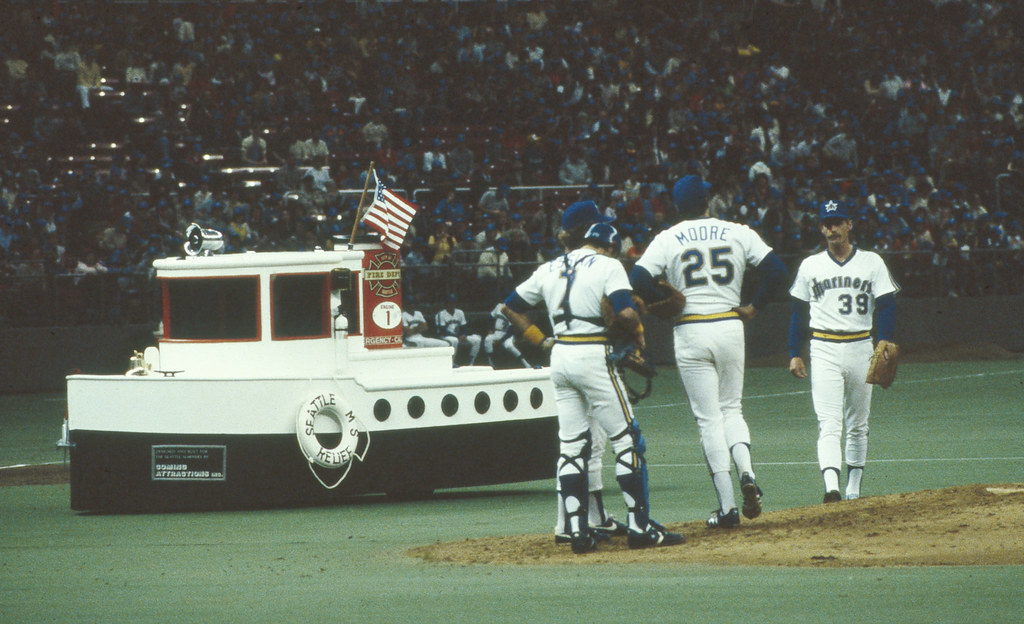
In 1982, the Mariners introduced a nautically themed bullpen car called the Tugboat. On Opening Day, Caudill stole the keys during pregame festivities, leaving the Tugboat stranded on the left-field line and delaying the start of the game. I have no memory of this at all; you can see it in all its glory here and here.