Showing posts with label (All Star Card). Show all posts

Tuesday, June 5, 2012

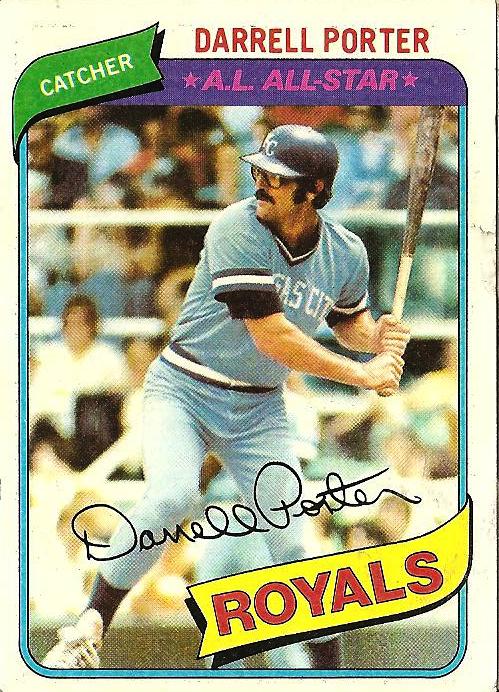
#360 Darrell Porter


Who is this player?
Darrell Porter, catcher, Kansas City Royals
After posting one of the best offensive seasons by a catcher up to that point, Darrell Porter of the Kansas City Royals shocked the baseball world during Spring Training 1980 when he disclosed substance abuse problem. Initally, only alcohol was cited as a problem, but Porter also acknowledged a cocaine addiction. He spent the next six weeks in a rehabilitation facility and his return to the diamond was seen as an example of his will and courage. However, his performance was effected by the lack of Spring Training, hostile opposing fans and a brief hospitalization. Despite this adversity, he was still able to help the Royals advance to their first World Series in franchise history. When the season ended, Porter followed former manager Whitey Herzog to St. Louis when he signed a large free agent contract with the Cardinals.

A Midwestern boy, Darrell Porter was born in Joplin, Missouri and became a prep star at Southeast High School in Oklahoma City, Oklahoma. A standout on the diamond and the gridiron, Porter received scholarship offers from 40 schools as a football candidate. Blessed with a powerful throwing arm, he initially signed a letter of intent with to quarterback at the University of Oklahoma before deciding on a baseball future. The Milwaukee Brewers made him their first selection of the amateur player draft in June 1970 and offered him a reported $70,000, a large sum for its time. The left-handed hitting Porter homered in his first professional at bat later that summer and was immediately tabbed as a major league prospect.

Darrell made his major league debut the following season and lived up to his billing by crashing a home run against AL MVP and Cy Young Vida Blue. At the time, he was the youngest player in the major leagues. However, he required some more seasoning in the minor leagues before returning to the bigs for good in 1973. That rookie season his .257 batting average and 16 home runs, placed him third in the Rookie of the Year voting and he was named to the American League All-Star team in 1974. However, Porter began to be plagued by the pressure to live up to his advance billing, and this ultimately was a major part of his substance abuse issue. He was traded to the Kansas City Royals following the 1976 season in a curious move, partly because of Brewers' owner Bud Selig decision to rid the team of a potential problem.

Blessed with a new start in Kansas City, Porter's offensive production increased. He was named an All-Star three seasons in a row (1978-1980) and helped the Royals reach the postseason three out of the four seasons he was a Royal. The one season Kansas City didn't reach the playoffs was Porter's finest (1979) which saw Darrell become only the sixth catcher in Major League history drive in and score 100 runs in the same season. He also led the American League with 121 walks and reached base a league-leading 284 times. For good measure, he also placed among league leaders in sacrifice flies, hit by pitches and triples.

While with the Cardinals, Porter was never able to regain his offensive production of 1979, but he was still a solid catcher able to draw walks and get on base. Despite this, he was given a hard time by the St. Louis fans, even as the Cardinals drove towards a postseason appearance in 1982. Porter rewarded them with a scintillating performance in the NLCS, batting .556 (5 for 9) in the Cardinals three game sweep of the Atlanta Braves. He followed that with a similar performance in the World Series against Milwaukee. With several timely hits, including the game-winner in Game 7, Porter was again named the Most Valuable Player. He was also an inspirational figure, often re-telling the story of his addictions and his conversion to a born-again Christian. His autobiography, Snap Me Perfect! was released prior to the 1984 season.

Porter had his best statistical season in St. Louis in 1983 but the Cardinals were unable to return to the postseason. Injuries began to take their toll as he fractured a finger in '83 and suffered a broken collarbone and thumb in 1984. St. Louis returned to the World Series again in 1985, with Porter again having a good NLCS, this time against the Dodgers. However, Darrell and the Cardinals struggled offensively in the World Series against Porter's old team the Royals, and St. Louis came up short in seven games. Porter would spend the final two seasons as a part-time player with the Texas Rangers before retiring after the 1987 season and 17 major league campaigns.

In retirement, Porter, like many of his contemporaries became a broadcaster for a time, was heavily involved in charity world and dabbled in antiques. On August 5, 2002, Porter was found dead in Sugar Creek, Missouri outside of his vehicle. It was initially believed that Porter's car was stuck on a tree stump and the high heat and humidity played a role in his death when he attempted to push the car. An autopsy concluded that he died of "toxic effects of cocaine" consistent with recreational use and induced a condition called excited delirium that caused his heart to stop. He was only 50 years old.

Why I love this card
First, any All-Star card commanded my immediate respect. Something about the All-Star banner that was on these cards elevated the players in my young mind as a future Hall of Famer. Secondly, I was drawn to the fact that Porter went to bat without any batting gloves. For an aspiring Little Leaguer, this was affirmation, especially during a time when batting gloves were becoming the rage. They are pretty standard now at all levels, but back then it was kind of cool to see an All-Star buck the on-coming trend.

Something else...
Porter and Hall of Famer Mickey Cochrane are the only catchers in American League history to draw 100 walks, score 100 runs and drive in 100 RBI in the same season. Porter of course in 1979, Cochrane in 1932.

Also included below is Porter's 1980 Topps Super card. Unfortunately, this was not something that I obtained during the summer of 1980, rather it was something that I stumbled across years later when I stumbled across the whole set.


Friday, June 25, 2010

#310 Dave Parker


Who is this player?
Dave Parker, rightfielder, Pittsburgh Pirates
Although he was considered one of the best players in the game, Dave Parker was a target for criticism, due to his boastful demeanor and million-dollar-a-year contract. Nevertheless, the "Cobra" was elected to start the All-Star Game by the fans and led the Pirates in RBI. But 1980 was not a good year for Dave Parker. Fans threw batteries at him, he played much of the year with a myriad of injuries, went through a divorce and got sued. Although he batted a very respectable .295, it was considered a "down" year for him and it was widely thought that he would bounce back to his previous form.

Born in Mississippi, but growing up in Cincinnati, Ohio, as a youth Parker was given a glove by future Hall of Famer and Red star Frank Robinson. At age 15 he was big enough and good enough to play with a local semipro team and he was a football star in high school. His senior season he tore his knee yet still earned attention from 62 schools that wanted him to play football. Dave decided he had better chances in baseball, but his injury made several teams wary. He was drafted on the 14th round of the 1970 amateur draft by the Pittsburgh Pirates.

Parker made an immediate impact in the minors; MVP of the Florida League in 1970 and the Carolina League in 1972. He was in Pittsburgh a year later and it took little time for him to be compared to Pirate greats Willie Stargell and Roberto Clemente. During a five year period (1975-1979) he won two batting championships, batting a collective .321, won three Gold Gloves, led the league in hits and doubles, was the 1979 All Star Game MVP and the 1978 National League MVP. As the 1980s began, it appeared that Parker was on the road to Cooperstown.

Unfortunately, it was not to be. After the distractions of 1980, Parker slumped at the plate, gained weight and simply did not perform at his previous levels. When his contract elapsed in 1983, the Pirates allowed him to leave as a free agent and Parker signed with his hometown Cincinnati Reds. One of the reasons for his sudden drop in performance was revealed in 1985 when Parker testified at the Pittsburgh Drug Trials. There, he described his heavy cocaine use and how it effected his play. He claimed that he was now drug-free, and he returned to All-Star status in 1985. He led the NL in RBI and was second in the league's MVP vote while batting .312 and clubbing 34 home runs.

After four years in Cincinnati, the productive, but aging Parker was traded to the Oakland A's where he served as designated hitter. His veteran presence helped lead Oakland to the World Series the two years he was there, including a championship in 1989. He was an All-Star again with Milwaukee in 1990 and played for both the Angels and Blue Jays the following year. He was unable to catch on with another team in 1992 and his 19-year major league career came to an end. He served as a first-base coach for the Anaheim Angels, then as a batting coach for the St. Louis Cardinals in 1998. Today, he owns several Popeye's chicken franchises in the Cincinnati area.

Why I love this card:
This was a premium card to get during the summer of 1980. Yet, I found it very difficult to warm up to Parker. I knew he was a great player, but I didn't view him in the same light as a Brett, Schmidt or Rice. What I remember most about this was my Dad's shock when Parker wore an earring in his ear. To him, it was disrespectful and distasteful. Remember, it was 1980 and it wasn't as common as today. I too, couldn't figure out why a guy would want to wear an earring.

Something else....
Largely due to his peak years, Parker still receives minor Hall of Fame consideration. I suspect that with the recent inductions of Rice and Andre Dawson, Parker's body of work will get further review. I wonder how much the Drug Trials effected his overall bottom line.

Nevertheless, Parker was a star in 1980 and was given a Topps Super Card and Burger King card. I actually like the Burger King version a little better since I think they did a much better job of centering the photo. Both are shown below:


On this date in 1980:
The #1 song in the country on this date is "Coming Up" by Paul McCartney. A largely forgettable song today, it is notable since it is McCartney's first #1 hit after the breakup of his second band, Wings. The video is pretty good and is here.

Sunday, May 30, 2010

#290 Steve Garvey


Who is this player?
Steve Garvey, first baseman, Los Angeles Dodgers
Iron Man. Popeye. Mister Dodger. By 1980, critics of Steve Garvey had been chipping away at the veneer of Garvey's public persona for some time. An article in the August issue of "Inside Sports" exposed issues in Garvey's private life and marriage. The couple engaged in a prolonged libel suit to prevent publication, but to no avail. The distraction seemingly didn't effect Garvey on the field. He was elected to start the All-Star Game in his home stadium, led the National League in hits (200), drove in 100 runs for the fifth time and batted over .300 for the seventh time. He played in every game, leading the Dodgers in a furious run at the NL West title against the Houston Astros. The Dodgers tied for the division lead on the last game game of the season before falling in a playoff.

Much of Steve Garvey's story is well known. His father was a bus driver for the Brooklyn/Los Angeles Dodgers in Spring Training when he young. This eventually led to a job as a batboy. Garvey was a high school standout and drafted by the Minnesota Twins, but he accepted a scholarship at Michigan State University. Steve played both baseball and football and excelled on the diamond under the tutelage of former major leaguer Danny Litwhiler. Garvey was drafted on the first round of 1968 amateur draft, which was one of the greatest drafts in sports history. In addition to Garvey, the Dodgers also drafted Bobby Valentine, Ron Cey, Joe Ferguson, Tom Paciorek and Doyle Alexander that summer.

This influx in young talent initially made it difficult for Garvey to find consistent playing time. It wasn't until he was stationed as the Dodgers' regular first baseman in 1973 that became one of the most consistent players of the decade. Garvey's breakout year came in 1974 when he was voted to the All-Star Game as a write-in candidate and was named the NL MVP. That season began a string were Garvey averaged 201 hits, 23 HR and 104 RBI for the next seven seasons. He was a perennial All-Star (named MVP of the game twice) and Gold Glove winner. The Dodgers made the World Series three times but were unable to clinch the championship.

The Dodgers finally broke through in 1981, winning the World Series over the Yankees with Garvey batting .417 in the six games. His production began to slip as the 1980s wore on and, with the Dodgers in the midst of a youth movement, Garvey was allowed to leave as a free agent after the 1982 season. He signed with the San Diego Padres and immediately provided legitimacy to the rising club. In San Diego, Garvey set the NL record for consecutive games played with 1207 and led the Padres to their first World Series in 1984. Garvey's dramatic game-winning home run in Game 4 of the NLCS turned the tide in the Padres favor, but they were unable to ride that momentum to a championship, losing to the Detroit Tigers.

Garvey set a record in 1984 playing in 193 consecutive errorless games and was an All-Star again in 1985, but his production was dwindling rapidly. He suffered an injury in 1987 and never played again, ending his 19-year career. Garvey alleged collusion played a role in the sudden end to his playing days and sued unsuccessfully in court. In the late-1980s, his public persona was shattered for good when he was named in several high profile paternity suits. He has since appeared in several informercials and is on the Board of Directors of the Baseball Assistance Team (B.A.T.)

Why I love this card
To me this card was a version of the old saying "Wait an hour before you go swimming." I wanted to like Garvey, I really did. Everything told me that I should; he had the stats, he was on a good team and he had the All-Star banner on this card. Look at the forearms, for crying out loud! However, like the saying, something told me to not entirely believe the hype. I respected Garvey but wasn't really a fan. And I didn't get cramps, either.

Something else....
Looking to establish an elite fighting force to take on Ninja mafia terrorists? Enlist the help of Steve Garvey! To be seen is to believe, here and here.

Garvey also had a 1980 Topps Super Card, below:


On this date in 1980:
Garvey goes 2 for 4 in an 8-4 Dodger victory over the Atlanta Braves.

Thursday, May 6, 2010

#270 Mike Schmidt


Who is this player?
Mike Schmidt, third baseman, Philadelphia Phillies
Hall of Fame, 1995
Quite simply, Mike Schmidt owned the 1980 season. The two are synonymous. In leading the Philadelphia Phillies to their first World Championship, Schmidt clubbed a career high 48 home runs, the most ever for a third baseman. He authored the season's most crucial home run when his 11th-inning blast essentially clinched the division on the second-to-last day of the year. Schmidt followed that with an MVP performance in the World Series, batting .381 with two home runs and seven RBI. He was the unanimous selection for league MVP, the leader in several categories. He was also named a Gold Glove winner. At the moment this card fell into the hands of this nine-year old, there weren't many players better.

Mike Schmidt's Hall of Fame biography describes him as "(a)n unprecedented combination of power and defense." Never has one sentence been so accurate yet so understated. Today, it is a given that a third baseman will provide both power and stellar defense. Schmidt's performance throughout the his 18-year career went a long way into cementing that perception. He was one of the most prolific sluggers of his era, leading all players in home runs during the 1980s.

The Dayton, Ohio native played in the College World Series in 1970 and was selected by the Phillies in 1971. He made his major league debut late in the 1972 season but success did not come easily for Schmidt. He struggled throughout the 1973, batting .196 and striking out 136 times. Mike had a breakout season the following year and led the NL in home runs the first of eight times. His rise coincided with the Phillies dominance in the National League East as Philadelphia won the division three years in a row (1976-1978). During that era, Schmidt hit four home runs in a game at Chicago but was often a target of the harsh Philadelphia fans.

During the 1980s, Schmidt led the Phillies to the World Series twice and won three MVP awards. In 1983, in celebration of the team's 100th anniversary, Schmidt was voted by fans the greatest player in the history of the franchise. He was moved to first base for most of the 1985 season but returned to third in 1986 and won his final MVP award. A torn rotator cuff caused him to miss most of the 1988 season and when he was unable to return, he announced his retirement in May of 1989. In tribute, fan still voted him to start the All-Star game that July.

Schmidt helped broadcast the 1989 NLCS for NBC and he also broadcast for the Phillies. When he was inducted into the Hall of Fame in 1995, he garnered the 4th highest percentage of the vote (96.52%). He was also honored by the team by having his number retired and a statue erected in his honor at Citizen's Bank Park. Lately, he has been very vocal in support of Pete Rose's Hall of Fame candidacy and is involved in several charitable endeavors. He served as third base coach for Team USA in the 2009 World Baseball Classic and even managed in the Phillies minor league system.

Why I love this card
It's Mike Schmidt. It was 1980. If you didn't freak out when you got this card you either didn't like baseball or didn't have a pulse. Or maybe a girl (sorry, that was during my 'you have cooties' phase).

Something else....
I can't find it on the web, but if you can somehow find the Christmas episode of "Always Sunny in Philadelphia" who will know why it is mentioned in a Schmidt post. Hilarious. On June 10, 1974, Schmidt hit a pitch into a public address speaker suspended 117 feet above and 329 feet away from home plate in the Astrodome. The ball then fell to the field, where, by the Astrodome's ground rules, it remained in play. Since he had already started his slow home run trot, he was held to a single - the only 500 foot single in history.

Below here is also Schmidt's 1980 Super Card:


On this date in 1980:
Schmidt was 2 for 5 with 4 RBI as the Phillies defeated the Atlanta Braves 10 to 5 at Veterans Stadium. Schmidt had a double and his first triple of the season.

Saturday, January 9, 2010

#230 Dave Winfield


Who is this player?
Dave Winfield, right fielder, San Diego Padres
Hall of Fame, Class of 2001
Coming off a season in which he led the National League in RBI, Dave Winfield entered 1980 in the final year of his contract with the San Diego Padres. As the year began, he shocked the Padres and baseball by asking for a $20 million dollar, 10-year deal. The contract discussions dominated Winfield's 1980 season and while he was again an All-Star, there was a drop in his offensive numbers from the previous year. The Winfield Sweepstakes began in earnest when the season ended. The New York Yankees won Winfield's services, signing him to the richest contract in baseball history at the time.

Born the day of "The Shot Heard 'Round The World," indeed it was as if Dave Winfield was destined for baseball stardom. The 6'6" Winfield excelled at several sports as a youth and he earned a full scholarship to the University of Minnesota for baseball and basketball. He led the Golden Gophers to a Big Ten Championship in basketball and was drafted by four professional teams, the Padres, two basketball teams, the Atlanta Hawks and Utah Stars of the ABA and the Minnesota Vikings (even though Winfield never played college football).

Winfield chose baseball and he was promoted directly to the majors, never spending a day in the minor leagues. He quickly became the Padres first true superstar earning Gold Glove accolades and was a legitimate MVP candidate. Dave was the first active athlete ever to establish a charitable foundation. Founded in 1975, the Winfield Foundation provided scholarships and education for underprivileged kids. It also inadvertently opened batting practice at the All-Star Game when Winfield brought nearly 10,000 kids to the hometown event in 1978.

When he moved on to New York, Dave enjoyed a successful, yet sometimes tumultuous nine years. The Yankees adavnced to the World Series in Winfield's first year, but he struggled, batting .045. He was selected to the All-Star Game every season and won five of his seven career Gold Gloves. He engaged in a memorable batting race with teammate Don Mattingly in 1984, batting a career high .340. As his time in New York wore on, he fell out of favor with owner George Steinbrenner. His attempts to discredit Winfield and his foundation temporarily led to Steinbrenner's banishment from Major League Baseball.

After a brief stop with the California Angels, Winfield signed on with the Toronto Blue Jays as a free agent in 1992. It was there that Winfield earned redemption by leading the Jays to a World Series title. In the 10th inning of Game 6, Winfield had the deciding a hit, a double that scored the game-winning run. Dave spent the last three seasons of his 22-year career with the Twins (where he achieved his 3000th hit)and Indians. In retirement, he gained several accolades, with the ultimate being his induction to the Hall of Fame in 2001. Today, Winfield can be seen as an analyst on ESPN's Baseball Tonight.

Why I love this card
Winfield had a lot of cards in 1980. Below is also his Topps Super Card and his Burger King Card. The BK one is different than the regular issue, so that means it's time for another vote - the ballot box is now open.

Something else....
At first I thought I would mention the Seagull incident in Toronto but that one has been told and retold. One I didn't know came in 1994. Winfield was traded to the Cleveland Indians at the trading deadline for a "player to be named later." The 1994 season had been halted two weeks earlier and eventually cancelled by the strike. Winfield did not get to play for the Indians that year and no player was ever named in exchange. To settle the trade, Cleveland and Minnesota executives went to dinner, with the Indians picking up the tab. This makes Winfield the only player in major league history to be traded for a dinner.

On this date in 1980:
Detroit Tigers outfielder Al Kaline became only the tenth player in history to become elected to the Baseball Hall of Fame in his first year of eligibility. Brooklyn Dodger outfielder Duke Snider, who waited 11 years, is also elected.


Monday, December 7, 2009

#210 Steve Carlton


Who is this player?
Steve Carlton, starting pitcher, Philadelphia Phillies
Hall of Fame, Class of 1994
As one of the premier pitchers in baseball, Steve Carlton turned in one of the finest performances of his career in 1980. Not only was he named National League Cy Young winner for the third time in his career, but he helped lead the Phillies to their first World Championship. "Lefty" was clutch in the postseason for Philadelphia, going 3-0, including two wins in the World Series. Carlton led the league in victories, strikeouts and games started and his 304 innings pitched marked the last time any pitcher has topped the 300+ mark in a single season.

Trailing only Warren Spahn, Steven Norman Carlton would eventually become the second-winningest lefthanded pitcher of all-time. He had his beginnings with the St. Louis Cardinals and worked his way into the starting rotation of the great Cardinal teams of the late 1960s. Twice an All-Star with the Cardinals, he appeared in both the 1967 and 1968 World Series. He finished second in the NL in ERA in 1969, and when he won 20 games for the first time in 1971, he asked for a pay raise and held out. Rather than capitulate, the Cardinals traded him to the Philadelphia Phillies.

In that first year in Philadelphia, he had possibly one of the greatest pitching seasons ever. Not only did he win the pitching version of the triple crown (Wins, ERA, Strikeouts), his 27 wins marked 46% of his team's victories is a record in modern major league history. His success was attributed to his mastery of the slider and training regimen that was ahead of its time. He employed martial arts, running and strength conditioning in his regimen but is perhaps best known for working his hand to the bottom of a large canister of rice.

Carlton also became noted for his silence with the media. Upset at some of the things attributed to him, he stopped speaking to the media in 1977 and continued his stance until his release from the Phillies in 1986. During that time, he won three Cy Young Awards, leading the league in victories and strikeouts three times each. He was selected to the All-Star team five more times (10 times total) and started the 1979 game. He won his 300th game in 1983 against the old team the Cardinals and for a time, traded the all-time lead in strikeouts with Nolan Ryan.

Lefty signed with the Giants in 1986 and bounced around to the White Sox, Indians and Twins during the last few years of his 24-year career. In 1987, he and Phil Niekro became the first teammates and 300-game winners to appear in the same game. Steve was selected to the Hall of Fame on the first ballot in 1994 with 95.8% of the vote. He created a brief controversy with some of his comments regarding the Elders of Zion, but he has enjoyed a quiet retirement as a regular at Hall of Famer ceremonies each year. He maintains his own website and continues to make personal appearances.

Why I love this card
During the summer of 1979, my Dad sat me down to watch the All Star Game for the first time. I was instructed to watch the two starting pitchers: Nolan Ryan for the AL, Steve Carlton for the NL. These two immediately captured my attention and imagination. When I got this card during the summer of 1980 (complete with the All Star designation) I knew Lefty was something special. He became a cornerstone of my baseball card collection and it was special to be in attendance at his induction in 1994.

Something else....
When Carlton signed with the San Francisco Giants, much was made of the fact that Lefty was finally going to speak to the media. Dad told me that I should tape it since it was so rare (he never told me to tape something). I still have that somewhere, along with Carlton's appearance on Married...With Children.

Lastly, below is Carlton's 1980 Burger King Card. It is very similar to the regular Carlton issue except that it is moved slightly up and to the left. I actually think that this card is framed better than the regular Carlton.


Saturday, November 28, 2009

#200 Jim Rice


Who is this player?
Jim Rice, left fielder, Boston Red Sox
Hall of Fame, Class of 2009
Probably the most feared righthanded hitter in the game at this time, if you got a Jim Rice card in 1980, it would be a good day. After a strong start, Rice suffered through an 0-18 slump in May and was hit by a pitch in June. He suffered a fractured wrist and missed more than a month over the summer, including the All-Star Game where he was voted by the fans to start. He regained his stroke upon his return and was named AL Player of the Month in September. Rice finished the year with 24 home runs, which still placed him ninth in the American League.

Jim Rice played his entire 16-year career in Boston, linking him with Ted Williams and Carl Yastrzemski in a lineage of Hall of Fame left fielders that stretched for 50 seasons. A product of Anderson, South Carolina, Rice was signed by scout Mace Brown. Jim was the first selection of the Red Sox in 1971 and proceeded to dominate the minor leagues. His team won the Junior World Series in 1973 and Jim was the International League MVP and Triple Crown winner the following year. He was promoted to the Red Sox in the latter stages of the 1974 season, poised to make history.

In 1975, with fellow rookie Fred Lynn, the "Goldust Twins" led the Red Sox to the AL pennant. Unfortunately, Rice missed the postseason, including the famous 1975 Series, thanks to a broken hand suffered on September 21. Rice became a perennial All-Star, being so honored nine times during his career. He was also a consistent MVP candidate, winning the award in 1978 in what would be the finest season of his career. That year, he led the league in hits, slugging, triples, home runs and RBI. Amazingly, his 406 total bases that year established a franchise record on a team historically renowned for its hitters.

Rice indeed have a prolific career at the plate. He led the league in homers three times, total bases four times and had 100 RBI in a season on eight different occassions. He helped lead the Red Sox back to the World Series, this time in 1986 and Rice batted .333 in Boston's heartbreaking loss. While not acknowledged for his fielding, he mastered the Green Monster in left as had his predecessors. He was also known for grounding into double plays, for which he set a single season record in 1984 with 36.

After his playing days ended unceremoniously in 1989, Rice stayed within the Red Sox family as a coach and broadcaster. As the Red Sox gained prominenance in the 2000's, Rice's case for the Hall of Fame grew stronger. He was inducted in 2009, his final year of eligibility and the Red Sox honored him by retiring his number. Despite a summer of accolades, Rice caused a minor contoversy by criticizing Manny Ramirez, Alex Rodriguez and Derek Jeter.

Why I love this card
This card captures Rice perfectly at this stage in his career. He is truly intimidating here as he awaits the pitch. Flip the card over and absorb the stat line that he has put forth at this point. I can remember sitting on the porch being in awe at Rice's combination of power and average. I thought he was a Hall of Famer for sure. Granted, while the 1980s wore on my opinion on Rice changed. Injuries limited him and I didn't view him as a Hall of Famer, but every time I see this card, I remember the other side of the argument.

Something else....
I think the Rice was unfairly given the persona of being moody or uncooperative. During his entire career he lended his time and name to children's charity and I personally witnessed him sign autographs for kids while skipping over adults. Here is a story of how he saved a young fan's life in 1982.

Pictured below is Jim Rice's 1980 Topps Burger King card. At first glance they appear to be the same card, but the BK card's photo of Rice is slightly moved to the left. Likewise, you can see Rice's right foot under the Red Sox banner which seems to be the bold font as compared to the base set issue.

Saturday, August 8, 2009

#110 Fred Lynn


Who is this player?
Fred Lynn, centerfielder, Boston Red Sox
During the summer of 1980, Fred Lynn was regarded as one of the best players in baseball. The defending American League batting champion, Lynn had made a run at a Triple Crown in 1979, finishing second in homers and fourth in RBI. He had been named to the All-Star team every season of his career, hitting a home run in the AL's loss in the 1980 Classic. He was again batting over .300 and already hit for the cycle when an fractured foot ended his season prematurely. When the season ended, Lynn found himself the subject of several trade rumors.

Attending USC as a football scholarship, Lynn played wide receiver and defensive back as a freshman before shifting to baseball full-time. He was an All-American in 1972 & 1973 and was selected in the second round by the Boston Red Sox in 1973. In a little more than a year, Lynn made his major league debut and hit .419 in 15 games. It would be a precursor of what was to come in 1975. Teaming with Jim Rice, the "Goldust Twins" led the Red Sox to the American League pennant. Lynn in particular was outstanding, leading the league in runs, doubles and slugging percentage while hitting .331. He was named Rookie of the Year and MVP, and the Red Sox famously battled to the seventh game of the World Series before falling in the final game.

Expectations were high for the Red Sox in 1976, but the season was a disappointment. Lynn, however, cemented his reputation as a star at the plate and in the field. He was terrific diving forward, snaring line drives, and jumping to reach over fences and take home runs away from hitters. During his career, Lynn earned Gold Gloves four times and was a staple on This Week In Baseball. His daring defensive play, however, eventually cut into his effectiveness at the plate as the cumulative effect from the injuries began to take its toll. He began the 1977 season on the disabled list, with torn ligaments in his left ankle. He ended up hitting .260 in 129 games.

In 1978, Lynn's ankle returned to health and he hit .298 with 22HR, and 82RBI, but again, the Red Sox famously lost the AL East in a one-game playoff. Lynn was traded to the California Angels prior to the 1981 season when the Red Sox would not meet his salary demands. He helped lead the Angels to the 1982 ALCS and was named Series MVP when he batted .611 even though California lost in five games to the Milwaukee Brewers. The following season, Lynn hit the only grand slam home run in All Star history. It would be Lynn's fourth All Star homer in his ninth and final All Star appearance.

On November 8, 1984, Lynn signed with the Baltimore Orioles as a free agent. He would play with the Orioles for four seasons, hitting 23 home runs from 1984 through 1987. He was a useful player, batting as high as .287 in 1986 and a .499 slugging average. Injuries caused him to miss time and the most games he played in a season for the Orioles was 124 in 1985. He was sent to the Detroit Tigers at the trading deadline in 1988 and also spent the 1989 in Motown, but it was becoming clear the the end of his career was near. He played his 17th and final season in 1990 as a San Diego Padre. In retirement, he has appeared on ESPN as an analyst, been a staple at All-Star Fan Fest, and has been involved with Child Haven, a charity for disadvantaged children.

Why I love this card
When I began this blog, this was one of the cards that I had in mind. I still think of this card when I think of this set. I played Little League for the St. Joan Yankees during the summer of 1980 (hated it was the Yankees) but was assigned #19, Lynn's number. I also played the outfield (because I wasn't that good) but this card made me run off the field with my glove up like Lynn. Even though we finished first that season, my enduring memory of that summer is running off the field like Fred Lynn.

Something else....
My Dad was also a Fred Lynn fan. Not because of this card, but because he was in attendance at the best game of Lynn's career on June 18, 1975. Lynn had 10 RBI and three HR and just missed a fourth. Family legend goes that I was supposed to be in attendance but my Mom decided that a night game was way past this four-year old's bedtime. At least Dad got to see a memorable game.

Saturday, July 18, 2009

#85 Ted Simmons


Who is this player?
Ted Simmons, catcher, St. Louis Cardinals
A standout catcher for several years, Simmons broke Johnny Bench's streak of nine-straight All-Star elections in 1979 when he was voted to start by the fans. He was unable to enjoy the game however, as a broken wrist took a chunk out his season. He was hitting .321 at the time of the injury. 1980 was an even better season for Simmons, as the switch-hitter hit .303 (9th in the league), finished 6th in slugging and on-base percentage, hit 21 home runs and drove in 98. At the end of the season, the Cardinals signed free agent catcher Darrell Porter and Simmons was not in favor of switching positions. He was later involved in a major trade to Milwaukee.

Drafted in 1967, Simmons was managed in the minor leagues by future Hall of Famer Warren Spahn. He made his big league debut only a year later with the defending World Champions, but returned to the minor leagues for more seasoning. He stuck with the Cardinals for good in 1970 and almost immediately became one of St. Louis' most valuable hitters. Simmons was also not above challenging the status quo. In 1972, in only his second full season, refused to sign his contract. This was extremely rare in his era, a full four years before Messersmith-McNally. Simmons eventually signed that year, but his actions proved his determination and mettle.

He was no less so on the field. Ted Simmons has never received the national attention he likely deserved while with the Cardinals, even though he was a six-time All-Star, hit .300 or better six seasons, topped 20 homers on five occasions and twice drove in more than 100 runs. This was done in an era where total offensive numbers were much lower than today. He was forever playing in the shadow of Bench, which kept him from earning more recognition.

In 1981, now a Milwaukee Brewer, he again made the All-Star Game and helped the Brewers to their first postseason appearance. The following season, he was part of the greatest Brewers season ever as he helped lead Milwaukee to their only World Series. In a bit of irony, Simmons and the Brewers lost to his old team the St. Louis Cardinals. Simmons had another All-Star season in 1983, hitting over .300 and driving in 108 runs. The Brewers, however, had peaked and had begun to decline, finishing in last place in 1984. Simmons was traded to the Atlanta Braves for the 1986 season, where he would spend the last three years of a 21-year career, retiring with a .285 average.

Almost immediately upon his retirement, Simmons became involved in the management side of baseball, culminating in him being named GM of the Pittsburgh Pirates in 1992. A heart attack abruptly ended his tenure as Simmons made some necessary life changes. He eventually returned to the game as bench coach of the Brewers and in 2009 was named bench coach for the San Diego Padres.

Why I love this card
Another local boy! Simmons was born in Hazel Park, Michigan. I also liked this card because it was good to see Simmons get his due as an All-Star. Besides, who these days wears their caps backwards in a game situation? That jumps out at me now, but it wasn't a big deal then.

Something else....
I didn't realize until researching this that Simmons almost Merkled away the 1982 AL East title. In the 3rd inning of a Brewer-Oriole game on June 16, 1982, with runners on first and second with 1 out, Pete Vuckovich struck out John Lowenstein. Simmons received the pitch and, thinking that it was the 3rd out, rolled the ball back to the mound and began to walk off the field. The Oriole runners each advanced. Joe Nolan then singled both runners home before making the true 3rd out trying to stretch the hit to a double. The game then went into its second rain delay and was finally called after midnight. The game was replayed as part of a double-header on the last Friday of the season. The Brewers held a 3 game lead over Baltimore with 4 to play that weekend and proceeded to blow that lead by losing both ends of the double-header as well as the Saturday game. Finally on Sunday, the Brewers saved Simmons from an ill-fate by winning on the final day of the season.

Tuesday, May 26, 2009

#45 Frank White


Who was this player?
Frank White, second baseman, Kansas City Royals
At the time this card was in circulation, White was the incumbent American League All Star and the premier defensive second sacker in the game. While he didn’t return to the All Star Game in 1980, White helped lead the Royals to their first World Series appearance and he was named MVP of the League Championship Series.

Frank White is the most successful graduate of the Kansas City Royals Baseball Academy - established by team owner Ewing Kauffman and run by Syd Thrift. The purpose of the Academy was to refine the skills of athletically-gifted prospects that had been neglected by other major league teams because they had not played much baseball in high school or college.

When he made his debut in 1973, he was seen as a good defensive player with limited skills at bat. Indeed, he won his first of six straight Gold Glove Awards in 1977. In time, White would hone his craft to become one of the important bats on a Royals team that won the AL West three consecutive seasons (1976-78) and was elected to the All Star Game for the first time in 1978.

He hit .545 in the Royals three game sweep of the Yankees in the 1980 ALCS, but Kansas City lost the World Series to the Philadelphia Phillies. He would hit 22 home runs in 1985 and 1986, helping the Royals win the 1985 World Series. In fact, White served as Kansas City’s cleanup hitter for most of the Series. During the 1986 All Star Game, his seventh-inning home run gave the AL a lead that they would not relinquish.

White has been decorated as one of the greatest Royals of all time, having his number 20 retired in 1995 and a statue erected of him at Kauffman Stadium in 2004. His teams won the AL West six times in his 18 seasons (all with the Royals). He is still ranked prominently on the Royals all time lists in every offensive category and his eight Gold Gloves is the team’s best.

Why I love this card
Here is our first All-Star card! I was always more partial to the individual player card having the All Star designation instead of the separate All Star subset that Topps did before and after 1980. I also think that this All Star designation is the best of its era. It doesn’t have the shield or star of previous editions or the bolder banners used before and after. Simple. Effective. It was always special to get an All Star card.

Something else....
After the end of White's playing career, he coached with the Royals and then the Boston Red Sox. He then managed the Wichita Wranglers for three years before moving in Kansas City's front office. In February 2008 it was announced that White was joining FSN Kansas City to serve as a part-time color commentator on Royals telecasts as well as an analyst on the channel's Royals Live postgame show