Showing posts with label (1980 Topps Burger King). Show all posts

Tuesday, July 26, 2016

#385 Enos Cabell


Who is this player?
Enos Cabell, third baseman, Houston Astros

As the Houston Astros were making their run to their first divisional championship, Enos Cabell was the team's everyday third baseman. By 1980, Cabell was pretty much a fixture in Houston and began the season as the sixth place hitter in the order. As the summer wore on and the Astros found themselves in a pennant race for the NL West flag, manager Bill Virdon moved Cabell to the second spot in the batting order. While he did provide a consistent bat in the lineup, Enos did lead all National League third basemen in errors, sometimes at crucial junctures. However, he often responded when his team needed him most, as he did during the one-game playoff for the division title against the Dodgers.


Much is already on the web in regards to Cabell's career. Two excellent articles can be found here  and here. There is even substantive coverage given to Cabell's brief appearance in "Bad News Bears in Breaking Training."

Rather than repeat what has already been documented, for this post we would include a couple of items surrounding Cabell that may not be as immediately apparent.

The first came on Friday, May 14, 1982. Cabell by this time had moved on to the Detroit Tigers and was playing regularly if not at a set position. On this evening, he was the Tigers' #2 hitter and third baseman. The Tigers and Minnesota Twins were involved in a very tense game that would see two bench clearing brawls, multiple ejections and a game-winning home run in the bottom of the 11th by Kirk Gibson. Cabell was was brushed back in the bottom of the 11th igniting the second brawl of the game that saw some wild haymakers by Larry Herndon, Sparky Anderson get knocked to the ground and Dave Rozema be stretchered out when he attempted to karate kick a Twin and his knee gave way. Luckily, footage of this brawl exists:


After Cabell left Detroit, his name would be among those accused in the Pittsburgh Drug Trials of 1985. Cabell testified that his usage decreased after being confronted by Anderson. To his credit, Cabell admitted his wrong doings, estimating that he used cocaine 100 times between 1978-1984 and saying through his testimony he was "embarrassed" and "figured it was time to pay"

In his retirement, Cabell has become a fixture in the Houston area working as a special assistant to the general manager since 2004. Also, he has worked  with the Joe Niekro Foundation. Neikro, Cabell's former teammate died of a brain aneurysm as  did Cabell's wife. The foundation's purpose to support patients and families effected, providing education, and also helping fund research. Here is a story that appeared with Cabell and Joe's daughter Natalie, who created the Foundation:


Why I love this card
The mesh backing of Cabell's hat. This was similar, if not exact, to the replica hats that you would by at the souvenir stands at the ballpark. Also, every Little League hat in existence had a mesh backing, along with the plastic adjustable straps. If you weren't careful and pulled that strap too hard, you might bust the tiny plastic tabs that would hold your hat in place. And then that would be a disaster that could ruin your whole season. To know that Cabell, just might, have the same problem? Made the major leagues that much more reachable.

Something else...
Cabell also had a card in the Burger King Pitch, Hit and Run set. A curious selection since Cabell had never appeared in an All Star Game or any of the "key" stats of the day. Maybe he was included for the "run" portion of the contest since he had 238 stolen bases in his 15-year career with the Orioles, Astros, Giants, Dodgers and Tigers.

The Cabell card is very similar to the 1980 base card with the exception that the photo is shifted a bit to the right to include a complete view of Cabell's hands on the bat.


Tuesday, June 21, 2016

#370 Cesar Cedeno


Who is this player?
Cesar Cedeno, first baseman, Houston Astros

While the position on this card indicates Cedeno is a first baseman, Cesar Cedeno began 1980 making sure that there would be no mistake that he is the Houston Astros’ centerfielder. Cesar spent the 1980 season in center helping the Astros to their first ever NL West Championship. Typically batting fourth or fifth, the right-handed hitting Cedeno finished fifth in his league in batting (.309), seventh in slugging percentage and eighth in stolen bases. In the middle of Game 3 of the NLCS against the Phillies, Cedeno fractured his ankle trying to beat out a double play. His injury, along with the absence of J.R. Richard, was instrumental in the Astros not reaching the World Series.

“He’ll end up with decent statistics, but statistics are for people who don't know anything. He's never been the same hitter since that incident.”

An unidentified teammate made that remark to Peter Gammons in 1977 and in many ways it unfortunately encapsulates the career of Cesar Cedeno. An excellent five-tool player scouted by the Astros at an early age, Cedeno earned comparisons to Roberto Clemente and Willie Mays. By the time Cesar was 25 years old, he was already a four-time All Star, a five time Gold Glove winner and a seemingly unlimited future.

As a young boy, it was Cesar's mother who encouraged him to play and even bought him his first glove growing up in Santo Domingo. He was discovered by the Astros at age 16 in 1967 and he quickly worked his way towards stardom. By 1973, he was universally acclaimed as one of the best young players in the league, if not the very best. It was at that point that fate intervened. For most fans of this era, what happened next is fairly well known. Alcohol, a handgun, a hotel room. Cedeno was involved in the accidental shooting death of a 19-year old girl, Altagaracia De La Cruz. The 22-year old Cedeno called police and then fled the scene, but turned himself in the next day, with the support of his father and his wife. He was charged with voluntary manslaughter and jailed for a time until his trial. The charge was later changed to involuntary manslaughter (of which he was found guilty) and paid a fine.

It remained a shadow that followed Cedeno, leading many to speculate it affected his play. While that remains speculation, the fact that the Astros changed the dimensions of the Astrodome in the mid-1970’s severely hampred his power numbers and his aggressive style of play and his temperament was the source of numerous injuries and some consternation. He nonetheless was often a fan favorite and was featured in the 1977 movie Bad News Bears in Breaking Training


When he fractured his ankle in the 1980 NLCS, he never regained his range in centerfield and the transition into the second half of his career had begun. After years of fan abuse regarding the shooting, Cedeno finally reacted by confronting a fan in the stands in 1981. After 12 seasons, Houston traded him to the Cincinnati Reds for Ray Knight. He played for the Reds, Cardinals and Dodgers before ending his major league career in 1986.

In retirement, there were still several issues that continued to dog Cedeno, even as he tried to continue his time in the game. Most recently, Cedeno returned to the Astros organization as hitting coach for the Greensville Astros. Cedeno set Astros' club records for total bases, slugging percentage and steals in a single season during his Houston tenure.

Why I love this card
Promise. Optimism. That's what I recall when I see this card today. I knew nothing about the shooting in 1980, but I knew that getting a Cedeno card represented something. Whether its the promise of a successfully stolen base, the eye-popping color of the Astros' uniforms or the optimism that eventually Cedeno is going home, this card was different than the standard fare. Even if it meant without his helmet or cap, Cedeno is going home. He will score. And everything will be alright. 

Something else...
Cedeno was often included in sub-sets throughout the 1970s: Hostess, Kellogg's etc. Not surprisingly, he, along with Nolan Ryan and J.R. Richard were one of the three players to represent the Astros in the 60 card, 1980 Topps Super Set. It is pictured here

Likewise, Cedeno was included in the 1980 Burger King set. The card is essentially the same photo as the regular issue, only a little tighter shot with some of the background cropped out.


Wednesday, June 22, 2011

#321 Keith Hernandez


Who is this player?
Keith Hernandez, first baseman, St. Louis Cardinals
As one of the reigning co-MVP's in the National League, Keith Hernandez began 1980 by signing a new five-year contract. Hernandez was also the league's defending batting champion and he was again among the league leaders for nearly the entire season. He was selected to the National League All-Star team and finished the campaign with a sparkling .321 average, second in the league. He won his third consecutive Gold Glove, led the league in runs scored and on-base average and earned his first Silver Slugger Award. Amazingly, "Mex" was able achieve these accolades in a year that, by his own admission, he "went crazy" on cocaine.

The son of a professional baseball player, Keith Hernandez grew up in northern California where he was schooled in the game at an early age by his father. He matured into a star quarterback and first baseman in high school and was drafted by the St. Louis Cardinals in the 42nd round of the 1971 player draft. Initially, he struggled with minor league pitching, but he developed a reputation as an excellent fielder; one that would become his hallmark. His bat quickly came around and he was the leading batter in AA in 1974 and earned his promotion to St. Louis near the end of the season.

Keith earned a starting position in 1976 and again established a reputation as an excellent fielder with a steady bat. His breakout year came in 1979 when he won the batting title en route to an MVP season and consistently was one of the most feared hitters in the National League. In 1982, his clutch single in Game 7 helped the Cardinals win a World Championship against the Milwaukee Brewers. However, Hernandez's tenure in St. Louis suddenly and shockingly came to an end the following season when he was traded to the New York Mets. Later, it was divulged that he was traded dueto his (and the team's) cocaine issues.

With New York, Hernandez gave up the drug and helped lead the young Mets into contention in 1984. He was in the midst of 11 consecutive Gold Glove seasons and again helped a team to the postseason, this time the Mets, in 1986. Hernandez's veteran presence helped the Mets navigate a tough NLCS against Houston and another clutch hit in Game 7 of the World Series against Boston helped to break open the game and give New York its second championship. Hernandez and the Mets made a return to the postseason in 1988, where they were upset by the Los Angeles Dodgers.

Hernandez's cocaine issues became national attention during the summer of 1985 as part of the Pittsburgh Drug Trials. As one of the bigger "names" of the trial, his testimony was widely reported. When he estimated that 40% of major leaguers were using cocaine during that period, he came under fire and had to recant. Unfortunately, it became a significant part of his career that some believe may have kept him from receiving serious Hall of Fame consideration.

He left the Mets following the 1989 season and spent 43 games with the Cleveland Indians in 1990 before ending his 17-year career. In retirement Hernandez became even more popular than he was as a player, mainly due to his famous "Seinfeld" appearance and his "Just for Men" commercials with Walt Frazier. He has been a popular broadcaster since 2006 and despite a flap or two is respected for his keen knowledge of the game.

Why I love this card
OK, I'll be honest. I didn't love this card in 1980. I was a huge Willie Stargell/Pittsburgh Pirates fan and my nine-year old mind was unreasonably angry with Hernandez for the whole co-MVP thing. I had thought that Willie should have won out right and I selfishly blamed Hernandez. Yes, he won the batting title, but I didn't appreciate him at all at the time.

Something else...
Why did Topps give Hernandez card such an odd numbering? As an All-Star and MVP, usually guys like that got a card with a number ending in 0 or 5. It seems odd to give a player of Hernandez's caliber such a common number. Keith also had a Topps Super issue and a Burger King card which are pictured below. Which makes the numbering thing of his primary card all the more puzzling.


Friday, June 25, 2010

#310 Dave Parker


Who is this player?
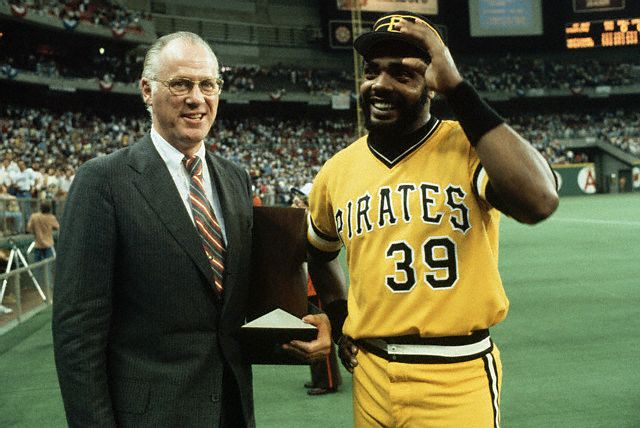
Dave Parker, rightfielder, Pittsburgh Pirates
Although he was considered one of the best players in the game, Dave Parker was a target for criticism, due to his boastful demeanor and million-dollar-a-year contract. Nevertheless, the "Cobra" was elected to start the All-Star Game by the fans and led the Pirates in RBI. But 1980 was not a good year for Dave Parker. Fans threw batteries at him, he played much of the year with a myriad of injuries, went through a divorce and got sued. Although he batted a very respectable .295, it was considered a "down" year for him and it was widely thought that he would bounce back to his previous form.

Born in Mississippi, but growing up in Cincinnati, Ohio, as a youth Parker was given a glove by future Hall of Famer and Red star Frank Robinson. At age 15 he was big enough and good enough to play with a local semipro team and he was a football star in high school. His senior season he tore his knee yet still earned attention from 62 schools that wanted him to play football. Dave decided he had better chances in baseball, but his injury made several teams wary. He was drafted on the 14th round of the 1970 amateur draft by the Pittsburgh Pirates.

Parker made an immediate impact in the minors; MVP of the Florida League in 1970 and the Carolina League in 1972. He was in Pittsburgh a year later and it took little time for him to be compared to Pirate greats Willie Stargell and Roberto Clemente. During a five year period (1975-1979) he won two batting championships, batting a collective .321, won three Gold Gloves, led the league in hits and doubles, was the 1979 All Star Game MVP and the 1978 National League MVP. As the 1980s began, it appeared that Parker was on the road to Cooperstown.

Unfortunately, it was not to be. After the distractions of 1980, Parker slumped at the plate, gained weight and simply did not perform at his previous levels. When his contract elapsed in 1983, the Pirates allowed him to leave as a free agent and Parker signed with his hometown Cincinnati Reds. One of the reasons for his sudden drop in performance was revealed in 1985 when Parker testified at the Pittsburgh Drug Trials. There, he described his heavy cocaine use and how it effected his play. He claimed that he was now drug-free, and he returned to All-Star status in 1985. He led the NL in RBI and was second in the league's MVP vote while batting .312 and clubbing 34 home runs.

After four years in Cincinnati, the productive, but aging Parker was traded to the Oakland A's where he served as designated hitter. His veteran presence helped lead Oakland to the World Series the two years he was there, including a championship in 1989. He was an All-Star again with Milwaukee in 1990 and played for both the Angels and Blue Jays the following year. He was unable to catch on with another team in 1992 and his 19-year major league career came to an end. He served as a first-base coach for the Anaheim Angels, then as a batting coach for the St. Louis Cardinals in 1998. Today, he owns several Popeye's chicken franchises in the Cincinnati area.

Why I love this card:
This was a premium card to get during the summer of 1980. Yet, I found it very difficult to warm up to Parker. I knew he was a great player, but I didn't view him in the same light as a Brett, Schmidt or Rice. What I remember most about this was my Dad's shock when Parker wore an earring in his ear. To him, it was disrespectful and distasteful. Remember, it was 1980 and it wasn't as common as today. I too, couldn't figure out why a guy would want to wear an earring.

Something else....
Largely due to his peak years, Parker still receives minor Hall of Fame consideration. I suspect that with the recent inductions of Rice and Andre Dawson, Parker's body of work will get further review. I wonder how much the Drug Trials effected his overall bottom line.

Nevertheless, Parker was a star in 1980 and was given a Topps Super Card and Burger King card. I actually like the Burger King version a little better since I think they did a much better job of centering the photo. Both are shown below:


On this date in 1980:
The #1 song in the country on this date is "Coming Up" by Paul McCartney. A largely forgettable song today, it is notable since it is McCartney's first #1 hit after the breakup of his second band, Wings. The video is pretty good and is here.

Tuesday, June 15, 2010

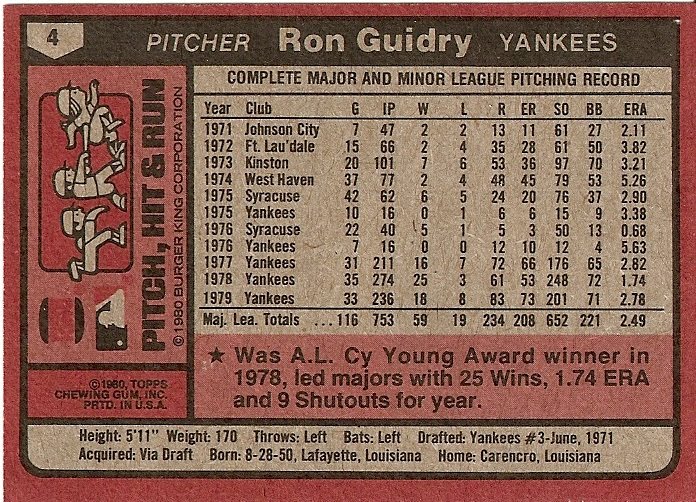
#300 Ron Guidry


Who is this player?
Ron Guidry, starting pitcher, New York Yankees
Two years removed from the best season of his career, Ron Guidry began 1980 as the unquestioned ace of the Yankees staff. In "Bronx Zoo" fashion, he started the year by being fined by the club for participating in ABC's Superstars competition. On Opening Day, the southpaw allowed only two singles and retired 20 of the final 21 batters he faced, but earned a no-decision against the Texas Rangers. His performance was streaky for much of the year, but his 17 wins helped lead the Yanks to the AL West flag. Ron started and lost Game 1 of the ALCS, a series that saw New York lose to the Kansas City Royals. When the season ended, his name was involved in trade rumors to the Boston Red Sox for outfielder Fred Lynn. Instead, the Yankees renegotiated Guidry's contract and he stayed in New York.

1978, 25-3. Those numbers will forever be linked with Ronald Ames Guidry. His dominating performance that year not only led to a Cy Young Award and an another world championship, but was one of the finest pitching seasons of the modern era. Guidry's defining moment of the 1978 season was his 18-strikeout performance against the California Angels and his .893 winning percentage that year is the highest ever for a starting pitcher. Additionally, Guidry's 1.74 ERA remains the lowest in the American League since 1968. Throw in two post-season victories, including a World Series complete game, and you begin to see just how good Guidry was at his very best.

No one could have predicted such success when the man known as "Gator" was selected by the Yankees in 1971. The Louisiana-born Guidry pitched well in the minors, but found it difficult to crack the starting rotation. There was also a knock against him that he was too small to pitch effectively in the majors. However, he was moved into the starting rotation for good in 1977 and won 16 games en route to a world championship. His blazing fastball found him atop the game's strikeout leaders and he was soon alternately known as "Louisiana Lightning." His size would never again be an issue.

A four-time All-Star, Guidry quietly distinguished himself with class, hardly ever finding himself tabloid fodder like most of his teammates. He won the Gold Glove Award five consecutive seasons (1982-86) and three times won 20 games, leading the league again in 1985. Guidry began to experience some arm trouble in 1981 and despite his high levels of achievement, it effected his pitching. He struggled during the last three years of his 14-year career and retired in 1989 when shoulder surgery did not improve his arm.

His number 49 was retired on "Ron Guidry Day," August 23, 2003. The Yankees also dedicated a plaque to hang in Monument Park at Yankee Stadium. He joined Joe Torre's staff as pitching coach in 2006 and was criticized when the pitchers did not perform well in '07 and '08. Though he was interested in returning to the Yankees for the 2008 season, he was not offered a position on new manager Joe Girardi's coaching staff. He has returned to the Yankees as a spring training instructor and remains a popular figure at Yankee events and Old-Timers gatherings.

Why I love this card
When I got this card, I was convinced that Guidry was going to go to the Hall of Fame. This was one of those "hands off" cards that everybody respected. You didn't even bother to ask to trade for it because the unspoken law was that you didn't trade it. After all it was a "hundreds" card. Any card that ended with two zeros (300) was special. You either had it or you didn't. It would be a couple years later when we stopped caring about that and just traded liberally.

Something else....
Guidry was featured earlier on the ERA Leaders card, and he also had two other issues in 1980, first in the Burger King set and again in the Topps Super. Here are both.


Thursday, June 10, 2010

1980 Topps Phillies Burger King

The recent Dave Rader post illicited two responses from our friends Jim from Downingtown who has several excellent late 1960s set blogs and The Phillies Room.

They reminded me of a regional version of the 1980 Topps Burger King Pitch-Hit-Run set. To my knowledge, Philadelphia was the only city to have a regional set in 1980 as the rest of the country was issued the national Pitch-Hit-Run set, the only nationally distributed set of the era.

This set featured several Phillies on 1980 cards that were not issued with the rest of the 22-card set. Specifically, Keith Moreland, Lonnie Smith, Dallas Green, John Vukovich and Kevin Saucier. Here are a couple scans of some of the cards. This Phillies set is slightly different from the national set in that the Burger King logo is not in place of the position flag in the upper left corner like it is in the national issues, nor does it have the stamp "Collector's Series" in green.


These cards were originally intended to support local Pitch-Hit-Run competitions throughout the country. The Pitch-Hit-Run competition has long been the official skills competition of Major League Baseball and over the years has several different sponsors. Today it is sponsored by Aquafina, but during the 1977-1980 seasons, Burger King sponsored the competition and printed several sets of cards.

Burger King began producing the cards with Topps in 1977. There was no "national" set, only a 24-card New York Yankees edition. Probably the most unique card of this set is the Reggie Jackson, which differs from his airbrushed headshot version in the 1977 base set.

Base Set:

Burger King:


In 1978, the program was expanded with outlets in the home areas of the Detroit Tigers, Houston Astros, and Texas Rangers along with the Tri-State Region for the Yankees cards. All of these sets had 23 cards. Another Yankee free agent, this time Rich Gossage, got a another version of his 1978 card, except this time they went with a simple headshot instead of the bad airbrushed Yankee uniform:

Base set:

Burger King:


Also, in the case with the Tigers, several players received their own card instead of on a rookie card like Alan Trammell


The offering for 1979 was reduced from the four teams which had sets the previous year to two teams - the New York Yankees and Philadelphia Phillies. Both teams had 23 cards. Probably the most remembered card from this set was the Pete Rose issue which showed him as a member of the Phillies:


I wonder if these cards eventually led to the creation of the "Traded" sets in 1981. Surely Topps had to know that there was a demand for such cards as they tried to incorporate similar traded sets in 1974 and 1976. With free agency in its infancy and the Topps monopoly broken, Topps must have realized what they had on their hands with the potential of such cards.

Speculation on my part, but with Topps being motivated to print cards such as these, Fleer and Donruss would have to respond. This would eventually lead to the "Rated Rookies" craze of the mid-1980s and the boom thereafter. Sure, it may be a stretch to think that these meager BK cards were partially responsible for the card collecting growth later in the decade, but I can't help but think that sometime during this period, someone over at Topps knew that they had a pretty good idea on their hands and was testing it out through these mostly regional sets.

Tuesday, May 11, 2010

#275 Jerry Koosman


Who is this player?

Jerry Koosman, starting pitcher, Minnesota Twins
After many seasons as a New York Met, Jerry Koosman was beginning his second season as ace of the Minnesota Twins' pitching staff in 1980. At 37 years old, Koosman began to show some signs of wear. Although he was still very durable (243 IP, 8 CG) his ERA for the season finished over 4.00 for the first time in eight years. Koosman was a popular player for the Twins who seemed to be trading away nearly anyone of value during this era. His most memorable game of 1980 is likely a masterful 10-inning, 3-hit win over the eventual AL East champion New York Yankees.

Born Jerome Martin Koosman, Jerry is a proud native of Appleton, Minnesota and graduate of West Central School of Agriculture. He was essentially discovered during his time in the army at Ft. Bliss, Texas. The son of an usher at the Polo Grounds told his father about Koosman who was on his army baseball team. The father told the Mets about Koosman, and he was signed upon his discharge in 1964. When he struggled initially in the minors, the Mets were about the release him when the farm director requested Koosman be retained at least until his first payday as he owed the Mets money they had wired him after his car broke down en-route to spring training.

It was the break that saved Koosman's career. He jumped from Single-A to Triple-A in one season and led the International League in strikeouts in 1967. He was inserted into the Mets rotation in 1968 and began the season with consecutive shutouts. In that rookie year, he won 19 games, was named an All-Star, fashioned a 2.08 ERA, finished fifth in complete games and tenth in strikeouts. Yet Koosman was not named Rookie of the Year. He was edged out for the award by future Hall of Famer, Johnny Bench. "The Kooz" was the oft-forgotten third man in the triumvirate of young hurlers (Tom Seaver/Nolan Ryan) who came up with the Mets in the 1960s.

Yet Koosman was one of the keys to the Miracle Mets of 1969. Again an All-Star, Koosman won two games in the World Series, including the clincher in Game 5. His heroics on the mound would place him on the cover of Life magazine. He also won two games in the 1973 postseason, Game 3 of the NLCS that featured the Bud Harrleson-Pete Rose fight as well as Game 5 of the World Series. As the Mets fell from the heights of pennant contender, Koosman was particularly effected, as he was 11-35 over a two year span.

This led Koosman to request a trade and he was sent to his hometown Twins. The Twins promptly traded him to the White Sox during the 1981 season and he appeared in the postseason again with Chicago in 1983. He returned to the National League with the Phillies for two seasons (1984-1985) before retiring at the age of 42 after 19 major league seasons. Currently, Koosman is in the Duluth Federal Prison in Minnesota for tax evasion. Court records show Koosman failed to pay Federal income taxes for 2002, 2003 and 2004. In September 2009, he was sentenced and he is scheduled to be released in June 2010.

Why I love this card
Koosman was the starting pitcher for the Twins at the first game I ever saw live. I went with my Dad, my buddy Looie and his father. Looie's family had just moved onto the block 18 months prior from Flushing, New York and were huge Mets fans. All I heard about was how great Koosman was. It was the first time I had ever heard about the Miracle Mets and 1969. When I got this card later that summer, I knew that I had to keep it.

Something else....
Koosman and Nolan Ryan share the same rookie card in the 1968 Topps set. I still rue the day I didn't buy that card in 1989 for $50. It was in my hands!! Koosman also gave up Pete Rose's 4000th hit when Rose was with the Montreal Expos (remember that?). Finally, Koosman had a 1980 Burger King card that is very similar to the 1980 base set card, except that this photo shows more of the background.


On this date in 1980:
Mobster Henry Hill is arrested for drug possession. His story is told in the movie "Goodfellas." You can watch the scene here.

Tuesday, February 16, 2010

#245 Phil Niekro


Who is this player?
Phil Niekro, starting pitcher, Atlanta Braves
Hall of Famer, Class of 1997
In March of 1980, Phil Niekro of the Atlanta Braves was honored with the Clemente Award for his work raising money and awareness for spina bifida. However, the veteran's season began slowly, losing his first four decisions and losing ten times before the All-Star break. The durable knuckleballer was nonetheless the cornerstone of the Braves pitching staff, leading the league with 38 games started. Phil also led the league in losses (18) and home runs allowed (30). He was rewarded after the season when he received his third of five Gold Glove Awards in his career.

A childhood friend of NBA Hall of Famer John Havilcek, Phil and his younger brother Joe learned the knuckleball at an early age from their father. Phil would make the knuckleball his signature pitch, en route to 318 career victories, starting with the Milwaukee Braves in 1964. He worked his way into the Braves starting rotation and in his first season as a starter (1967), led the National League in ERA. Two years later, he won 23 games as the Braves were the very first NL West Champions and qualified for the playoffs. Unfortunately, Niekro and the Braves lost in three straight to the eventual World Champion "Miracle" New York Mets.

Niekro would spend 20 years in Atlanta and was the teams' most recognizable player as the team slipped into mediocrity in the 1970s. He pitched a no-hitter in 1973 and four times led the league in innings pitched, each time topping over 300 innings. He twice led the league in victories and in 1979 became the first starting pitcher since Grover Cleveland Alexander in 1971 to start 44 games. "Knucksie" was so reliable that he averaged 38 starts and 288 innings pitched per season during the 1970s.

As the elder statesman, Phil helped lead "America's Team" to another division title in 1982 and led the league in winning percentage. At age 44, the Braves erred in thinking Niekro was at the end of his career and released him. He was quickly signed by the New York Yankees and was selected to the All-Star team in his first Yankee season. The following year, he won his 300th game, an 8-0 shutout on the final day of the 1985 season. It would be his final Yankee appearance.

Niekro bounced between Cleveland and Toronto for two seasons before returning home to the Atlanta Braves in 1987. It would make only one appearance for the Braves before finishing his 24-year career at the incredible age of 48. Even with 300 wins, Phil had to wait five years before finally achieving the honor of the Hall of Fame in 1997. Phil also famously managed the Colorado Silver Bullets, the all-female professional baseball team in the mid 1990s. Currently, Niekro is a member of the Kiz Toys Board of Advisors, lending his expertise on the company's baseball line.

Why I love this card
I remember looking at the back of this card and seeing that Niekro was older than my Dad. And it wasn't close, Phil had over two years on my Dad. Phil immediately had my respect at a young age for that reason alone. When I asked my Dad how come he wasn't in the majors when Phil was, the answer was simple. "I can't throw a knuckleball," was th reply.

Something else....
Phil also had a Burger King issue in 1980 (See below) as well as a Topps Super Card. The Burger King card is framed a little tighter (and better) than the regular set issue with all the extra background. Awesome red warmup jersey that Phil is sporting here, even if he has one of those trucker-mesh caps on.

On this date in 1980:
A total solar eclipse occurred on this particular day 30 years ago. It wasn't visible in the United States, but I do remember us talking about this in class. Invariably it led to playground discussion that you would go blind if you looked directly at an eclipse.