Sunday, November 1, 2009

#182 Ken Reitz


Who is this player?
Ken Reitz, third baseman, St. Louis Cardinals.
A slick-fielding defensive whiz, Ken Reitz set a record for third basemen in 1980 committing eight errors all season. He began the season at a torrid pace at the plate, among the league leaders in hitting and batting over .400 until the middle of May. Reitz earned his first All-Star selection that July and when Mike Schmidt was unable to start the game, Reitz took his place as the National League starter. His average cooled during the summer but he still finished a respectable .270. His days as a Cardinal were numbered when Whitey Herzog took over and he was traded to the Chicago Cubs in a package for relief ace Bruce Sutter in December.

Called "The Zamboni Machine," for his fielding prowess, Reitz was selected by the St. Louis Cardinals on the 31st round of the 1969 draft. He made his debut in 1972 and in his first two full seasons, he led all NL third basemen in fielding percentage (.974 in 1973 and '74), but the Gold Glove eluded him. He captured his first and only Gold Glove in 1975, curiously, the year he committed his most errors. With most of his career in the shadow of Schmidt, Reitz never received the recognition that his fielding deserved.

He was traded to the San Francisco Giants prior to the 1976 season but he only spent one season by the Bay and returned to the Cardinals in 1977. In addition to his glove, Reitz was also known for his slow foot speed. He was consistently among the league leaders in grounding into double plays and it was the primary reason that Whitey Herzog gave in trading him to the Chicago Cubs in 1981.

Reitz was a fan favorite in St. Louis. He was not a flashy hitter, but he was a consistent one, his hitting improving during his first few seasons. After batting .235 during his rookie season, he batted below .250 only once over the next seven. He was also known for his temper, he tore up a St. Louis airport after too many beers and too long a wait in 1979 and refused to show up to the Chicago Cubs after he was traded (he relented after the Cubs threw in $150K).

In Chicago, Reitz became addicted to amphetamines and it significantly reduced the length of his career. He was traded to the Pirates the following year and his 11-year career ended in 1982. He was accused of passing bad checks in the mid 1980s and played with the Senior Professional Baseball League. Today, he is part of the Celebrity Players Golf Tour and makes personal appearances on behalf of the Cardinals about 20 times a year.

Why I love this card
When the All Star Game rolled around and Reitz was named the starter, I scrambled to get this card. 1980 began my tradition of trying to get as many All Stars as possible to lay out during the game. In short, I overpayed for this card. It cost me a Carl Yastrzemski and Steve Kemp (remember I'm in Detroit) in one of my worst trades ever. But I didn't feel that way at the time.

Something else....
I've mentioned this before, but the Cardinals (and possibly the A's) have the prettiest looking cards in the 1980 set. The color combination with the pennants and the team's primary colors just make every one of the cards look good. It's a nice contrast to the browns, purples and oranges dotted here and there throughout the set.

Saturday, October 31, 2009

Dollar Tree Sells Baseball Cards


Just as I was bemoaning the fact that you can't find baseball cards for sale anymore, my wife sends me on a shopping trip to Dollar Tree. Sent to get paper plates, sandwich bags and double-A batteries. Standard fare, nothing special.

Imagine my shock, surprise, amazment, bewilderment, excitement when I saw a large display selling, of all things, sports cards. There were several sports represented, most packs were from 2008. There were Donruss Americana Football, Upper Deck First Edition baseball and football, Upper Deck Football Heroes, and MISL set and then these:


As you can see, the wrapper advertises "40 years of Baseball Trading Cards," with "Historic Star Card in Every Pack." The packs advertise that you may get a card from as far back as the 1960s. The company is Cards One and you can find their website here.

A-ha! Here it is, the fine print on the wrapper:
Approximate odds per pack: Historic Star Card 1:1 Packs, Vintage Baseball Trading Card 20 Years or Older 1:5 Packs, Vintage Baseball Trading Card 30 Years or Older 1:10 Packs, Vintage Baseball Trading Card 40 Years or Older 1:100 Packs
Now, I know I should know that this is merely a recycled way to get me to buy a bunch of commons. There is no earthly reason that I should expect anything good to come out of my dollar investment. Doesn't matter. It's a pack of baseball cards and I am a sucker.

Without further ado, here is who I received

1977 Topps Leon Roberts #456
1986 Topps Traded Gary Redus #90T
1988 Topps Len Matuszek #92
1988 Topps Mike Stanley #219
1989 Fleer Mike Moore #285
1989 Fleer Erik Hanson #549
1989 Score Kevin Elster #130
1989 Topps Bret Saberhagen #750
1990 Donruss Jerry Reed #614
1990 Fleer Jim Deshaies #229
1990 Fleer Bobby Witt #315
1990 Leaf Steve Sax #96
1990 Score Dave Magadan #46
1990 Score Gregg Olson #63
1992 Fleer Bill Krueger #285


Considering that eight of the 15 cards are 20 years or older, I didn't do too bad. I don't ever recall being excited to see a Leon Roberts or Gary Redus card but I was today. I guess they consider Bret Saberhagen to be the "Star" card. Or maybe it is Len Matuszek. And you can never have enough Mariner pitchers. Good Lord, I forgot how bad they were.

All in all, it was a fun way to spend a buck. On Halloween I would consider it a treat like chocolate. Its good to have one or two but I think a whole bunch of these might make me sick.

Happy Halloween!!

Friday, October 30, 2009

#181 Moose Haas


Who is this player?
Moose Haas, starting pitcher, Milwaukee Brewers
As a 24-year old control pitcher entering his fifth season, Moose Haas enjoyed his most successful season in 1980. He won 16 games that year and established himself as one of the best pitchers on the Brewers staff. He placed in his league's top ten in twelve different categories, including ERA, complete games and shutouts. However, he also placed eighth in losses and home runs allowed.

Born Bryan Edmund Haas, here is how he earned his famous nickname:
"Moose" earned his nickname after an unfortunate weekend run-in with a full grown moose while on vacation in the Appalachian mountains. The confrontation resulted in the 12 foot tall moose felled at the hands of Mr. Haas. The head of the moose (later named "Wallace") was hung in his dining room as a memento of that infamous meeting and remains on display to this day.
He signed with the Brewers in 1974 as a hard throwing righthander out of Franklin High School in Reisterstown, Maryland. He made his major league debut two years later and earned a spot in the starting rotation in 1977. He won ten games in his first season and looked to be a major part of the Brewers' future plans. The path was delayed somewhat in 1978 when he blew out his elbow in an April game against Boston. He missed the remainder of the season and when he returned in 1979, he transformed himself from a power pitcher into a finesse pitcher. He won 11 games in his comeback season.

Haas followed up his strong 1980 season with an 11-7 season during the strike-shortened 1981 season. The Brewers qualified for the playoffs that year, but Haas lost his two starts in the divisional playoff, including the Game 5 finale against the Yankees. He had better luck in 1982, defeating the Angels 9-5 in Game Four of the ALCS, but he was hit hard in two appearances in the World Series.

He had an excellent season came in 1983 as his 13-3 mark gave him a league-leading .814 winning percentage. However, the Brew Crew never returned to the postseason. Haas remained a durable and reliable part of the Brewers rotation through 1985, averaging 13 victories a season. To this day, his name still dots the Brewers record book in several career pitching marks. The Oakland A's gave up four players to get Haas in March of 1986 and started quickly with a 7-2 start. However, he began to have arm trouble that ended his season and despite a brief comeback in 1987, his 12-year career was over.

Why I love this card
His name. As an eight year old, not many names in baseball were much better than that.

Something else....
Probably due to the sour feelings surrounding the 1981 strike and split season, the Eastern Division Playoff between the Brewers and Yankees in largely forgotten today. Four of the five games were close and featured six future Hall of Famers and other All-Star caliber players. It was the Brewers' first postseason against the veteran Yankees and I was eager to see the Brew Crew take the Yankees out. The Brewers got off to an early 2-0 lead and I went to bed happy. Haas couldn't hold it and the Brewers lost the game and the series. I can still remember how disappointed I was when I went to school the next day. Don't worry Moose, I have forgiven you.

#180 Warren Cromartie


Who is this player?
Warren Cromartie, leftfielder, Montreal Expos
Originally part of the "Outfield of the 80s," Warren Cromartie was shifted to first base when the Expos acquired Ron LeFlore. "Cro" handled the transition flawlessly, appearing in all 162 games and clubbing a career high 14 home runs. Typically batting fifth in the lineup, his batting average hovered over .300 for most of the season and he led the league in intentional walks. The Expos faded down the stretch and lost the NL East flag on the final weekend of the season.

Cromartie played high school baseball with future Expos' teammate Andre Dawson and was Montreal's first round pick in the 1973 amateur draft. He debuted a little over a year later as a September call-up in 1974. The lefthanded hitting Warren split time between Montreal and the minor leagues the next two seasons before finally earning a starting position in 1977. Cromartie would team with Dawson and Ellis Valentine as a group of promising young players on a rising Montreal team.

Unfortunately, the Expos never quite attained the greatness predicted of them. Cromartie moved back to the outfield in 1982 when the Expos acquired Al Oliver. A fan favorite, he even had a candy bar with his name on it sold at Olympic Stadium. Cro was a dependable part of the Expos lineup for seven seasons, typically batting around .280. However, when his contract expired at the end of 1983, the 30-year old Cromartie took the unprecedented route of signing with the Tokoyo Giants. It was one of the only times a player went overseas during the prime of his career.

It Japan, Cromartie would play for the legendary Sadahara Oh. He would spend seven seasons in Japan and was named the MVP of the Central League in 1989 when he batted .378 with 15 home runs and 78 RBI. Cromartie was a productive player in Japan and again was one of the most popular. His tenure in Japan was loosely reflected in the movie "Mr. Baseball," and he wrote a book detailing many of his experiences in the Japanese league. He returned to Major League Baseball in 1991 with the Kansas City Royals and batted .313 mainly as a reserve over the course of 69 games. It would be the final season of his 10 year major league career.

Today, he hosts a radio show "Talking Hardball with Cro" in Fort Lauderdale. He served as a broadcaster for the Expos in their final season in 2004 and was the manager of the Japan Samurai Bears. The Bears were all-Japanese team in the independent U.S. Golden Baseball League which existed for one season, chronicled in this film. (** Warning - the trailer contains colorful language)

Why I love this card
I liked the Expos in 1980. Granted, I was more of a Pirate fan, but the Expos intrigued me. Whether it be their multi-colored "M" on their cap (still think it's and ELB) or their core of young players like Cromartie, the Expos were a favorite. I thought that this card was an error card when I got it due to the number on Cro's jersey being blue instead of red (yes, I paid attention to that stuff). What I realized much later was that Topps simply used a 1978 photo of Cromartie as they changed their uniform subtly in 1979.

Something else....
In 2007, Cromartie made his professional wrestling debut in a charity match against Japanese legend Tiger Jeet Singh. Coming to the ring with a baseball bat and in a uniform with "Samurai Man" across the front, Cromartie emerged victorious, likely after this amateur wrestling move:

Thursday, October 29, 2009

#179 Ron Davis


Who is this player?
Ron Davis, relief pitcher, New York Yankees
A hard throwing righthander, Davis was entering his second full season in 1980. He was slated to serve as setup man to Rich Gossage after an effective performance as closer when Goose was injured in 1979. In a largely unheralded role, Davis won nine games, saved seven and finished the year with a 2.95 ERA. His success was instrumental in leading the Yankees to the AL East title, despite their loss in the ALCS to the Kansas City Royals. Soon, many successful teams would begin to use this formula of a solid setup man to their closer.

Originally drafted by the Chicago Cubs, he was traded while still in the minor leagues to the New York Yankees in 1978. He made the most of his first major league opportunity the following season winning 14 in relief and saving nine in 44 appearances. His performance earned him Rookie of the Year consideration as Davis finished fourth in the balloting.

1981 was arguably the best of Davis' career. He was recognized for his effective work by being named an All-Star, appeared in the World Series (a six-game loss to the Dodgers) and set a record for striking out eight consecutive batters as a reliever in a May game against the Angels. Davis would prove that this was no fluke as he struck out three or more in 11 of his 43 appearances. With his stock high, he was traded to the Minnesota Twins for shortstop Roy Smalley.

In Minnesota, Ron never attained the same level of success that he had in New York. Playing for the worst team in the American League in 1982, Davis lost nine games and his ERA ballooned. He placed in the top 10 the next four years in saves (1982-1985), totalling 106 over that span. However, Davis was the scapegoat for a Twins organization that was going through growing pains. He set a record in 1984 for blowing 14 saves a mark that still stands. In 1986, he lost his closer's role with two spectacularly blown saves early in the year. You can read about those in Davis' Wikipedia entry here.

Davis was traded to the Chicago Cubs midway through the 1986 season and spent the last two seasons of his career in middle relief with the Cubs, Dodgers and Giants. His major league career ended in 1988 after 11 seasons. Davis played in Japan in 1989 and married Kendall Davis, lead singer for the Groove Merchants. Today, he runs the Major League School of Baseball Camps for Children in Arizona and his son was drafted by the New York Mets in 2008.

Why I love this card
I can recall the date that I received this card. Sunday, August 16, 1981. The strike had just ended and the Yankees were visiting Tiger Stadium. The game was broadcast locally in Detroit. Louie down the block was a major Yankees fan and we were watching the game at his house. He was really rubbing it in when the Yankees entered the ninth with a 4-1 lead. The Tigers rallied to score four in the ninth, capped by a dramatic Kirk Gibson home run to win the game, one that will remain with me probably as long as I live. Louie was so disgusted with Davis (who allowed the home run) he traded it this card to me on the spot. That is the one you see above.

Something else....
Fitting that a Yankee card would follow a Phillie card during the World Series. During the 1981 Strike, Davis worked as a waiter in a Kansas City restaurant. He was part of the rescue efforts when a walkway collapsed on July 17, 1981 that killed over 200 people. I remember this happening at the time, but it had been pushed from my memory until I was researching Davis for this post.

Wednesday, October 28, 2009

#178 Tim McCarver


Who is this player?
Tim McCarver, reserve catcher, Philadelphia Phillies
As the 1980 season began, Tim McCarver had already announced his retirement from baseball and had moved to the Phillies broadcast booth. Although he announced his retirement in October 1979, Topps interestingly made a regular issue card of him for this set (but no Lou Brock?) In September, the Phillies activated McCarver primarily so that he could become the 11th player in major league history to play in four decades. The lefthanded batting McCarver appeared in six games and had a two-run double in the final game of his 21-year career.

It is ironic and fairly fitting that Tim McCarver is the subject of today's post. As I type this, Game 1 of the 2009 World Series is being played and McCarver is covering his 20th Series, the most by any broadcaster. He is equally respected and reviled by fans and critics alike and have become one of the dominant voices of the game during this generation. He has covered the game on four networks and has been present at nearly every historic postseason event of the last 25 years.

When I first got this card, however, McCarver was just an old guy at the end of his career. There was no real inkling of what was to come later, just what he had accomplished. He broke in as a 17-year old in 1959, appearing in eight games for the 1959 St. Louis Cardinals. He eventually assumed the starting position behind the plate in 1963 and he was a key member of the the two-time World Champion Cardinals of the mid-1960s. A very complete biography of McCarver can be found here.

McCarver's playing days have been overshadowed by his broadcasting career. An offensive threat in an era where that was uncommon for a catcher, McCarver was a two-time All-Star that was the MVP runner up in 1967. He led the league in triples in 1966 and batted .275 during his first 11 years as Cardinal. When the 1970 season ended, McCarver was part of the Curt Flood-Dick Allen trade and went to the Philadelphia Phillies. McCarver bounced around during the early 1970s, playing for four teams in six seasons (Phillies, Cardinals again, Expos and Red Sox).

He returned to the Phillies in 1976 and served primarily as Steve Carlton's personal catcher. McCarver signed a unique contract after the 1976 season. He was offered a job as broadcaster for the Toronto Blue Jays, but the Phillies countered with an offer to stay on as a player then have two years as a broadcaster after the 1977 season, he played until 1979 when he became the Phillies broadcaster. In addition to his national duties, McCarver has served as analyst for the Mets (1983-98), the Yankees (1999-2001) and San Francisco Giants in 2002. Away from baseball, he hosted the 1992 Winter Olympics and hosts the syndicated "Tim McCarver Show."

Why I love this card
At the time, I was only familiar with McCarver simply because he made the last out of the 1968 World Series. In Detroit, the highlight film of that Series was shown often during rain delays or at other points during the season both on TV and at Tiger Stadium. I didn't have an appreciation for him as a All-Star caliber player, simply a guy who played with Lou Brock and Bob Gibson.

Something else....
Where to begin with McCarver....

Is it the "Grand Slam Single" in 1976 when he passed a teammate on the base paths....

Or Deion Sanders dunking him after the 1992 NLCS when McCarver criticized "Prime Time" for simultaneously playing for the Braves and Falcons.....

Or the recent post by our friends at Dinged Corners. Perfect for Halloween. Listen to how scary this is here......

I'll go with this little selection on Youtube. Ten seconds of pure goodness.

Tuesday, October 27, 2009

#177 Dave Heaverlo


Who is this player?
Dave Heaverlo, relief pitcher, Oakland A's
The A's sold the righthanded Heaverlo to the Seattle Mariners on Opening Day 1980. He arrived to the Kingdome in the fifth inning, entered the game in the eighth and earned the save. Despite being one of Oakland's better pitchers, he was shipped out primarily due to his outspoken nature as the A's player representative. He complained about the A's front office and travel schedule and he returned to his native Washington as the Mariners setup man. He set the Seattle club record (since broken) for appearances in 1980 with 60.

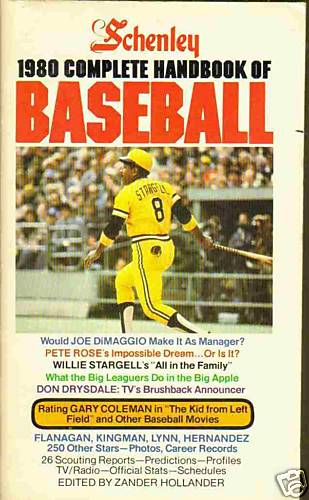
Beyond the statistics, Dave Heaverlo's career is marked by words like "colorful" and "jokester." He was one of the first players ever to shave his head, unheard of a generation ago. You can see that slightly here and here. He also kept the number 60 that he recevied as a non-roster rookie throughout his major league career. According to Heaverlo's profile, the 1980 Complete Handbook of Baseball said:
Grew weary of listening to "funeral home music" on Oakland Coliseum public address system so he took matters into his own hands and changed the station on a transistor radio he found sitting, unattended, in front of the open microphone."

However, Heaverlo was an outstanding athlete. A prodcut of Central Washington University, he was a first round draft pick of the San Francisco Giants in the 1973 amatuer draft and as a professional was used exclusively as a relief pitcher. His outstanding performance in the minors earned a quick ticket to the major leagues and he made his debut in 1975. He became a fixture in the Giants bullpen for three seasons, averaging 53 appearances a season and compling a 3.11 ERA. He was one of the key players in a multi-player package the Giants sent to Oakland for Vida Blue.

In Oakland, Heaverlo assumed the role of closer on a truly terrible A's team that lost 201 games in two seasons. He unfairly garned a reputation of being unable to hold a lead, but appeared in 60+ games in both years and having one of the best ERAs on the team. In Seattle he cemented his reputation as a clubhouse comic with a series of wigs and ghoulish masks. However, he was released during Spring Training in 1981, primarily due to a personality conflict with manager Maury Wills. He signed on with the A's again, but lasted only six games in the final season of his 7-year big league career.

Away from the game, Heaverlo has stayed in his native Washington as a radio show host and color commentator for Central Washington Football. He also serves as pitching coach for the Big Bend Vikings in Moses Lake, Washington.

Why I like this card
I have mentioned the 1980 Complete Handbook of Baseball in other posts. This book provided a perfect compliment offering a bit more substance to these players. The entry above about Heaverlo makes me laugh as much now as it did then. It was how I recognized Heaverlo when I finally got this card late in the year. Can you imagine a major league team today with a microphone up to a transistor radio? Great stuff. A little disappointed that his head isn't shaved in the photo, though.

Something else....
Here's how truly terrible the A's were in the final days of Charlie Finley. When he traded his last marketable star, Vida Blue, he received seven players in return from the Giants. By the time these cards were out a little more than three years later, none of them were still with the A's. Granted, none of them became superstars, but not even one of them stuck? Sheesh. And with that, all of the players in the Vida Blue trade have now been featured. It will not be mentioned again. Really.

Monday, October 26, 2009

#176 Champ Summers


Who is this player?
Champ Summers, right fielder, Detroit Tigers
A popular fan favorite in Detroit, Champ Summers was coming off a strong and surprising performance in 1979 and looked to repeat it in 1980. Used sometimes in right field, but mostly at DH, the lefthanded hitting Summers took advantage of the short porch at Tiger Stadium. Champ batted over .300 for most of the season, with a highlight being a two-home run game against the Twins in June. He finished the year at .297 with 17 home runs and 60 RBI in just 347 at-bats.

Champ Summers road to the major leagues was truly unique. Born John Junior Summers he was tagged "Champ" by his father. According to family legend, the elder Summers said young John looked like he went "10 rounds with Joe Louis" at birth. Champ came from a family of athletes, his mother a professional bowler and his father a prizefighter in the US Navy. A teenage Summers even defeated a young Jimmy Connors in a youth tennis tournament.

However, Summers did not follow a path straight to the majors, he enlisted in the United States Army and served a tour of duty in Vietnam during the Tet Offensive. After his discharge, he played in a men's softball league where he was discovered and signed by the Oakland A's in 1971. The A's brought him up for a brief look but he batted only .125 in a month's worth of action and was traded to the Chicago Cubs.

Summers spent two years in Chicago seeing limited action as was traded again, to the Cincinnati Reds in 1977. He appeared in only 99 games in three seasons and failed to bat .200. He was, however, named MVP of the American Association and Minor League Player of the Year in 1978 when he batted .368 with 34 HR and 124 RBI. The Reds traded Summers to Detroit in May of 1979. It was in Detroit that he received his biggest break. He took over in right field and batted .313 with 20 home runs and 51 RBI in just 90 games.

The Tigers traded Summers to the Giants in 1982 and he never attained the success he enjoyed in 1979 & 1980. He was a part-timer for two seasons and the Giants shipped him to the Padres in 1984. As a veteran pinch-hitter and outfielder, Summers personality was his most valuable asset to the eventual NL Champions. His last game, ironically, was at Tiger Stadium in Game 5 of the World Series. He looks like he knows it here. Today, he owns and operates "Champ Summers' Summer Camp for Champs" a motivational sports retreat for kids.

Why I love this card
Very few cards in this set are the Summer of 1980 for me like Champ Summers. I traded for this card on the playground at school when I wasn't supposed to wrapped in a huge rubber band without a care towards condition or quality. As kids, we couldn't understand why Sparky Anderson didn't play him more often, after all, wasn't 'Champ Summers' an awesome baseball name? It seemed like everybody liked him. My only regret is that I didn't get to sit out in "Champ's Camp" in the right field stands. We all tried to emulate a version of his stance.

Something else.....
For some reason, and I don't know why, it was a big deal that Summers had the Playboy bunny logo tatooed on his shoulder. Also, Summers was a principal in one of the most infamous baseball fights of all time, in 1984. The Padres and Braves "Bean Brawl" was featured recently at MLB.com and you can see footage of it here.

Sunday, October 25, 2009

#175 Rick Reuschel


Who is this player?
Rick Reuschel, starting pitcher, Chicago Cubs
The mainstay of the Chicago Cubs pitching staff, "Big Daddy" had just completed eight consecutive seasons of at least ten or more victories. He was the Cubs starting pitcher on Opening Day, the third season in a row he was given that honor. 1980 was inconsistent for Reuschel as the Cubs struggled in the standings. Rick found a groove in midseason, winning six games in a row and lowering his ERA by a full run. He finished the campaign with an 11-13 record and led the league in games started and was fourth in innings pitched.

The righthander first gained attention by going 10-0 with a 1.29 ERA at Western Illinois University and was drafted by the Chicago Cubs on the third round of the 1970 draft. He quickly became the best pitcher in the Cubs farm system and was promoted to Chicago at midseason in 1972. In an era where the Cubs rarely finished in the first division, Reuschel was the team's most reliable and durable pitcher. He would win 131 games in his first stint on the North Side, being named an All-Star in 1977. That would also prove to be his best season, winning 20 games and finishing third in the Cy Young Award voting.

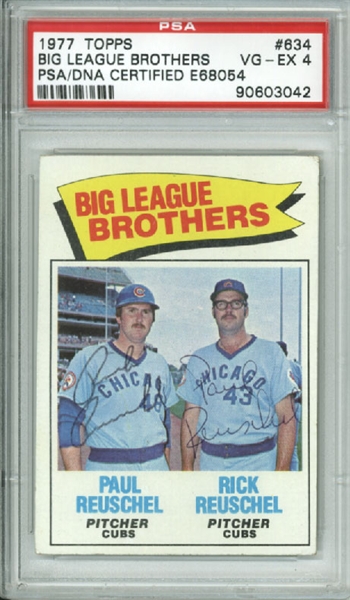
Despite his appearance, Reuschel was a tremendous athlete. He was an excellent fielder and smart baserunner that was often used to pinch run. He also could handle a bat fairly well for a pitcher, several times batting over .200 for the season. He was also briefly teammates with his brother Paul, and the two teamed up to shutout the Los Angeles Dodgers in 1975. In 1981, with the Cubs and Reuschel struggling, Rick was traded to the New York Yankees where he received his first taste of postseason action. He appeared in two games of the 1981 World Series, but the Yankees dropped the Series to the Los Angeles Dodgers.

The wear of all those innings in Chicago took their toll and Reuschel lost the entire 1982 season with a torn rotator cuff. He was released by the Yankees the following year but was determined to return to the major leagues. He returned to the Cubs very briefly, but wasn't used often and was released again. He latched on with the Pittsburgh Pirates where he experienced a renaissance, despite the Pirates being the worst team in baseball. He won 31 games in two and a half years, and was Comeback Player of the Year in 1985. He was also named an All Star in 1987 and won a Gold Glove in 1985.

Reuschel was traded again, this time to the San Francisco Giants at the trading deadline in 1987 and he helped the Giants reach the NLCS. He won 19 games in 1988 and again led the league in games started. The following year the Giants, led by Reuschel, won the NL West and this time advanced to the World Series. Rick was honored by being appearing on the cover of Sports Illustrated and was named starting pitcher for the National League in the All-Star Game. Rick spent two more seasons in San Francisco before his 19-year career ended in 1991. Today, brothers Rick and Paul tend to their farm in Quincy, Illinois.

Why I love this card
I always pronounced his name "Roo-shell" when I was a kid. Through the magic of Retrosheet.com, I am pretty sure that the photo on this card was taken on Sunday, July 15, 1979. This appears to be Riverfront Stadium and this was the only day game Reuschel appeared in that year. Retrosheet sure would have settled several arguments regarding our cards a lot quicker had it been around in 1980.

Something else....
There is a great story about Reuschel and the Phillies Larry Bowa at his Wikipedia entry here. It is definitely worth the read. In the age of Baseball Tonight and cameras at every game, even if this story is embellished the fact that no footage of this exists for multiple review just adds further luster to the story.

Saturday, October 24, 2009

#174 Ray Knight


Who is this player?
Ray Knight, third baseman, Cincinnati Reds
A year removed from replacing Pete Rose at third base for the Reds, Ray Knight began the 1980 season slowly. He was in an 0-15 slump in mid-May when he slammed two homers in one inning in a 15-4 rout against the New York Mets. He still holds the distinction of being the only Red to accomplish this feat. He was selected to the All Star Game, had a hit, walk and stolen base and scored the game-tying run in the NL's 4-2 victory. He played in all 162 games and even though his batting average dipped, he was still fifth in the National League in extra-base hits.

The righthanded hitting Kinght was born in Albany, Georgia, which is still his home today. Part Cherokee Indian, Knight's father was a major influence in Ray's road to the major leagues. A semipro player, the elder Knight would hit ground balls to the youngster for hours on end. The Reds drafted him out of Dougherty High School in the 10th round of the 1970 draft. His minor league career was marked by two serious beanings to his face that slowed his progress to the major leagues. Even though he recovered and made his major league debut in 1974, he spent most of his early career as Rose's understudy.

Largely because of who his was replacing, Knight was not initially popular in Cincinnati. Winning changes everything, however, as the Reds won 90 games and won the National League West. For his part, Knight finished third in the league in batting (.318) and placed fifth in the MVP voting despite several minor injuries. The Reds 1979 ride ended in the NLCS with a three game sweep by the Pittsburgh Pirates.

As the Reds fortunes drastically declined in the early 1980s, Knight was traded to the Houston Astros prior to the 1982 season. In his first season as an Astro, Ray was again an All-Star and led the teams in base hits and batting average. He remained in Houston for two and a half years where he was traded again, to the New York Mets at the trading deadline in 1984. He would reach his greatest fame as a member of the Mets as the starting third baseman for the 1986 World Champions. The was named MVP of the 1986 World Series, in large part for scoring the game winning run in the famous Game 6 and his Game 7 home run that gave the Mets a lead they would not relinquish.

In a controversial move, the Mets did not choose to resign Knight following the World Series and he signed on with the Baltimore Orioles. He played his 13th and final season in 1988 in the American League with the Detroit Tigers. In his post-playing days, Knight served as an analyst on ESPN and manager of the Cincinnati Reds in the mid 1990s. Today he is a brodcaster with the Washington Nationals. A commerical that he did for the club can be seen here.

Why I love this card
I have mentioned in previous posts how different it was in 1980 to get a card of a guy without his hat on. This is just the fifth of that type so far out of the first 174 cards. Compare that to some of the late 1960s sets that Jim from Downington is reviewing on his blogs. The 1980 set was an impressive mixture of different styles of photographs and Knight without his hat makes the card stand out much more than if he were merely wearning it. This shot reminds me of the Opening Day Little League parades that we used to have every year before the season began, complete with the rickety stands in the background.

Something else....
Knight was married to golfer Nancy Lopez in one of the higher profile sports marriages of all time. Sports Illustrated called theirs a "model marriage" in a 1986 article here. Knight even served as caddy for Lopez at a time. Their 27-year marriage came to an end earlier this year.

Finally, thanks to Greg at Night Owl Cards and his new 1975 Topps blog provided me with this scan of a 2005 Topps Fan Favorite of Knight


The polls are open once again on which version is the better Ray Knight. Polls are on the right, fire away.